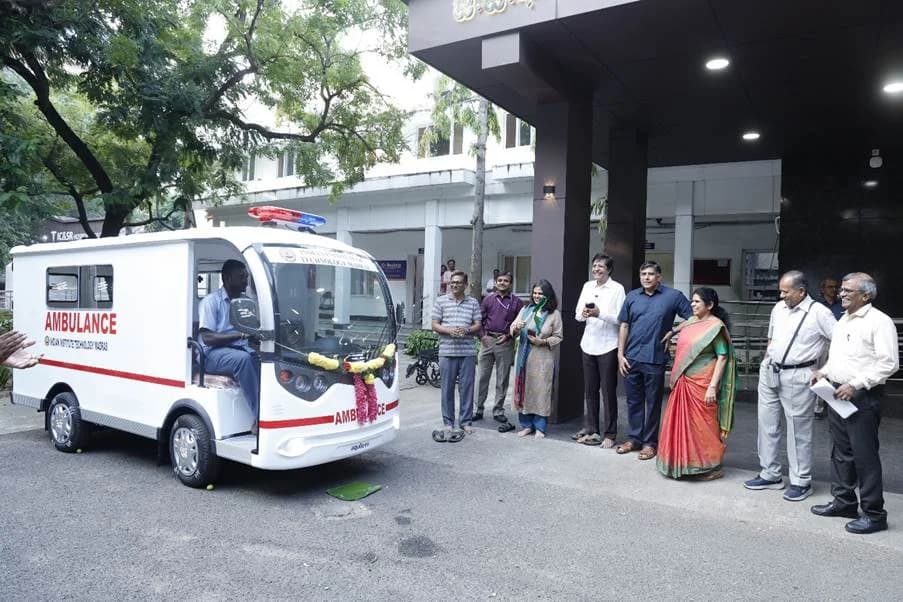
Union Health Secretary Punya Salila Srivastava on 22 November 2026 opened a Sleep Study Facility and an Autism Lab at the Indian Institute of Technology (IIT) Madras in Chennai, Tamil Nadu, and flagged off an electric-cart ambulance at the institute's hospital, the Ministry of Health and Family Welfare said in a statement released through the Press Information Bureau.
During the visit, Ms Srivastava also toured several of the institute's research centres working on brain mapping, cancer tissue banking, low-cost medical devices and assistive technology for persons with disabilities. She was accompanied by IIT Madras Director Prof. V. Kamakoti and Dean (Planning) Prof. R. Sarathi.
What will the new Sleep Study Facility do?
The Sleep Study Facility will assess, advise on and treat sleep-related disorders among the campus community, including students, faculty, staff and researchers. It is housed at the Campus Health Centre and will draw on specialists associated with Kauvery Hospitals in Chennai, according to the ministry.
The facility is also meant to support research. Subject to approval from the institute's ethics committee and the informed consent of participants, it will be used to study sleep patterns and different kinds of sleep disorders. The ministry said IIT Madras faculty intend to build indigenous, low-cost sensors for monitoring and analysing sleep.
What is the Autism Lab studying?
The Autism Lab will study Integrated Varmam Therapy, a treatment that draws on traditional Indian medical knowledge, for children with Autism Spectrum Disorder (ASD). It is part of the groundwork for a planned Centre for Indian Medical Knowledge (CIMK) at IIT Madras.
According to the ministry, the institute proposes to work with the paediatric neurology team at the All India Institute of Medical Sciences (AIIMS) Jodhpur, which has given the integrated therapy to more than 800 children, to study and scientifically evaluate the treatment protocol. The project also plans to develop indigenous pressure-sensing gloves that give practitioners real-time feedback, and to research possible genetic, molecular and epigenetic mechanisms behind the therapy, subject to the necessary ethical approvals.
The statement describes this as a proposed evaluation. It does not report any results on the therapy's effectiveness, and no findings have yet been published from the new lab.
Why does the e-cart ambulance matter?
The e-cart ambulance is part of a campus wellness initiative. It is intended to give faster medical help and easier transport within the large campus, especially for elderly residents and for patients who need assistance.
What else did the Health Secretary see?
At the Sudha Gopalakrishnan Brain Centre, Ms Srivastava was briefed on work to produce high-resolution, three-dimensional digital maps of the human brain at the level of individual cells. The ministry noted that Prime Minister Narendra Modi dedicated the centre to the nation on 11 October 2026 and launched its mission to map more than 100 human brains across different life stages, including brains affected by disease. On that occasion he also released C-STROKE, described as the world's first human ischaemic stroke atlas, with more than 1,000 annotated brain sections.
At the National Cancer Tissue Biobank, a joint initiative of the Department of Science and Technology and IIT Madras, she was told how cancer tissue samples are collected with patients' consent and preserved for research. The ministry linked the biobank's wider research network to the Bharat Cancer Genome Atlas, launched in February 2025 to build an India-specific cancer genomic database.
At the Healthcare Technology Innovation Centre (HTIC), she was shown low-cost devices such as a Mobile Eye Surgical Unit for cataract surgery in remote areas and a Neonatal Transport Unit. The National Centre for Assistive Health Technologies (NCAHT) presented lightweight wheelchairs, including the ultra-light YD One, and walking aids for children with cerebral palsy.
Why it matters
The visit came on the same day that Union Minister Jitendra Singh told THE WEEK Health Summit in New Delhi that India's health research is shifting towards prevention and genetics. The ministry described the IIT Madras projects as efforts to make healthcare more affordable and to support persons with disabilities and the elderly.
What happens next?
The research parts of both new facilities depend on ethics clearances and informed consent, and the collaboration with AIIMS Jodhpur on the autism therapy is still at the proposal stage. Timelines for the planned sensors, gloves and the Centre for Indian Medical Knowledge were not given.