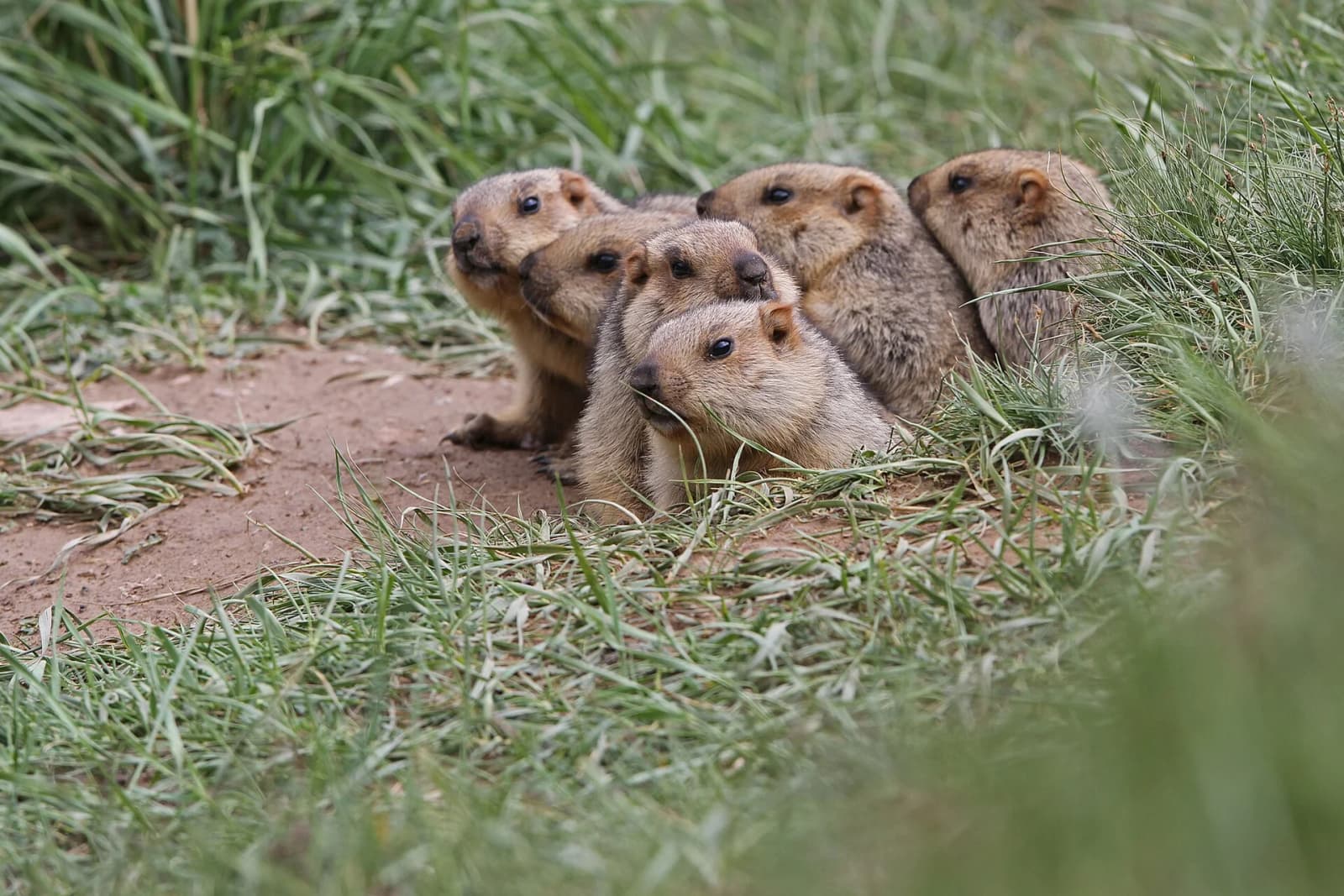
Droppings of the Himalayan marmot could serve as a new record of vegetation and climate change in the high Himalaya, according to a study by scientists at the Lucknow-based Birbal Sahni Institute of Palaeosciences (BSIP), which the Department of Science and Technology highlighted on 19 November 2026. The team analysed marmot faeces collected in Ladakh's Zanskar region and Uttarakhand's Dhauliganga valley.
Scientists usually reconstruct past environments from lake sediments, peat and soil, but such archives are scarce in remote, arid mountains. The DST release says the researchers tested whether the faeces of Marmota himalayana, a plant-eating mammal of cold, dry alpine zones, could fill that gap.
What did the scientists find?
They found that pollen in the droppings mirrors the plants the marmots eat, which in turn reflects the surrounding alpine-steppe vegetation. According to the paper in PLOS ONE, published on 28 October 2026, the team studied 45 samples gathered in August and September 2023: 25 from Pensila Pass in the Suru river basin of Zanskar, at about 4,000 to 4,200 metres, and 20 from the Rimkhim area of the Dhauliganga valley in Uttarakhand, at about 3,600 to 4,000 metres.
Key findings reported by the authors include:
- The marmots' mixed plant diet was dominated by Artemisia, Asteroideae, Caryophyllaceae and Chenopodiaceae, typical of a cold, arid alpine steppe.
- The team proposed three pollen ratios, Artemisia to Chenopodiaceae, to Cyperaceae and to Ephedra, as indicators of vegetation and climate. The paper says these are the first such ratios reported from marmot faeces.
- Dung-loving fungal spores such as Sporormiella, Saccobolus and Podospora made up about two-thirds of spores at both sites.
- Electron microscopy with X-ray spectroscopy detected 15 nutrient elements, with high levels of carbon, nitrogen, calcium, silicon and phosphorus.
- Statistical comparison showed only minor differences between the Ladakh and Uttarakhand sites.
Who carried out the study?
The authors are Sadhan K. Basumatary, Hukam Singh, Manish Mehta, Swati Tripathi, Mahesh G. Thakkar, H. Gregory McDonald, Eline N. van Asperen and Vinit Kumar. Besides BSIP, they are affiliated with the Wadia Institute of Himalayan Geology in Dehradun, the University of Lucknow, the Denver Museum of Nature and Science in the US and Newcastle University in the UK, according to the paper.
Why it matters
The Himalaya is highly sensitive to shifts in temperature, rainfall and snow cover. The DST said the marmot could be a strong indicator species for tracking vegetation and climate change at high altitude, and that changes in its habitat can signal shifts in altitude linked to changing conditions. Because marmot dung is found in places where lakes and peat bogs are rare, it could extend environmental records into areas that are otherwise hard to study.
The work also has a conservation angle. The release notes that marmots are an important prey species for the snow leopard, so a better understanding of their habitat needs can inform protection of the wider ecosystem. It follows another recent BSIP study in which pollen from a Bandhavgarh wetland revealed 2,700 years of monsoon changes.
What happens next?
The authors present their results as a modern reference point. Scientists studying ancient dung, or coprolites, and past ecosystems can compare their samples against this baseline to reconstruct how Himalayan vegetation and climate have changed over time.