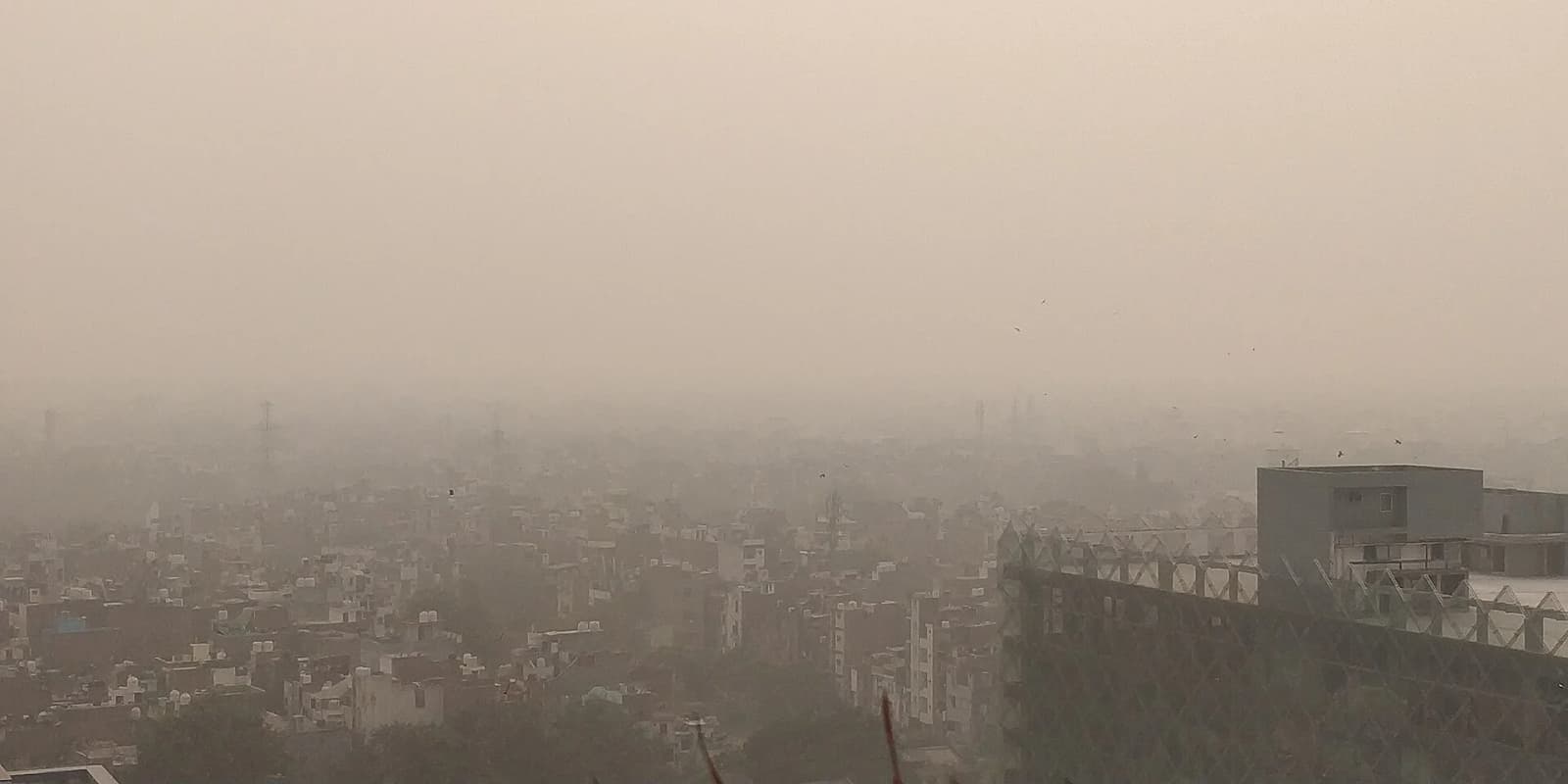
Delhi's air stayed in the 'poor' band on Friday, 20 November 2026, with the Central Pollution Control Board (CPCB) putting the city's Air Quality Index (AQI) at 270 at 7:05 am and 269 at 8 am, and fine particulate matter (PM2.5) as the main pollutant. Several monitoring stations, including Siri Fort, Jawaharlal Nehru University and Pusa, were above 300, in the 'very poor' range. MapMyTimes reported the day's readings and the weekend outlook here. This explainer sets out what the numbers mean, which anti-pollution rules apply right now, and what could change if the air gets worse.
What is the AQI and what do 'poor' and 'very poor' mean?
The AQI is a single number from 0 to 500 that sums up how polluted the air is, and higher is worse. Under the CPCB's national classification, 0–50 is 'good', 51–100 'satisfactory', 101–200 'moderate', 201–300 'poor', 301–400 'very poor' and 401–500 'severe'. A reading of 270 therefore sits towards the top of the 'poor' band, about 30 points short of 'very poor'.
The city figure is an average across Delhi's monitoring stations, so it can hide large local differences. On Friday morning, Business Standard, citing CPCB real-time data, reported that 57 of Delhi's 59 stations returned valid readings: 53 were above 200 and 14 were above 300. Siri Fort was highest at 348, while Lodhi Road recorded 162, in the 'moderate' range. The reading near your home or office may be quite different from the headline number.
Why is Delhi's air quality in the news?
It is in the news because the capital is in a fragile middle zone, just after tighter rules were lifted and with forecasts pointing to possible deterioration. On 17 November 2026, the Commission for Air Quality Management in NCR and Adjoining Areas (CAQM) withdrew Stage III of the Graded Response Action Plan (GRAP), its emergency rulebook for Delhi-NCR. According to the Press Information Bureau release on that decision, Delhi's AQI had improved to 204 that day, and forecasts from the India Meteorological Department (IMD) and the Indian Institute of Tropical Meteorology (IITM) indicated the AQI was likely to stay in the 'poor' or 'very poor' category in the coming days.
Since then the city average has drifted back up to around 270. The Union Environment Minister, Bhupender Yadav, has also ordered zero tolerance on pollution violations in Delhi-NCR, so enforcement is under scrutiny.
What is GRAP and how do its stages work?
GRAP is a set of anti-pollution actions that switches on in stages as the AQI rises. As reported by ETV Bharat when Stage II was invoked this season, Stage I applies when the AQI is between 201 and 300, Stage II at 301–400 ('very poor'), Stage III at 401–450 ('severe') and Stage IV when the AQI goes above 450. Each higher stage adds to the measures of the stages below it.
The CAQM's GRAP sub-committee decides when to invoke or revoke a stage, after looking at the current AQI and the IMD and IITM forecasts. It does not wait for every threshold to be crossed; it can act on a forecast, and it can keep lower-stage curbs in place when it lifts a higher one.
Which GRAP stage is in force now?
Stages I and II are in force across Delhi-NCR, and Stage III is not. The CAQM invoked Stage II on 2 November 2026, when Delhi's AQI reached 324 at 4 pm, its first 'very poor' day of the season, according to ETV Bharat's report of the commission's order. The commission then invoked Stage III by an order dated 6 November and revoked that order on 17 November, the PIB release says.
Two points from the 17 November release matter. First, the CAQM told agencies to intensify Stage I and II measures so that Stage III would not have to be reimposed. Second, a separate commission order dated 30 October 2026, restricting dust-generating demolition and outdoor construction across the NCR except for exempted projects, continues to remain in force.
How does this affect you?
Under Stage II, as described in ETV Bharat's report of the 2 November order, civic agencies have to step up mechanical road sweeping, water sprinkling and anti-smog guns; traffic police are to be deployed at busy junctions to ease congestion; checks on Pollution Under Control (PUC) certificates and visibly polluting vehicles are to be intensified; and hotels, restaurants and roadside eateries must stop using coal and firewood in tandoors.
Because Stage III has been lifted, the curbs that came with it are off for now. The PIB release noted, for example, that the Stage III order had asked state government and private offices in Delhi and nearby districts to work with up to 50% of staff attending physically from 5 to 20 November. ETV Bharat's report also notes that Stage III carries restrictions on BS-III petrol and BS-IV diesel light motor vehicles in parts of the NCR.
The CAQM's citizen charter asks people to check the AQI on the SAMEER app and the GRAP stage on the CAQM website, keep PUC certificates up to date, switch off engines at red lights, prefer public transport or car-pooling, avoid open burning of waste, and report polluting activity through the 311, Green Delhi or SAMEER apps.
What happens next?
What happens next depends mainly on the weather and on whether the city average crosses 300. Calm winds and cold nights tend to trap pollutants, which is why the CAQM leans on IMD and IITM forecasts when deciding stages. If the AQI moves into the 'very poor' range for a sustained period, Stage II simply continues; if it heads towards 400 or beyond, the sub-committee can bring Stage III back, along with its extra curbs.
For now, the practical guide is the official one: watch the CPCB readings for your nearest station, check the CAQM website for the stage in force, and expect the rules to change at short notice through the winter.
Photo source · Prami.ap90, CC BY-SA 4.0