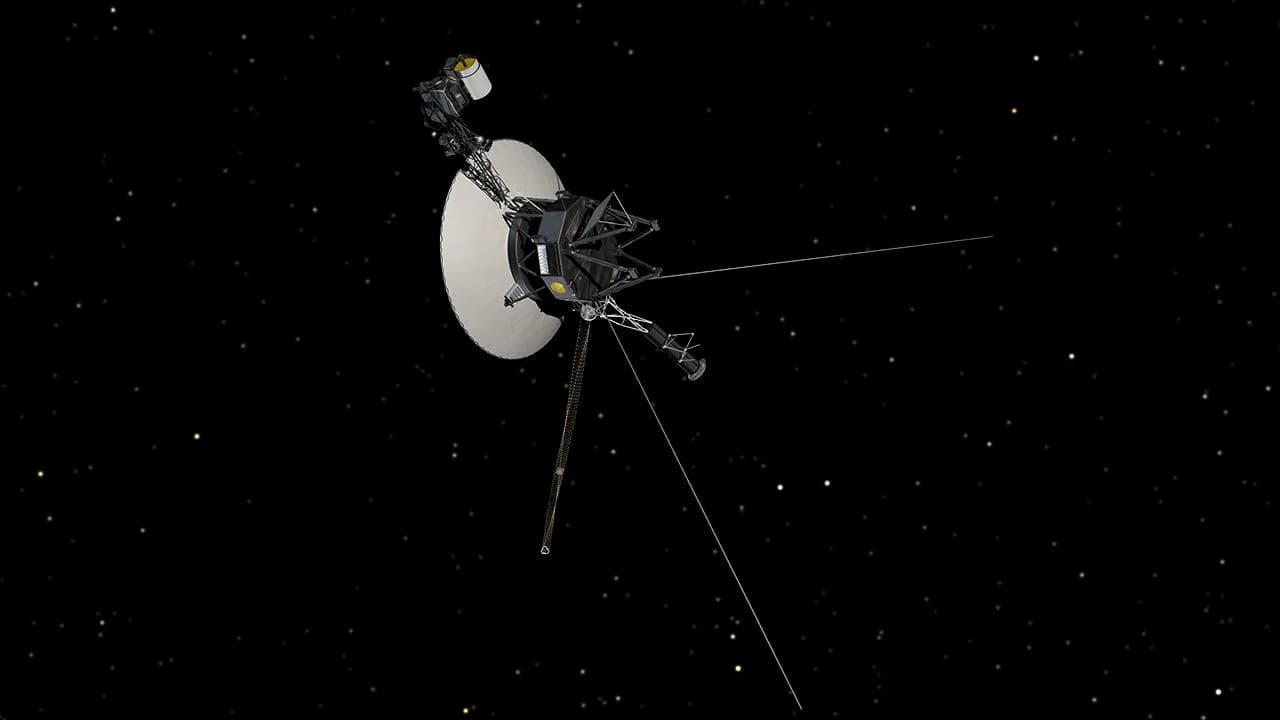
NASA's Voyager 1, the most distant object ever built by humans, is days away from a milestone no spacecraft has reached before. On Wednesday, 18 November, the probe will be one light-day from Earth, meaning a radio command sent from the ground will need a full 24 hours to reach it, the US space agency said in a media advisory last updated on 13 November.
That distance works out to more than 16 billion miles, or about 25.9 billion kilometres, according to NASA. The agency is marking the moment with a worldwide public light display and a discussion with the Voyager team in California.
What "one light-day" means
A light-day is the distance light covers in one day. Because radio signals travel at the speed of light, the figure is also a practical measure of how hard it has become to talk to the spacecraft: any instruction from mission controllers takes a day to arrive, and any reply takes another day to come back.
Voyager 1 lifted off in 1977, close to 50 years ago. NASA says the twin Voyager probes were designed to explore the outer planets by exploiting a planetary alignment that comes around only once every 176 years.
How the public can take part
On Tuesday, 17 November, after sunset, NASA is inviting people around the world to join an event called "Shine Bright for Voyager's Light-Day". The agency describes it as a symbolic wave of golden light circling the planet.
NASA has set up a website that turns smartphones and tablets into signal lamps, flashing "VGR" — Voyager's call sign — in Morse code. Details are available at go.nasa.gov/shinebright. Participants are encouraged to photograph or film their signal and share it on social media.
For readers in India, the timing matters: the light display is pegged to sunset on 17 November local time, so participants can take part from their own evening sky.
Discussion at JPL
On Thursday, 19 November, NASA's Jet Propulsion Laboratory (JPL) in Pasadena, California, will host a moderated discussion on the status of Voyager 1 and Voyager 2, the science they are still returning from interstellar space, and the difficulty of operating spacecraft across such vast distances. The event begins at 12 noon US Eastern time, which is 10:30 pm IST, and will be streamed on nasa.gov/live.
According to the updated participant list, the panel includes Nicky Fox, associate administrator of NASA's Science Mission Directorate; Jonathan Lunine, JPL chief scientist and Caltech professor of planetary science; Voyager project manager Suzanne Dodd; project scientist Linda Spilker; mission manager Kareem Badaruddin; and deputy project scientist Jamie Rankin of Princeton University. A question-and-answer session with media and audience members will follow.
NASA also plans to show a preview of a NASA+ documentary on Voyager, scheduled for release in 2027 to mark the mission's 50th anniversary.
Why it matters
Voyager 1 crossed into interstellar space in 2012, and Voyager 2, on a different path, followed in 2018, NASA said. Both continue to study the region beyond the heliosphere, the protective bubble created by the Sun. The light-day mark underlines how far the mission has stretched the limits of long-distance spacecraft operations.
JPL, managed by Caltech, built and operates both probes, and NASA's Deep Space Network, also managed by JPL, handles communications with them. The mission is funded by the Heliophysics Division at NASA Headquarters.
What happens next
The light display takes place on the evening of 17 November, the milestone itself falls on 18 November, and the JPL discussion follows on 19 November.
PS · NASA/JPL-Caltech