Two fossil teeth from a coal mine in southern Thailand have revealed a rodent that weighed roughly 30 kg about 34 million years ago, pushing evidence of giant rodents much further back in time than the famous South American giants. The new genus and species, Yakamys sirindhornae, is described in the journal Scientific Reports by a team from Thailand, Canada and France.
McGill University, one of the institutions involved, publicised the find in a release carried by Phys.org on 15 November. The paper, led by Yaowalak Chaimanee, appeared online on 4 November, according to the journal.
Found in the Krabi Basin
The fossils come from the Bang Mark Pit of the Krabi lignite mine in Krabi Province, according to the McGill release, and were recovered through a long-running project on fossil mammals of the Krabi Basin. Partners include McGill, Thailand's Department of Mineral Resources, France's national research agency CNRS and the Université de Poitiers.
The material is limited: a lower second molar and an associated lower incisor. The authors write that the teeth combine "exceptionally large dimensions" with a distinctive set of dental features. The enamel structure of the incisor matches that of the Ischyromyidae, an early family of rodents, the paper says.
The name joins the Thai word "yak", meaning giant, with the Greek "mys", meaning mouse or rat, McGill said. The species name honours Princess Maha Chakri Sirindhorn for her support of science and palaeontology in Thailand.
How big was it?
The team ran seven established equations that link tooth size to body mass. According to the paper, the estimates range from 21.4 kg to 47.3 kg, with a mean of 31.6 kg and a median of 28.6 kg. The authors use about 30 kg as a rounded figure.
McGill said that is about twice the size of other known rodents of the same era, such as Hulgana. Study co-author Virginie Millien, a biology professor at McGill, cautioned in the release: "This is only a ballpark figure, as there is substantial uncertainty associated with fossil body-mass estimation."
Why it matters
Giant rodents have evolved several times, but, as the paper notes, the best-documented cases are from South America in the later Neogene period. Evidence of gigantism among early rodents had been scarce.
The authors say Yakamys shows that large increases in body size had already happened in an early rodent lineage by the late Eocene, "well before" giant rodents diversified in South America. "Very large rodents are not restricted to recent ecosystems," Millien said in the McGill release.
The researchers also say the find highlights the importance of Southeast Asia's fossil record for understanding how rodents first diversified and changed shape.
What comes next
Because the animal is known from only two teeth, the team says more fossils will be needed to understand its biology, ecology and evolutionary history, McGill reported.
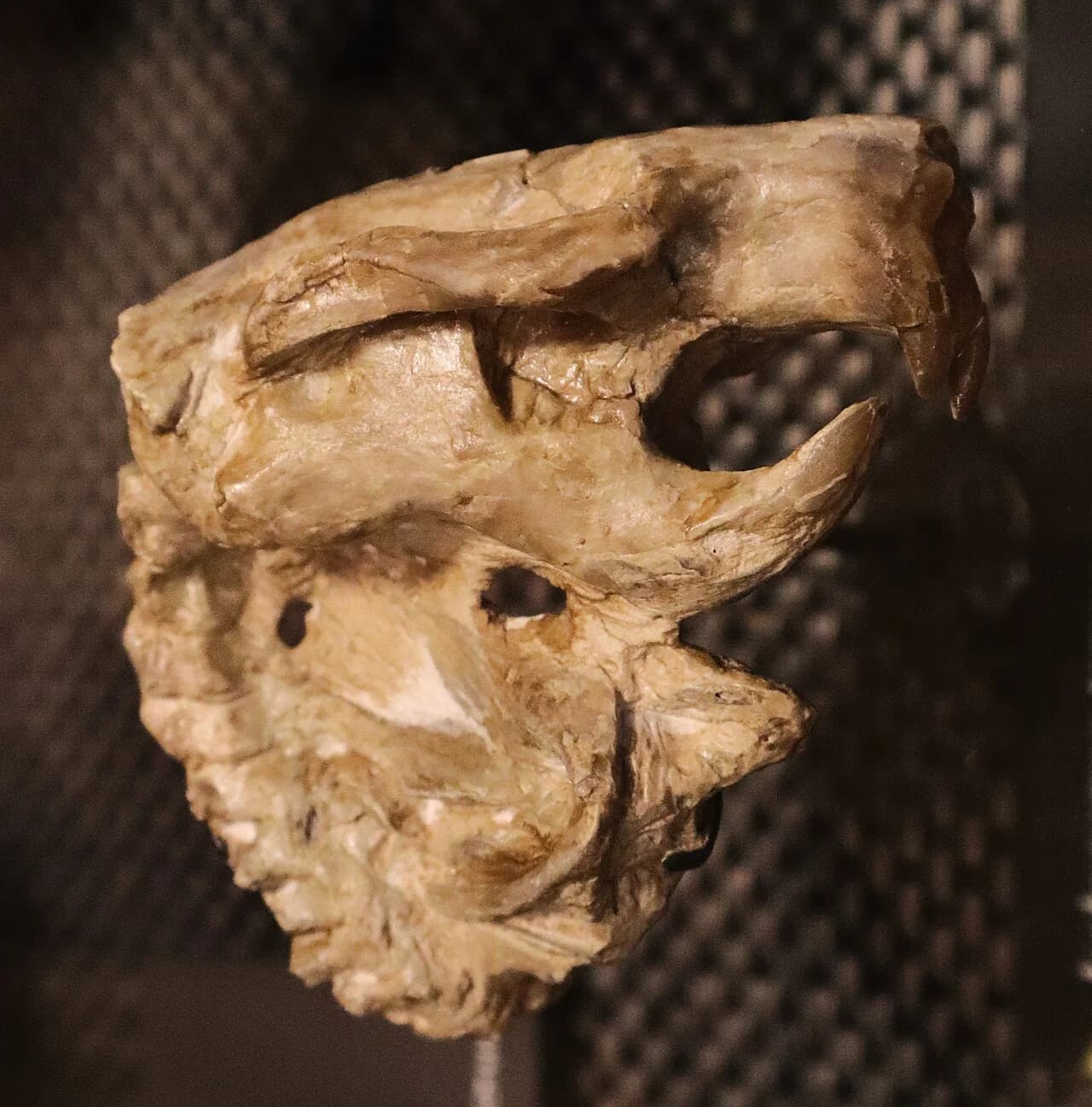
The photo with this article shows a skull of Ischyromys typus, a related member of the same rodent family, at the Beneski Museum of Natural History. It is used for illustration only and is not the Thai fossil.