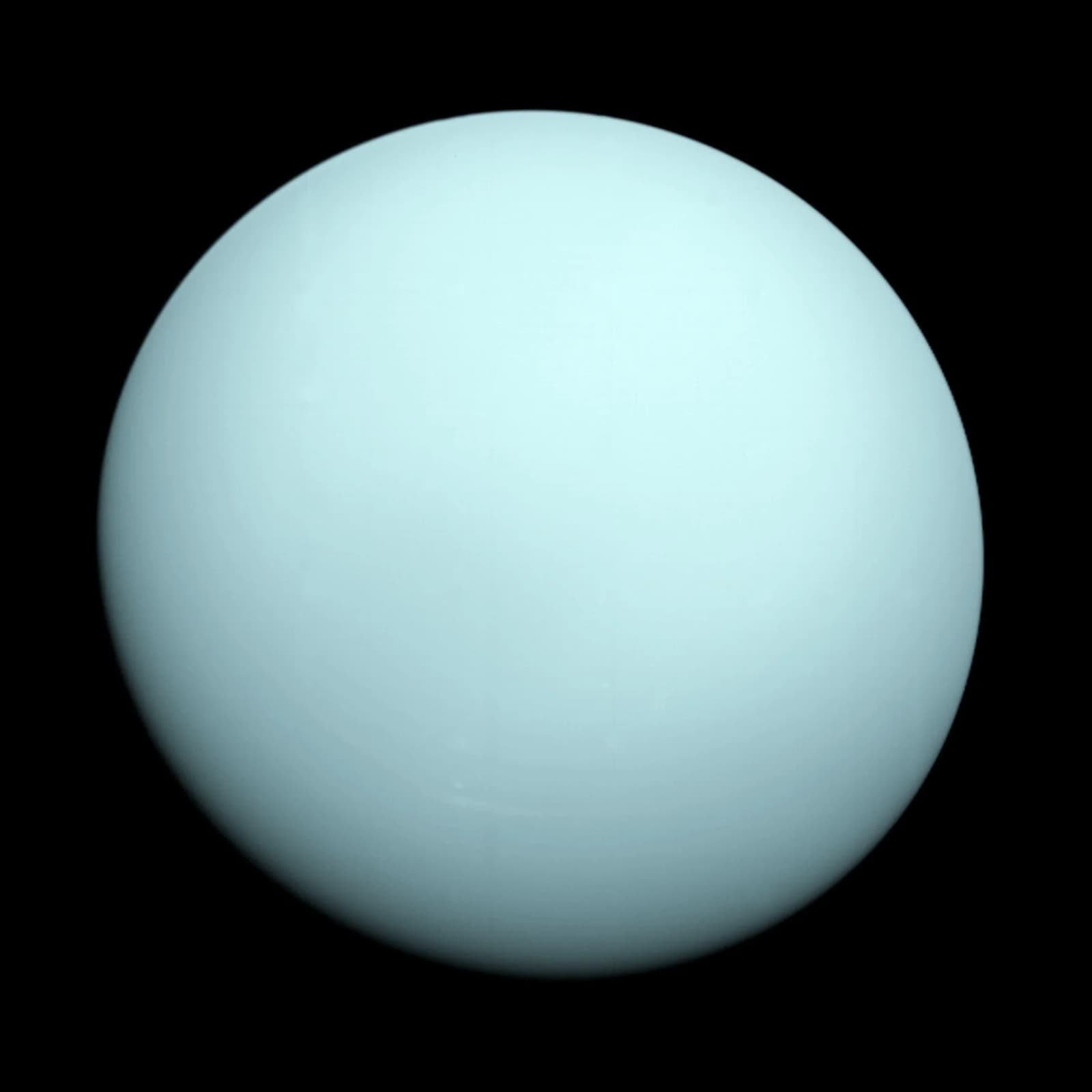
Uranus and Neptune have the strangest magnetic fields of any known planet, lopsided, tilted far from their spin axes and nothing like Earth's tidy bar-magnet pattern. A new modelling study suggests the reason may lie in how electrical conductivity changes with depth inside the two ice giants, and it raises a striking possibility: both fields may have shifted noticeably since a spacecraft last measured them nearly four decades ago.
The work, led by Chi Yan of the University of Texas at Austin's Jackson School of Geosciences, appears in the journal Communications Physics under the title "Electrical conductivity structure drives anomalous and potentially time-varying magnetic fields at Uranus and Neptune". Co-authors include Krista M. Soderlund, Jonathan M. Aurnou, Hao Cao, Adam Masters and Henrik Melin, with contributors from the University of California, Los Angeles, Imperial College London and Northumbria University. The paper was published online on 3 November, and the university's account of the findings was circulated on 15 November.
A puzzle left by Voyager 2
Everything scientists know directly about these magnetic fields comes from NASA's Voyager 2, which flew past Uranus in 1986 and Neptune in 1989. Its readings showed fields that are neither dipolar nor symmetric around the planets' rotation axes. According to the study summary, the dipole of Uranus is tilted by about 59 degrees and that of Neptune by about 47 degrees, compared with roughly 11 degrees for Earth.
In their abstract, the authors note that Uranus and Neptune have magnetic fields "unlike those of any other known planet". Planetary magnetic fields are produced by a dynamo, the motion of electrically conducting fluid deep inside a planet, so the odd shapes offer clues to interiors that cannot be observed directly.
What the models show
The team ran computer simulations of planetary dynamos in which electrical conductivity rises with depth. The researchers explain that under the extreme pressures and temperatures inside these planets, water breaks apart into ions and becomes more conductive further down. When this conductivity profile, set by the planets' composition and temperature, was built into the models, they produced large-scale magnetic features consistent with what Voyager 2 recorded.
The simulations also showed that such non-dipolar fields change substantially over time, although the pace varies and can slow down for a while. In the models, the magnetic poles could wander by tens of degrees within a few decades. "Earth's magnetic tilt drifts by only a degree or so over 50 years," Yan said in the university's account.
Why it matters
The authors write that changes in the strength or direction of the two fields are "plausible" in the more than 30 years since the Voyager 2 flybys, but stress that the size of any change is poorly constrained, because each planet has been measured up close only once. These are model predictions, not observed changes.
That uncertainty has practical consequences. According to the paper, possible field changes could affect how scientists interpret auroral observations, and should inform planning for future missions to the Uranus and Neptune systems.
What comes next
The team proposes testing the idea by comparing new auroral and upper-atmosphere observations from the James Webb Space Telescope with the old Voyager 2 data. Tom Stallard of Northumbria University, who led the Webb observing campaign, said the approach "promises to provide us with a way of understanding how the magnetic fields have changed". A full answer, the researchers say, will probably need new spacecraft to visit the ice giants.