A galaxy once hailed as home to the most distant black hole ever detected in X-rays may not host a giant black hole at all. A team led by astronomers at the University of Michigan has re-examined UHZ1, a galaxy seen when the universe was roughly 480 million years old, and concluded that the data offer "no compelling evidence" for the buried, actively feeding black hole that was reported there in 2023.
The study, by Fan Zou and colleagues, appears in The Astrophysical Journal and was highlighted by Phys.org on 15 November. Co-authors include researchers from NASA's Goddard Space Flight Center and the Harvard & Smithsonian Center for Astrophysics, according to the journal listing.
What the original claim said
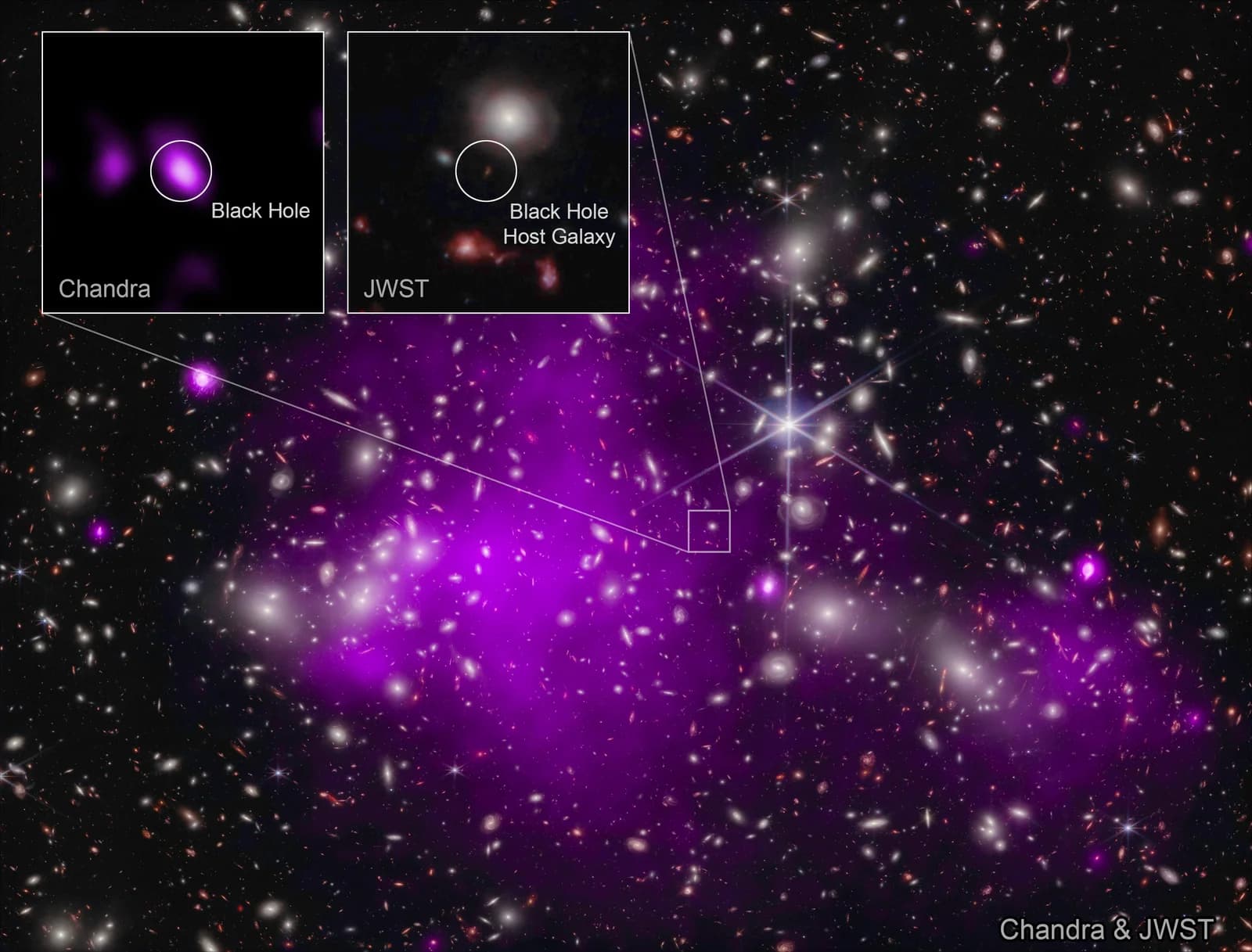
UHZ1 sits behind the galaxy cluster Abell 2744, whose gravity magnifies it. In 2023, NASA's Chandra X-ray Observatory and the James Webb Space Telescope were used to report a black hole there, and the finding was presented as an "outsize black hole galaxy" at cosmic dawn. Phys.org reports that the earlier work put the black hole at 10 million to 100 million times the mass of the Sun, heavily hidden by dust and possibly formed by the direct collapse of a huge gas cloud rather than from the remains of a star.
According to the new paper's abstract, that interpretation rested on an excess of high-energy (2 to 7 keV) X-rays picked up by Chandra at the galaxy's position, read as the signature of a heavily obscured active galactic nucleus.
What the new analysis found
The team analysed the complete 2.2 million seconds of Chandra imaging of the field, including 0.95 million seconds of observations not previously published, and added new mid-infrared photometry from Webb's MIRI instrument. Their main findings, as set out in the paper:
- Across a range of reasonable ways of processing the Chandra data, the X-ray excess reaches a significance of only 2.0 to 2.9 sigma, well short of the 4.2 to 4.4 sigma detection originally reported.
- The original signal depends on exactly how the X-ray and infrared images were lined up. Phys.org reports that only about 0.1% of the team's simulated alignments produced a signal as strong as the first claim.
- The X-ray signal did not grow with the extra exposure time, which the authors say would be expected from a steady source.
- UHZ1 was not detected in any of MIRI's nine imaging bands, where dust heated by a hidden black hole should glow. That caps the total luminosity of any buried black hole at below 1.3 × 10^45 erg per second.
Phys.org adds that the team also checked other possibilities: a dust-free black hole would have shown up in Webb's visible and ultraviolet data, and data from the ALMA radio array revealed very little dust that could hide a black hole surrounded by cold, distant material.
A small star-forming galaxy instead
Taken together, the authors write, the data "paint a consistent picture" of UHZ1 as a low-mass, metal-poor galaxy that is busy forming stars. Phys.org reports that its emission lines fit a galaxy with a stellar mass of about 100 million Suns, with no black hole required. The authors also note that independent Webb spectroscopy shows no black-hole signatures in the galaxy's ultraviolet or optical light.
"Independent confirmation was therefore urgently needed," the team writes, as quoted by Phys.org, referring to the 2023 interpretation.
Why it matters
How the first supermassive black holes grew so large so early is one of the open questions that Webb was built to tackle. UHZ1 had been presented as an example of a black hole born heavy, through direct collapse. The new paper says its conclusion about the missing active black hole holds "regardless of its proposed formation channel", which removes UHZ1 as evidence for that pathway, at least for now.
What comes next
The paper does not rule out a faint or inactive black hole in UHZ1; it sets an upper limit on how bright any hidden one could be.
The image with this article is the 2023 Chandra and Webb composite released with the original claim; its labels reflect that earlier interpretation.
PS · X-ray: NASA/CXC/SAO/Ákos Bogdán; Infrared: NASA/ESA/CSA/STScI; Image Processing: NASA/CXC/SAO/L. Frattare & K. Arcand