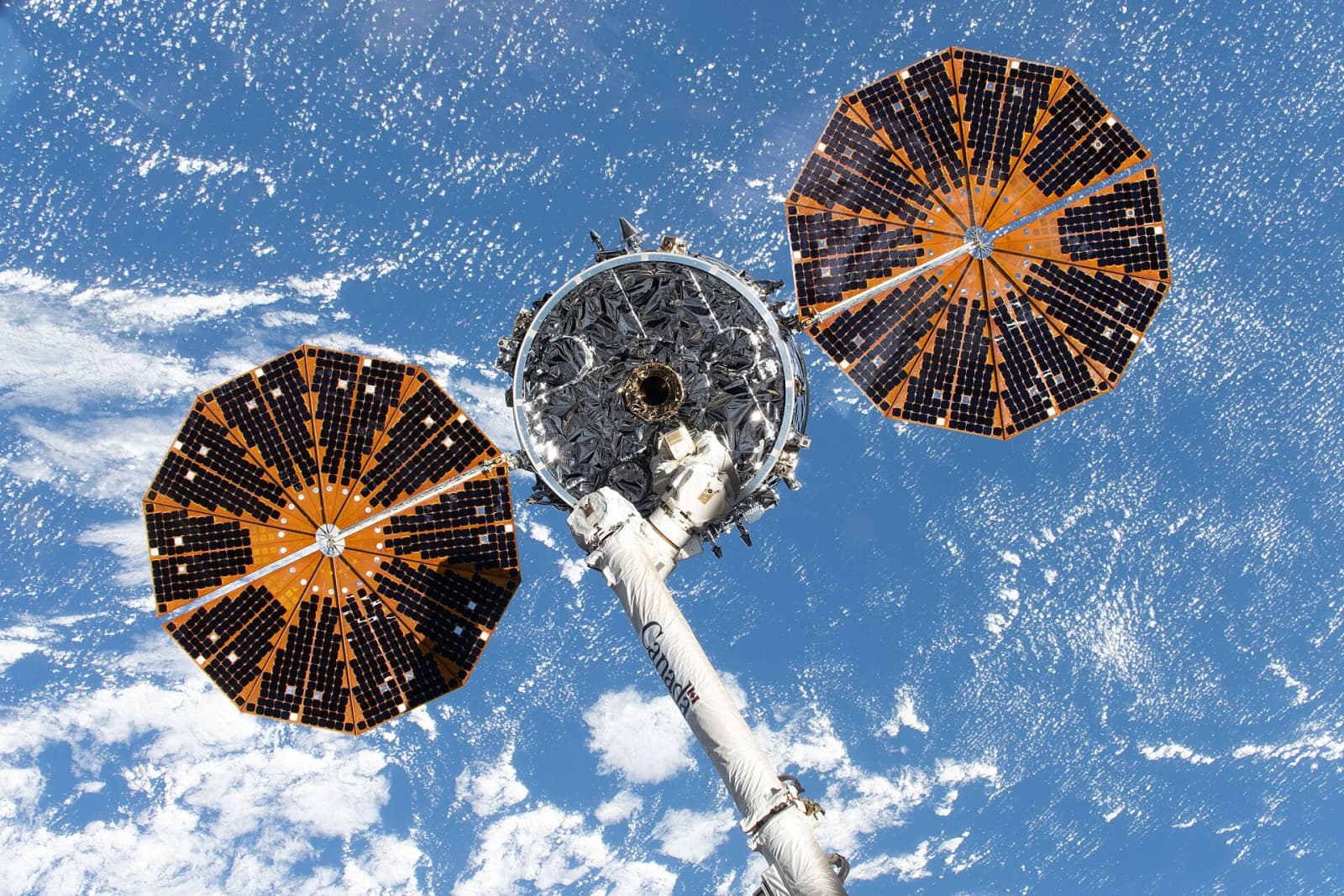
NASA, Northrop Grumman and SpaceX were set on 29 November 2026 to launch the Cygnus XL cargo spacecraft on the CRS-25 resupply mission to the International Space Station, after the spacecraft and its Falcon 9 rocket reached Space Launch Complex 40 at Cape Canaveral Space Force Station in Florida, United States, on 28 November.
According to a NASA space station blog update published on Saturday, liftoff is targeted for 10:47 a.m. EST on Sunday, 29 November, which is 9:17 p.m. in India. If the launch slips, the next opportunity is 10:24 a.m. EST on Monday, 30 November (8:54 p.m. IST).
What is the CRS-25 mission carrying?
The Cygnus XL is carrying about 11,000 pounds, or roughly 5,000 kg, of science investigations, crew supplies and equipment for the orbiting laboratory, NASA said. In its coverage advisory for the mission, the agency listed research on improved drug delivery for cancer and osteoarthritis, predicting how cancer spreads, treatments for muscle loss, better radiation sensing and food production for long-duration missions among the investigations on board.
Food production in space has been a recurring theme in NASA's recent work. MapMyTimes earlier reported that NASA is studying strawberries, cucumbers and lemon basil as fresh food for Moon and Mars crews.
Why is the spacecraft named after Jim Lovell?
Northrop Grumman has named this Cygnus the S.S. James "Jim" A. Lovell, honouring the former NASA astronaut. The company's mission page says it names each Cygnus after a person who has made significant contributions to human spaceflight, and credits Lovell with leadership in the Gemini and Apollo programmes. Lovell flew four missions, including Apollo 8 and Apollo 13.
Weather and launch readiness
NASA said forecasts had improved to a 75 per cent chance of favourable weather at launch time, with the thick cloud layer rule being the main concern. Teams will keep monitoring conditions, the agency added. A day earlier, on 27 November, NASA said its mission management team had given a go-ahead for launch preparations.
NASA's live coverage is scheduled to begin at 10:25 a.m. EST (8:55 p.m. IST) on its online platforms, including nasa.gov/live.
What happens after launch?
If the launch goes ahead on Sunday, Cygnus XL is expected to reach the station on Tuesday, 1 December. NASA astronauts Jessica Watkins and Luke Delaney are scheduled to capture the spacecraft with the station's Canadarm2 robotic arm at about 2:35 a.m. EST (1:05 p.m. IST), after which ground controllers will install it on the Earth-facing port of the station's Unity module.
The cargo craft is planned to stay attached to the station until May 2027. It will then depart loaded with several thousand pounds of disposal items and burn up on re-entry into Earth's atmosphere, NASA said.
What is confirmed so far
At the time of writing, the rocket and spacecraft were on the pad and the launch had not yet taken place. Launch times can change because of weather or technical checks, and NASA has said it will post updates as conditions develop. According to Northrop Grumman, the company has delivered more than 169,000 pounds of supplies, experiments and equipment to the space station since 2013.
Photo source · NASA Johnson Space Center (public domain)