NASA's twin ESCAPADE spacecraft have swung past Earth and fired their engines to head for Mars, the agency said on 9 November 2026. It is the first time NASA has used a powered Earth flyby to send a spacecraft towards the Red Planet.
The two probes now face a cruise of about 10 months, with arrival at Mars planned for September 2027. Once there, they are meant to study how the solar wind strips away the Martian atmosphere.
Two flybys, two engine burns
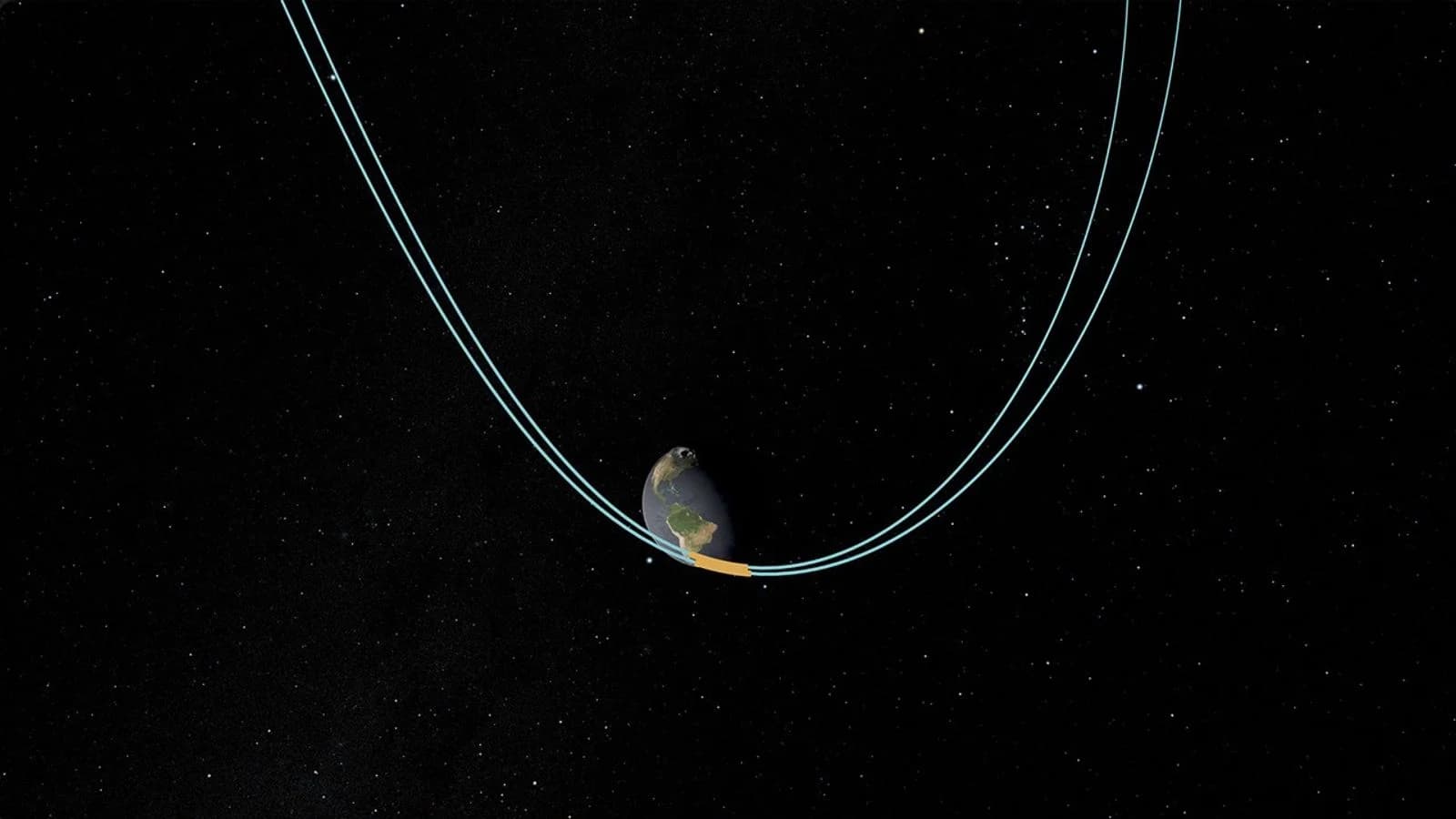
According to NASA, the first spacecraft made its closest approach to Earth at about 5 a.m. EST on 7 November, passing roughly 1,000 miles above the surface. At that point it fired its engine for around nine minutes in what mission teams call a trans-Mars injection burn.
The second spacecraft followed on 9 November, reaching closest approach at about 6 a.m. EST some 650 miles above Earth and completing a similar nine-minute burn.
Asal Naseri, acting associate flight director in NASA's Heliophysics Division, described it as "the first time NASA has used a powered Earth flyby to propel a spacecraft toward Mars".
An unusual road to Mars
ESCAPADE, short for Escape and Plasma Acceleration and Dynamics Explorers, lifted off on 13 November 2025 from Cape Canaveral Space Force Station in Florida. NASA noted that Earth and Mars were then on opposite sides of the Sun, a poor alignment for a direct trip.
Instead of heading straight out, the spacecraft spent months in a holding orbit around the Earth-Sun Lagrange point 2, about a million miles from Earth, before returning for this month's gravity assist. NASA said the probes used that waiting period to observe Earth's magnetotail.
Lead mission designer Jeff Parker of Advanced Space said the approach "provides the flexibility to launch almost anytime", pointing to the possibility of freeing future Mars missions from rigid launch windows.
What the mission will study
The mission's core question is how the solar wind, a stream of charged particles that NASA describes as moving at about a million miles per hour, affects the Martian environment and drives the loss of its atmosphere. The spacecraft will also sample the solar wind on their way between Earth and Mars.
Principal investigator Rob Lillis of the University of California, Berkeley, said ESCAPADE "will be the first science mission to choreograph two orbiters around Mars".
The mission is led by UC Berkeley's Space Sciences Laboratory, working with Rocket Lab, NASA's Goddard Space Flight Center, Embry-Riddle Aeronautical University, Advanced Space and Blue Origin. It is funded by NASA's Heliophysics Division through its SIMPLEx programme for small, lower-cost missions.
Why it matters
Mars launch opportunities usually come only when the two planets line up. By showing that a spacecraft can wait near Earth and then use a powered flyby to set off, ESCAPADE is testing a route that, according to its designers, could give mission planners more freedom over when to launch. The science, meanwhile, adds to efforts to understand how Mars lost much of its atmosphere.
What happens next
NASA said the spacecraft will carry out trajectory correction manoeuvres during the cruise. Orbit insertion burns, each lasting about 11 minutes, are planned for 7 and 9 September 2027. The probes will then take several months to settle into their first formation, with science operations expected to begin in June 2028.
About six months after that, the plan is for the pair to move into different orbits for a five-month campaign: one farther out to watch the incoming solar wind, and the other closer in to track how Mars responds in real time.
PS · NASA; trajectory visualisation: Advanced Space/Matt Bolliger