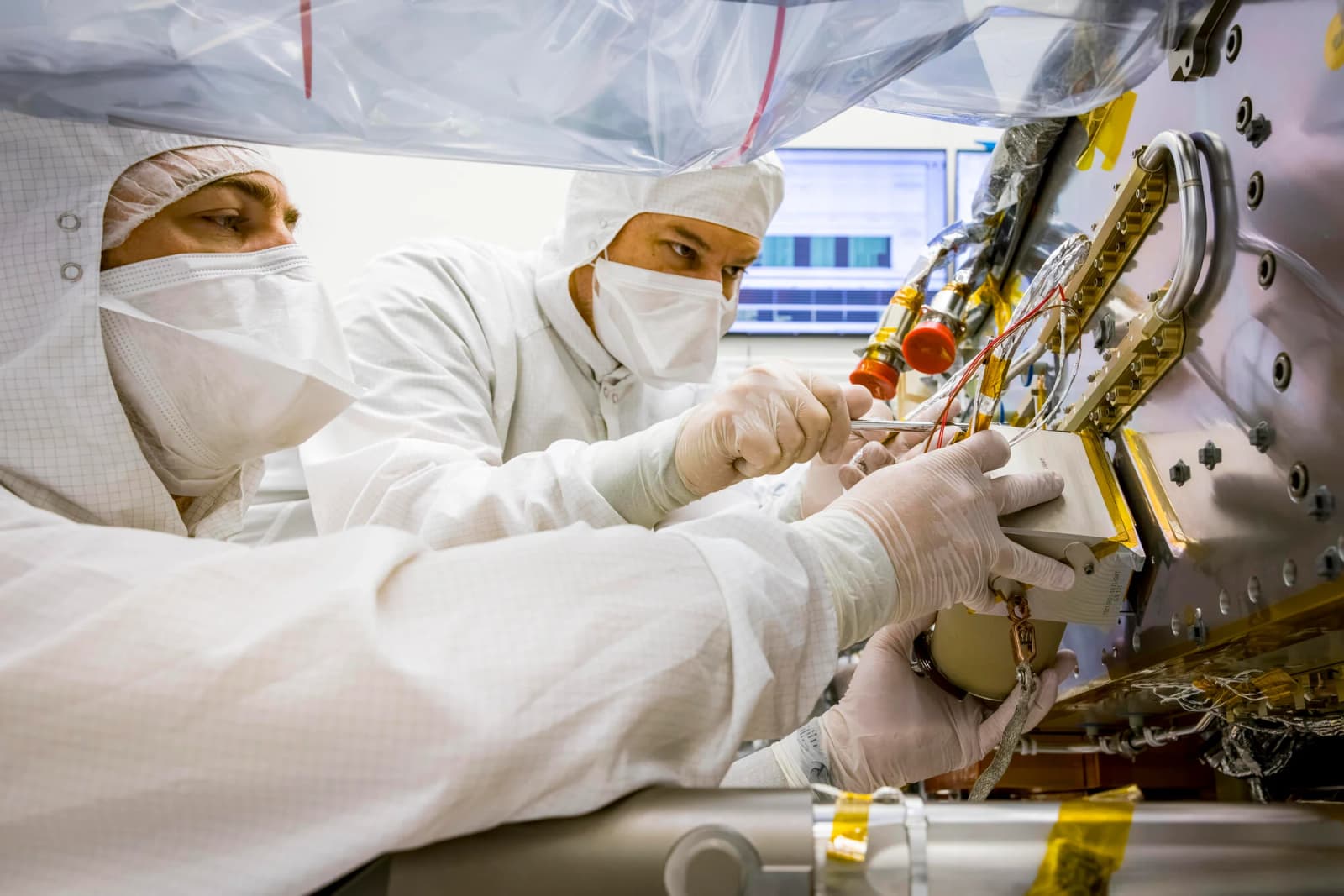
NASA's Dragonfly, a car-sized rotorcraft being built to fly on Saturn's largest moon, Titan, now has all seven of its science cameras installed, the US space agency said on 24 November 2026. The work was done at the Johns Hopkins University Applied Physics Laboratory (APL) in Laurel, Maryland, where the spacecraft is being assembled ahead of a planned July 2028 launch.
According to the NASA update, by mid-November the camera suite, called DragonCam, had been fitted in insulated housings, tested and integrated into the rotorcraft. The cameras were built by Malin Space Science Systems (MSSS). Dragonfly is due to reach Titan in late 2034.
What will the seven cameras do?
The cameras will give the mission's scientists views of Titan's surface from the front, the sides, below and up close, NASA said. A forward wide-angle camera with a 90-degree field of view is paired with a forward medium-angle camera at higher resolution; together they provide a stereoscopic view. Two side-mounted wide-angle cameras allow panoramas, and two downward-facing wide-angle cameras will help the team judge whether a landing site is safe for deploying the sampling tool and seismometer.
The seventh is a high-resolution microscopic imager that will examine millimetre-sized sand grains at the drill site. Technicians Chad Cook and Seth Harvey installed it on 6 November, NASA said. A 2026 design paper on the instrument describes the same seven-camera layout, connected to a digital video recorder.
How will the cameras survive Titan?
Each camera looks out through a window in a foam enclosure that shields it, and the rotorcraft's interior, from Titan's cryogenic surroundings, where temperatures reach minus 290 degrees Fahrenheit (about minus 179 degrees Celsius), NASA said.
Because Titan's night lasts nearly eight Earth days, Dragonfly also carries a configurable LED array built at APL that spans infrared to ultraviolet light. NASA said it will help scientists work out what surface materials are made of, may reveal organic molecules that glow under ultraviolet light, and lets the cameras show Titan roughly as human eyes would see it.
Panoramic images taken in the cleanroom on 9 November, soon after installation, have a yellow tint because DragonCam records light differently from the human eye, the agency added.
What did the scientists say?
Elizabeth Turtle, Dragonfly's principal investigator at APL, said the team would "be able to see Titan from perspectives we've never had before". Michael Ravine, DragonCam development manager at MSSS and a Dragonfly co-investigator, said: "These will be our eyes to see and explore this whole new world."
Carolyn Ernst, DragonCam instrument scientist at APL, said the cameras would give "critical context for the samples collected by DrACO", the mission's drill.
Why do the cameras matter?
The cameras serve both science and safety, according to NASA's description: the downward-facing pair will help decide whether a site is safe before instruments are deployed, while the microscopic imager and LED array will help explain the material the drill collects. With the full DragonCam suite in place, the rotorcraft's imaging system is complete ahead of the next round of instrument deliveries.
What happens next?
The rotorcraft's two navigation cameras, also built by MSSS, were installed in summer 2026. NASA said four more instruments are due for delivery, integration and testing over the next several months: the Gamma-ray and Neutron Spectrometer (DraGNS), the Geophysics and Meteorology package (DraGMet), the Mass Spectrometer (DraMS) and the Drill for Acquisition of Complex Organics (DrACO).
Photo source · NASA/Johns Hopkins APL/Ed Whitman