A giant, unstable star that has repeatedly flared up as though it were exploding has been found to have a hidden partner, according to NASA. Astronomers using the agency's Chandra X-ray Observatory say a black hole or a neutron star, orbiting the star every 113 days, is pulling gas off it and setting off the recurring outbursts.
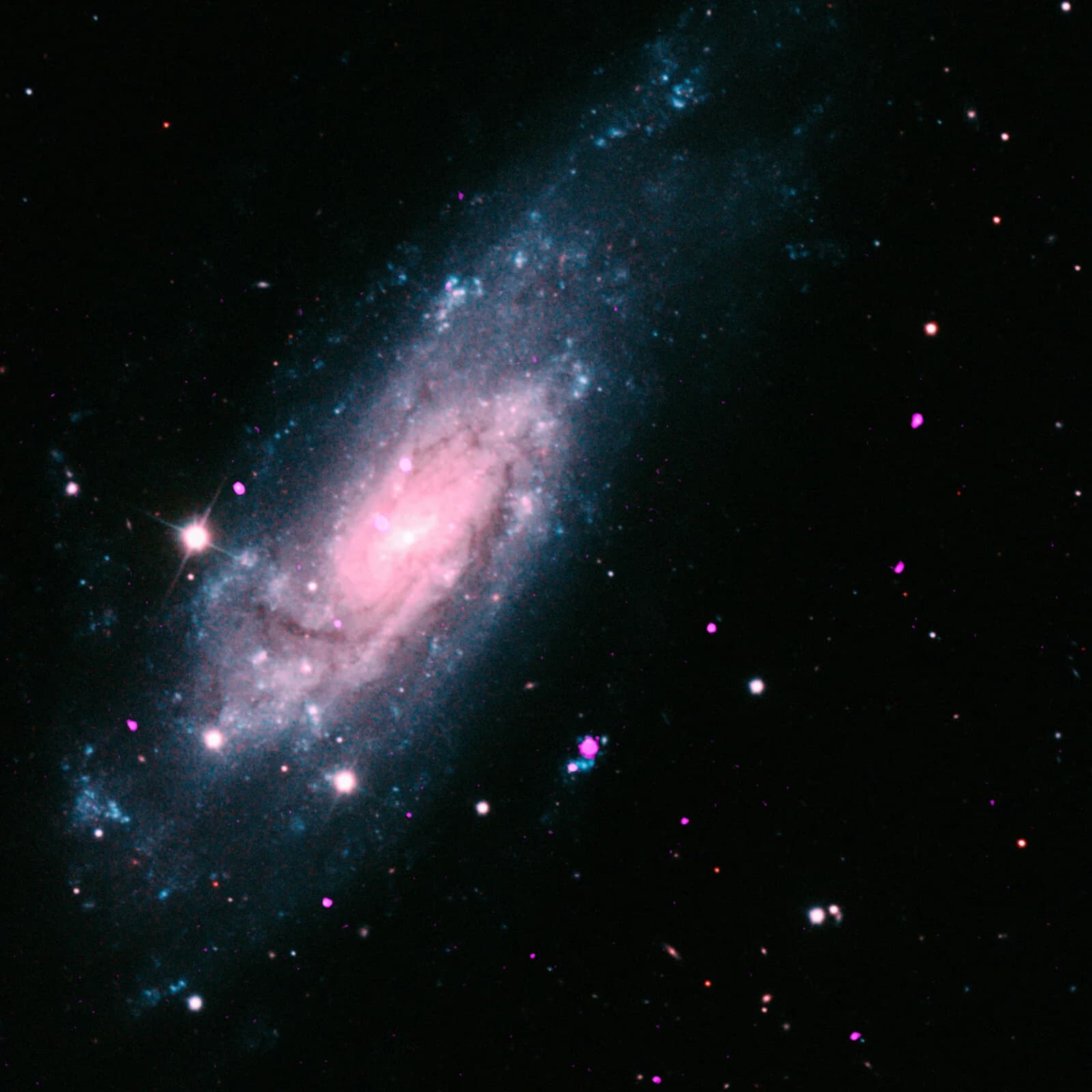
The star, catalogued as AT 2016blu, sits in the spiral galaxy NGC 4559, roughly 30 million light-years from Earth. NASA announced the result on 9 November 2026 and followed it with an image release on 13 November.
A star that kept 'pretending' to explode
AT 2016blu belongs to a class known as luminous blue variables: hot, massive stars whose brightness swings sharply. Astronomers estimate it holds at least 33 times the mass of the Sun. It is also described as a "supernova impostor", because its eruptions resemble a supernova but the star itself survives them.
According to NASA, observers recorded at least 27 optical outbursts between 2012 and 2026, arriving roughly every 113 days. The regularity was striking, but for years the cause stayed unclear.
"This star's behavior was confusing at first because it kept acting like a supernova," said co-author Núria Torres-Albà of the University of Virginia, in NASA's announcement.
How Chandra caught the culprit
The breakthrough came from timing. After ground-based telescopes picked up a fresh outburst in early 2026, the team requested Chandra observations under a "Target of Opportunity" programme, which is reserved for fast-changing events. Chandra observed the system between 24 and 27 March 2026.
Those data showed the source shining at least 100 times brighter in X-rays than in Chandra observations from 2001 and 2002, before the outbursts began. NASA said Chandra was the only X-ray telescope sharp enough to separate AT 2016blu from a bright X-ray source nearby.
"Until we were able to get Chandra data at the right time, we couldn't figure out what was making this happen," said lead author Mojgan Aghakhanloo of the University of Virginia.
The researchers' best explanation is an oval-shaped orbit. As the compact companion swings closest to the massive star, it captures some of its material. That gas becomes extremely hot and emits X-rays. Co-author Nathan Smith of the University of Arizona said, "The dense gas surrounding the system is heated by the X-rays and then glows in the optical."
Many observers, one result
The optical record behind the study came from several sources, NASA said, including the Katzman Automatic Imaging Telescope, the Las Cumbres Observatory Global Supernova Project, and the American Association of Variable Star Observers, whose data included contributions from more than 30 amateur astronomers. The findings are published in The Astrophysical Journal.
Why it matters
According to NASA, this is the first time an erupting star of this kind has been detected in X-rays, and the first such object found to have a black hole or neutron star partner.
The result could matter beyond a single star. NASA noted that AT 2016blu is bright enough in X-rays to be a candidate ultra-luminous X-ray source, a rare class of very bright X-ray objects that astronomers still do not fully understand. The discovery may also help explain stars that brighten before going supernova, since the agency said such behaviour may often stem from a massive star orbiting a compact object or another massive star.
What happens next
NASA's announcement did not set out specific follow-up observations. With a clock-like 113-day cycle now linked to a companion's orbit, however, the system's next outbursts can be anticipated, giving astronomers further chances to test the explanation in both visible light and X-rays.
Chandra is managed by NASA's Marshall Space Flight Center in Huntsville, Alabama, while the Smithsonian Astrophysical Observatory's Chandra X-ray Center runs its science operations from Cambridge, Massachusetts.
PS · X-ray: NASA/CXC/Univ. of Virginia/M. Aghakhanloo et al.; Optical: SDSS; Image Processing: NASA/CXC/SAO/P. Edmonds