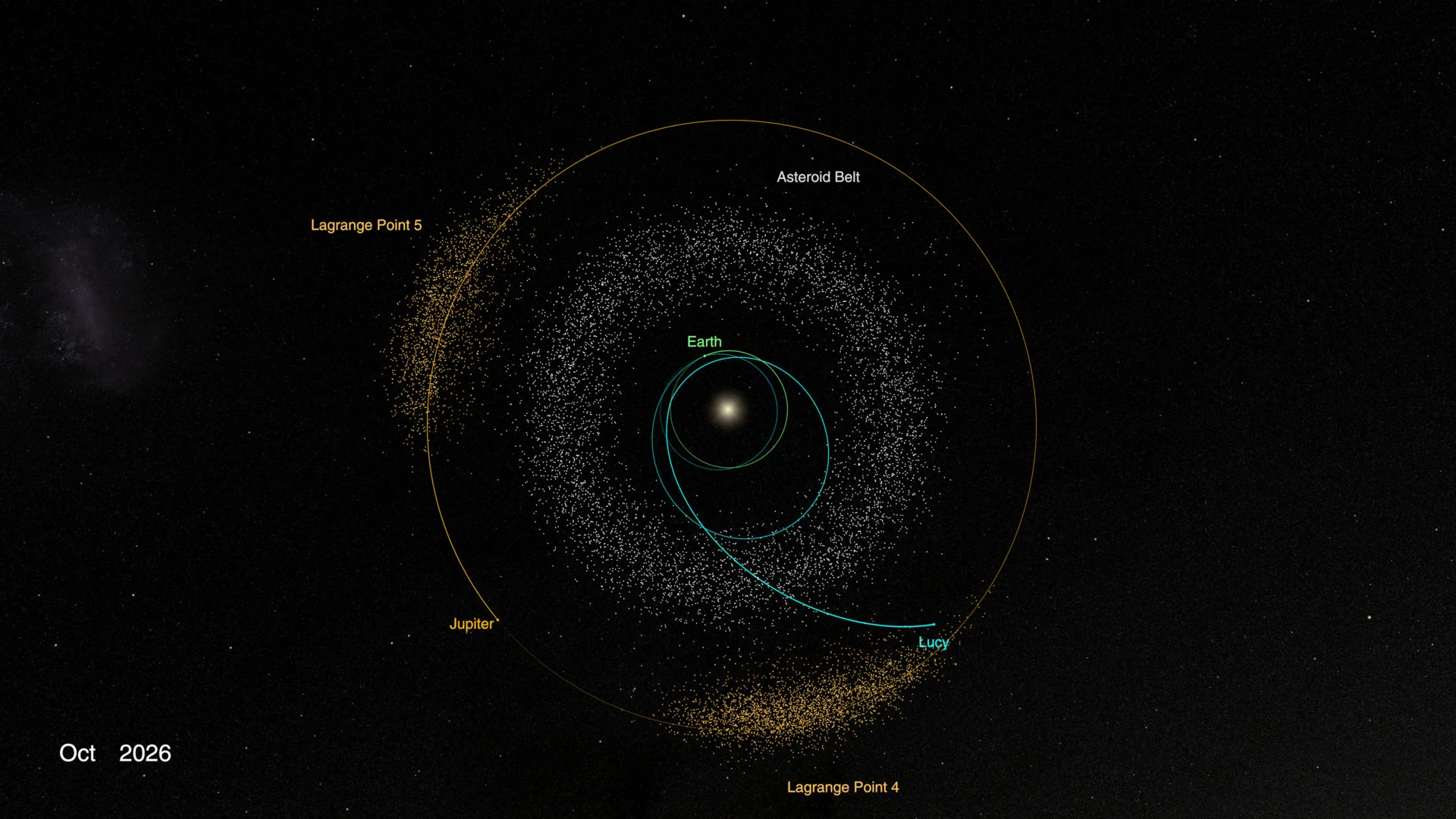
NASA’s Lucy spacecraft has reached the region occupied by Jupiter’s Trojan asteroids, a milestone announced on October 28 after a journey of more than 2.2 billion miles. Its first close encounter with one of the Trojans remains scheduled for August 11, 2027.
The spacecraft is approaching the L4 region, where a swarm of asteroids travels ahead of Jupiter around the Sun. A second swarm follows the planet. These regions do not have sharply defined boundaries, so engineers establish Lucy’s location using radio tracking and images of surrounding stars.
Lucy’s first Trojan target is Eurybates. Later planned encounters include Polymele in September 2027, Leucus in April 2028 and Orus in November 2028. The mission is intended to investigate ancient material that could help researchers understand how the planets formed and moved into their present arrangement.
The spacecraft and its instruments continue to operate as expected as sunlight weakens and temperatures fall farther from the Sun. Mission teams are now refining the observations for the brief, close-up encounter with Eurybates. Reaching the Trojan region is an approach milestone, rather than a completed asteroid flyby.
Visualization of Lucy’s path toward Jupiter’s leading Trojan asteroid swarm, shown for October 2026. Credit: NASA Scientific Visualization Studio / Kel Elkins. Visualization credit: NASA Scientific Visualization Studio / Kel Elkins (Science and Technology Corporation). NASA media guidelines: editorial reuse permitted with acknowledgment.