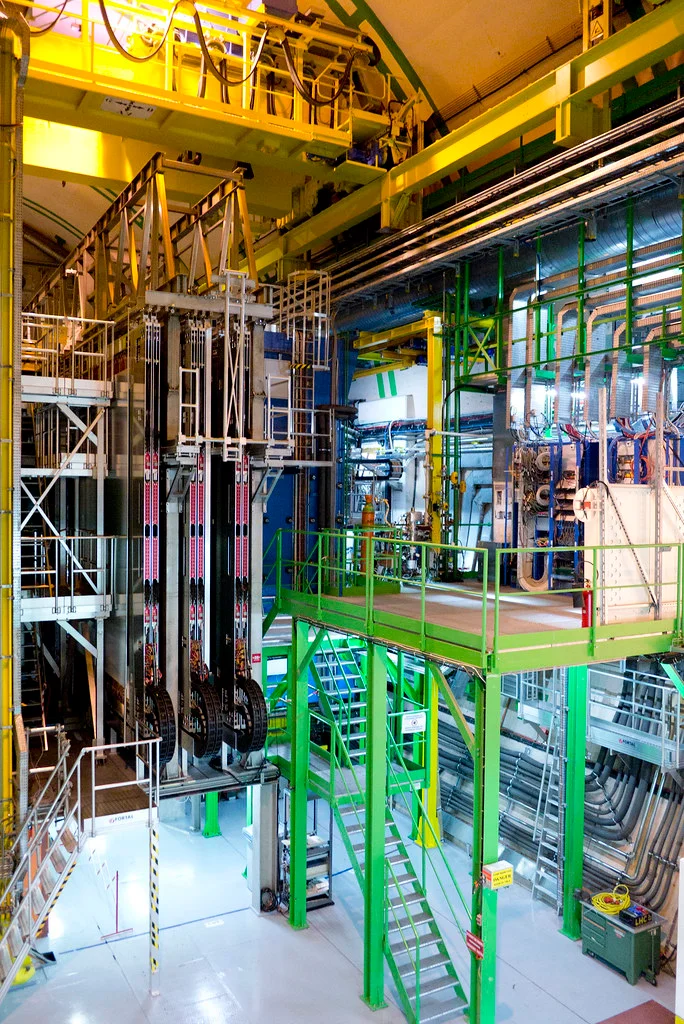
CERN’s LHCb collaboration reported evidence on November 3 of an exceptionally rare decay in which a neutral beauty particle transforms into two muons, heavier relatives of the electron.
The process involves a particle known as a B-d meson and is predicted to occur in roughly one in ten billion decays of that type of particle. CERN said this was the first evidence for the process from a single experiment.
The analysis combines data collected in 2024–25 with earlier measurements from 2011–18. Its statistical significance reaches 3.2 sigma, above the conventional threshold for evidence but below the five-sigma standard used to claim a discovery.
The result agrees with the Standard Model of particle physics. It does not establish that a new particle or force has been found. Precise measurements of rare decays can nevertheless help researchers test theories beyond that model.
An upgraded detector and improved analysis helped separate the tiny signal from other processes. Further data will be needed to confirm it.
Archive photograph of the LHCb detector, not an image of the newly reported result. Photo: Brian Suda, LHCb Detector / CC BY 2.0. Display may be resized or cropped.