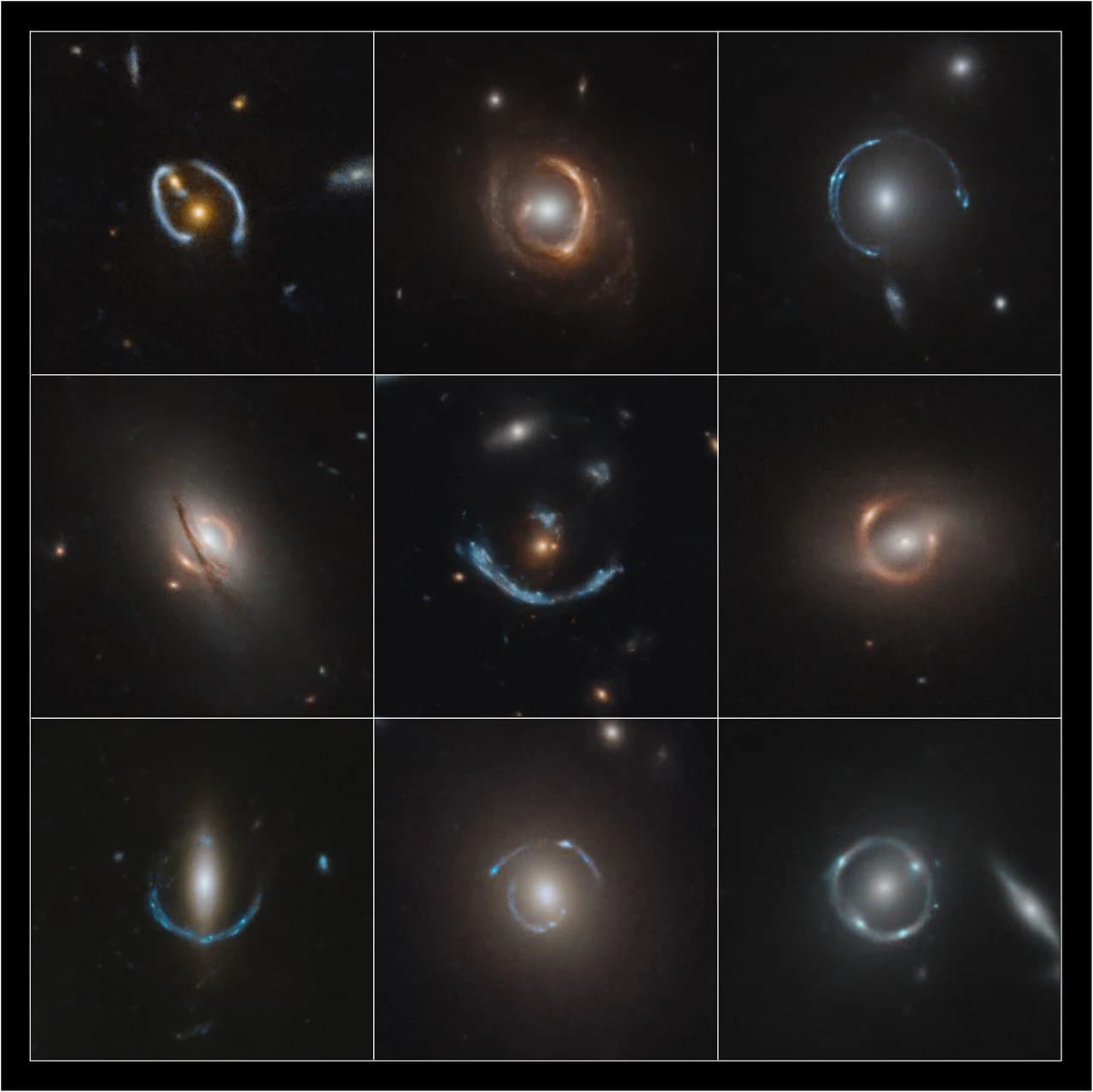
NASA has released a gallery of gravitational lenses photographed by the Hubble Space Telescope, describing the set as groundwork for follow-up observations by its newly launched Nancy Grace Roman Space Telescope. The agency published the collage and an explanation of the science behind it on 12 November 2026.
The lenses were first spotted with the Dark Energy Spectroscopic Instrument at Kitt Peak, then imaged by Hubble, and Roman is set to observe them further, NASA said. The agency noted in the image caption that Roman launched in August 2026.
What a gravitational lens is
Gravitational lensing, which Albert Einstein predicted, happens when the gravity of a massive object such as a galaxy bends and magnifies the light of something far behind it. NASA compares the effect to a huge natural lens that lets astronomers see objects at distances no telescope could reach alone. In the new images, the light of distant background galaxies has been stretched into arcs around the galaxies in front of them.
Hunting for clumps of dark matter
The main aim is to measure mass, including the dark matter that cannot be seen directly. By studying how strongly the background galaxies are distorted, researchers can work out how much mass the foreground galaxy holds and how it is spread out.
NASA said Hubble's sharp images may also reveal small flaws in the lensed arcs that would point to small clumps of dark matter. Finding such clumps could support the cold dark matter theory, which predicts many of them with masses between a million and a billion times that of the Sun. For comparison, NASA put the dark matter halo of the Milky Way at about 1.3 trillion solar masses.
A varied set of lenses
The gallery shows a wide range of shapes. NASA highlighted:
- an arc-and-counterarc pattern, where a pair of foreground galaxies doubles the image of a background galaxy;
- an Einstein ring, where the alignment is so close that the background galaxy almost fully circles the lens;
- quadruple images, where one background galaxy appears four times, in one case with double knots that are probably star-forming regions;
- a foreground galaxy with a visible dust lane, which NASA called rare in a lensing galaxy.
Colour also carries information. NASA said bluish arcs point to young stars and reddish arcs to older ones, differences that Hubble and Roman will use to study how galaxies evolved in the early universe. Most of the lensing galaxies are elliptical, older and compact, though a few appear to have spiral arms.
How Hubble and Roman will divide the work
NASA explained that Hubble mainly sees visible and ultraviolet light and gives very detailed views of single objects, while Roman works mostly in infrared and covers a far wider field of view. That means Hubble offers the better look at individual lenses, but Roman will be able to catch many more of them. If Roman spots an especially interesting lens, astronomers may point Hubble at it for a closer look.
In the case of the dusty galaxy, NASA said future infrared observations by Roman, which are less blocked by dust, could show whether the arcs actually form a more complete Einstein ring.
What happens next
According to NASA, researchers plan to use detailed study of the Hubble lens images to build an intelligent search tool that can efficiently find similar arcs in Roman's upcoming images. The Hubble data are expected to produce dark matter results of their own while preparing the ground for Roman's much larger sample of lenses.
The release comes as Roman's own commissioning moves ahead in space, making the gallery an early example of how NASA expects its observatories to work in tandem.
PS · NASA, ESA, X. Huang (University of San Francisco); processing: Gladys Kober