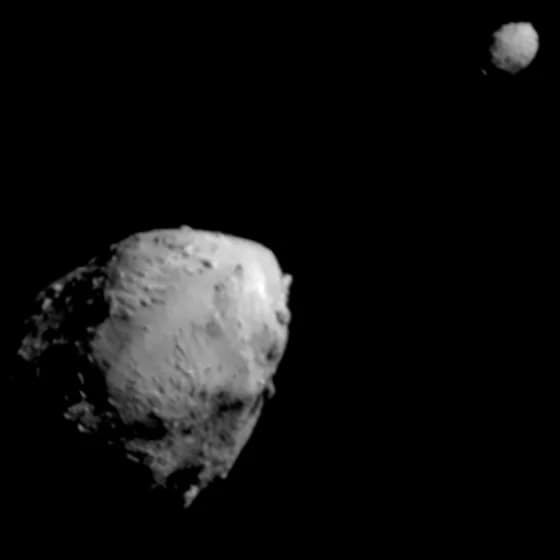
The European Space Agency's Hera spacecraft has sent back an early look at the double asteroid it travelled to study, showing the larger body, Didymos, with its small moon Dimorphos just peeking out from behind it. ESA released the preview image on 12 November.
What the image shows
Hera captured the view from a distance of 56 kilometres. It shows one side of Didymos, which measures about 780 metres across, with part of the 151-metre Dimorphos visible near the top of the frame. A handful of boulders can be made out along the moonlet's upper edge.
On Didymos itself, ESA said the picture reveals large boulders, smoother patches and a surprisingly sharp ridge running around the asteroid's equator.
A spinning top on the edge
Didymos is shaped like a spinning top and completes a rotation every 2.2 hours, a pace that brings it close to the point of flying apart, according to the agency. Computer models of rapidly spinning asteroids suggest that such fast rotation can push loose surface material from higher latitudes towards the equator, which may explain the ridge.
ESA added that some of that material may even have been thrown off Didymos altogether, offering a possible explanation for how Dimorphos came to exist. The moonlet circles Didymos at a distance of just over one kilometre.
Why Hera is there
Hera is a planetary defence mission. On 26 September 2022, NASA's 580-kilogram DART spacecraft deliberately crashed into Dimorphos at 6.1 kilometres per second. The impact threw a plume of debris across 10,000 kilometres of space and shortened the moonlet's orbit around Didymos by about 33 minutes.
The test showed that a spacecraft can nudge an asteroid, but it left important questions open. ESA says scientists still want to know whether the collision dug a crater or reshaped Dimorphos entirely, what the moonlet is made of, how its interior is arranged and how much mass it has. They also want to understand why the deflection was far larger than impact simulations had predicted.
What happens next
ESA said detailed images of both asteroids will be published on 25 November. Over the coming months, Hera is to carry out what the agency calls a close-up "crash site investigation" of Dimorphos using several instruments. It will also release two shoebox-sized CubeSats to survey the pair from closer range, and the mission is eventually planned to progress to a landing.
The answers Hera gathers are meant to turn DART's one-off experiment into a technique that could be relied on if a hazardous asteroid were ever found on a collision course with Earth.