The European Space Agency's Hera spacecraft has sent back an early look at the double asteroid that NASA deliberately struck in 2022, revealing a boulder-strewn main body with an unexpectedly sharp ridge around its middle and its small moonlet just peeking into view. ESA released the preview image on 12 November 2026.
What the image shows
The picture was taken from a distance of 56 km and shows one face of Didymos, the larger asteroid, which measures about 780 metres across. According to ESA, its surface mixes large boulders with smoother patches and features what the agency called a surprisingly sharp equatorial ridge. Only a sliver of Dimorphos, the 151-metre moonlet, is visible near the top of the larger body, with a few boulders seen along its upper side.
ESA offered possible explanations for the ridge. Didymos rotates roughly once every 2.2 hours, close to the speed at which it would begin to fly apart. Computer models of such fast spinners suggest the rotation can push loose surface material from higher latitudes towards the equator. Some material may even have been flung off Didymos altogether, which could explain how Dimorphos formed in the first place, the agency said.
Revisiting the DART crash site
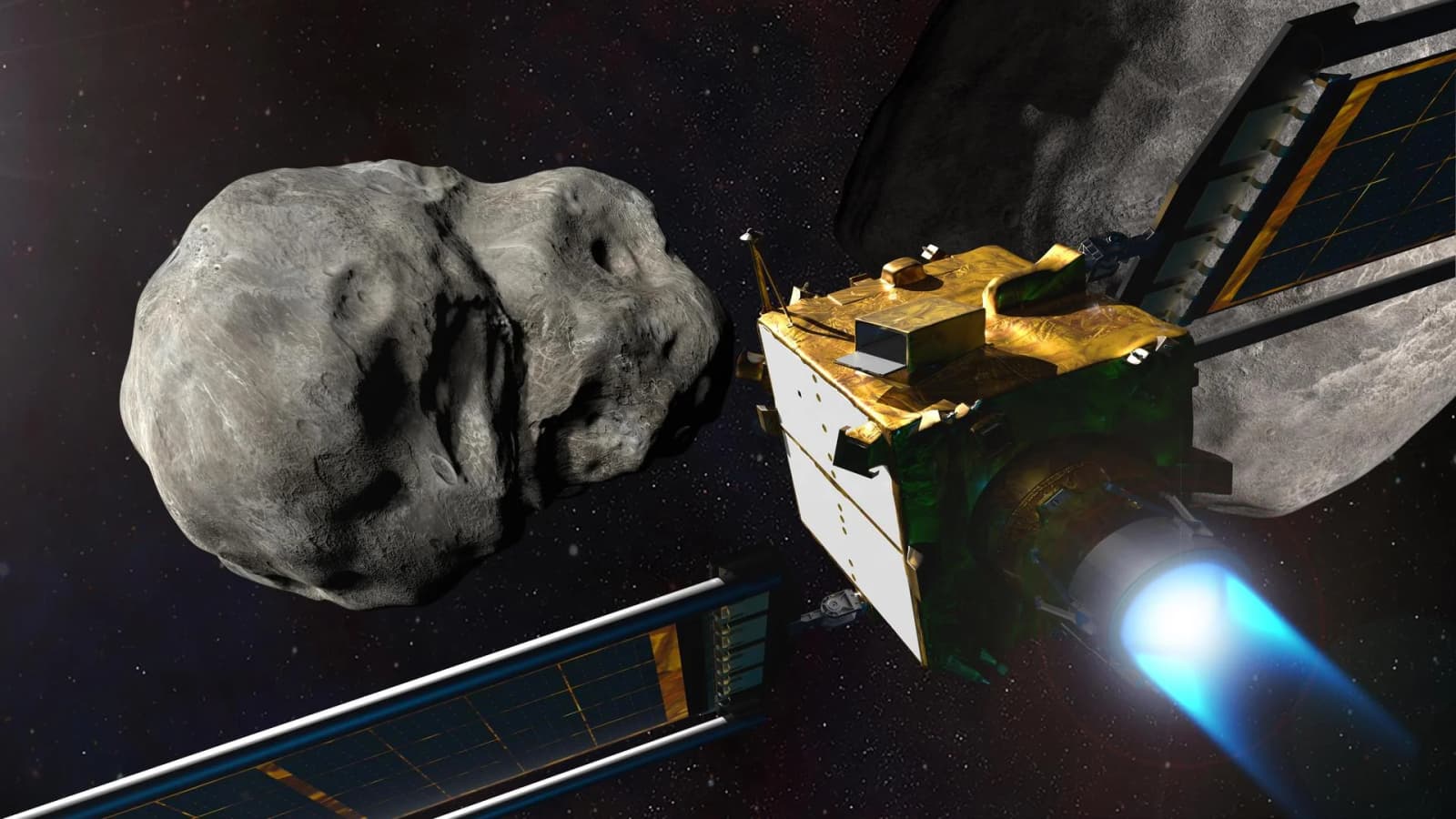
Hera's job is to investigate the aftermath of NASA's Double Asteroid Redirection Test. On 26 September 2022, the 580 kg DART spacecraft slammed into Dimorphos at 6.1 km per second, throwing a plume of debris across 10,000 km of space and shortening the moonlet's orbit around Didymos by about 33 minutes.
Scientists still want to know what the impact did to Dimorphos, whether it carved a crater or reshaped the whole body, what the moonlet is made of and how massive it is. ESA also notes that the deflection was much larger than simulations had predicted, and Hera is meant to help explain why.
Flying in 'rectangles'
In a separate update on 11 November, ESA said Hera, a spacecraft about the size of a small car, is in an early characterisation phase, staying roughly 25 to 30 km from the asteroid pair. Rather than circling, it moves along almost straight lines at around 12 cm per second, with thruster burns every three to four days turning its path by 90 degrees, creating what ESA calls "rectangular orbits".
The approach borrows from ESA's Rosetta comet mission and is designed to be safe: if a manoeuvre fails, Hera drifts away from the asteroids rather than towards them. The gravity involved is tiny. ESA puts Didymos's pull at about 40,000 times weaker than Earth's and Dimorphos's at about 200,000 times weaker.
Mission scientist Michael Kueppers said the aim at this stage is to gather "big-picture findings of relevance to supporting the mission's planetary defence goals".
The spacecraft is controlled from ESA's ESOC centre in Darmstadt, Germany, which contacts it for about eight hours a day through 35-metre deep space antennas in Argentina, Spain and Australia.
Why it matters
DART was designed to test whether deliberately crashing a spacecraft into an asteroid is an effective way to change its course. Neither Didymos nor Dimorphos poses any threat to Earth, but measuring precisely what the impact achieved will tell scientists how reliably the technique could be used if a dangerous asteroid were ever found on a collision course.
What next
ESA says detailed images of both asteroids will be released on 25 November. Next month Hera is due to move closer for a detailed characterisation phase, flying bowtie-shaped arcs from about 20 km. Over the following months it will carry out a close-up "crash site investigation" of Dimorphos with several instruments, release two shoebox-sized CubeSats for a closer survey and eventually attempt a landing.