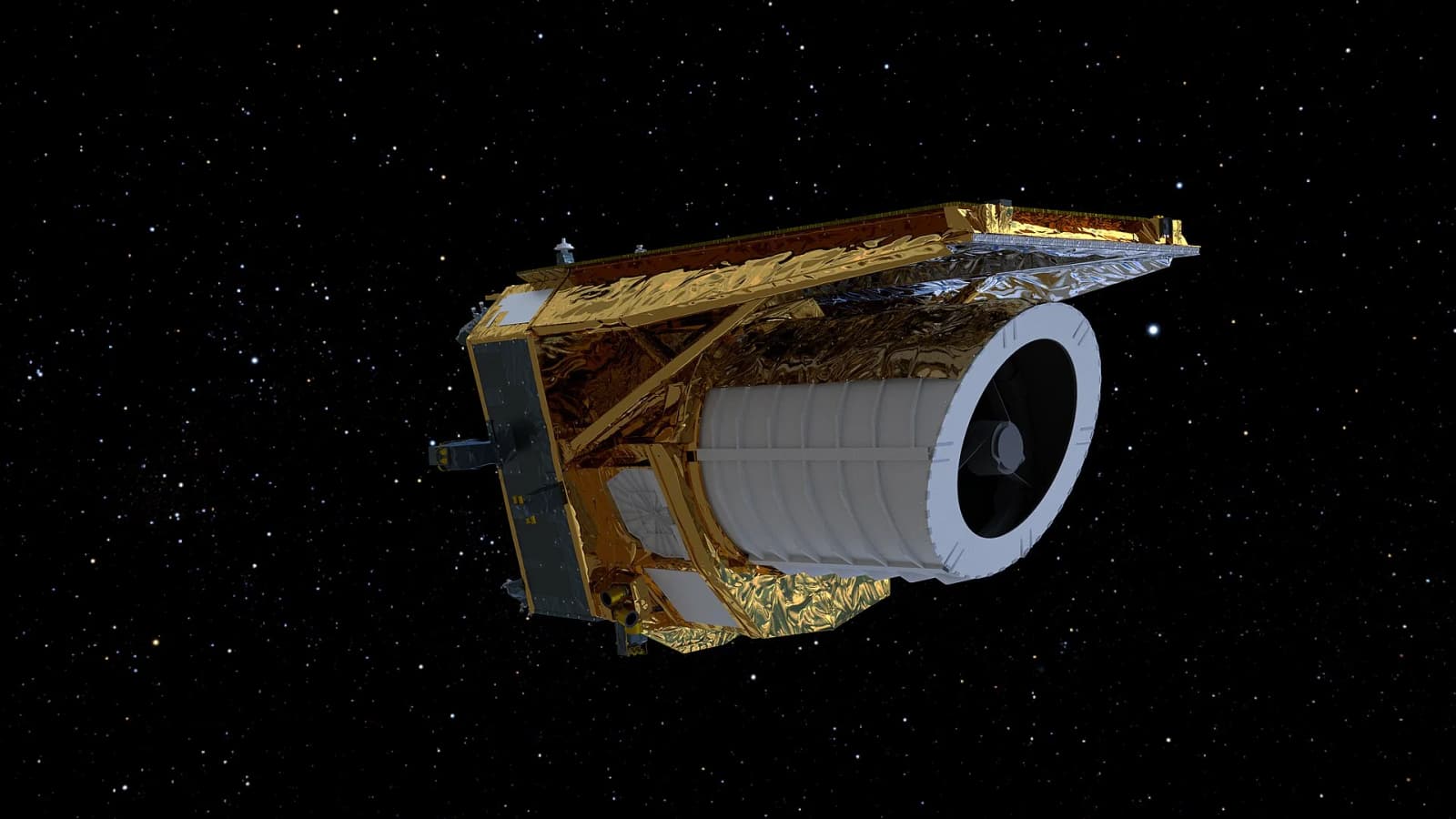
The European Space Agency has released the first major batch of science data from its Euclid space telescope, a vast catalogue covering more than a billion objects that will serve as the groundwork for the mission's three-dimensional map of the Universe. ESA announced the release, called DR1-Foundation, on 12 November 2026.
What is in the release
The dataset draws on roughly 13 months of observations and is the first major data release since Euclid launched in July 2023, ESA said. It records light from more than a billion objects over a patch of sky equal to about 9,500 full Moons, and includes raw data, calibrated images, catalogues, spectra and large sky mosaics.
According to ESA, the release contains more than 900 million galaxies, over 60 million quasar candidates and spectra from more than 160 million sources. Results from the telescope's wide survey cover 1,900 square degrees of sky, and the total data volume is about 1.7 million gigabytes. By comparison, the previous release spanned around 60 square degrees gathered over a few days.
Even so, DR1-Foundation represents only about 14% of the total sky area that Euclid will eventually survey.
A record haul of cosmic lenses
One standout is a catalogue of about 15,000 strong gravitational lensing candidates, which ESA describes as the largest ever compiled and bigger than all earlier catalogues put together. ESA says only about one galaxy in several thousand acts as such a lens. They allow scientists to weigh individual galaxies, including their dark matter, and to study how fast the Universe is expanding.
The lenses were found using machine learning together with thousands of volunteers in the Space Warps citizen science project on the Zooniverse platform. Natalie Lines of the University of Portsmouth, a member of the Euclid Consortium, recalled that the team had predicted more than a decade ago that Euclid would transform the search for such lenses.
Quasars and young clusters
Euclid is also building a census of quasars across cosmic history and has spotted some from a time when the Universe was about 5% of its present age, ESA said. The release includes protoclusters, the early forerunners of today's galaxy clusters, and faint light spread between galaxies detected in hundreds of clusters.
ESA Director of Science Carole Mundell called the release a scientific milestone that goes well beyond attractive images, while Euclid project scientist Valeria Pettorino highlighted that it spans more than a year of data over a much larger area than before.
Why it matters
Euclid's goal is to investigate dark energy and dark matter by tracing the last 10 billion years of cosmic history. Measuring the positions and distances of huge numbers of galaxies lets astronomers reconstruct the cosmic web in three dimensions.
The mission is led by ESA, with contributions from its member states and NASA, which supplied detectors for the Near-Infrared Spectrometer and Photometer. The Euclid Consortium brings together more than 2,000 scientists from about 300 institutes in 15 European countries, the United States, Canada and Japan. The data can be explored through ESA's Euclid Data Space platform.
What next
ESA says the full DR1 release is due in mid-2027 and will add weak lensing measurements, galaxy cluster information and analysis of how galaxies and clusters fit into the cosmic web. Scientists will also use hydrogen-alpha signals in the spectra to pin down galaxy distances and map the Universe's 3D structure.
PS · European Space Agency, CC BY-SA 3.0 IGO