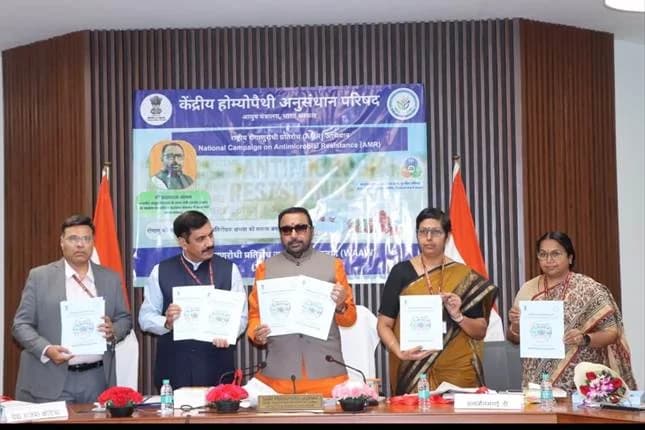
Antibiotics are not needed for every illness and do not work against viral infections such as the common cold and flu, Union Minister Prataprao Jadhav said in New Delhi on 19 November 2026 as the Central Council for Research in Homoeopathy (CCRH) held a National Campaign on Antimicrobial Resistance (AMR). The council, which works under the Ministry of Ayush, used the event to launch a dedicated AMR webpage and a bilingual awareness booklet, according to an official release issued through the Press Information Bureau.
The campaign ran under the theme "One Health, One Action: Prevent AMR Now" with the tagline "Act Together. Fight AMR. Protect the Future." Participants also took an AMR pledge committing to responsible use of antimicrobial medicines.
What is antimicrobial resistance?
Antimicrobial resistance is what happens when bacteria, viruses, fungi and parasites stop responding to the medicines meant to kill them, so infections become harder to treat. The release describes AMR as a significant public health challenge that needs coordinated action across human health, animal health, agriculture and the environment, an approach known as One Health.
What should people do differently?
The key message for households is simple: do not take antibiotics without a doctor's advice. Jadhav, who is Minister of State (Independent Charge) for Ayush and Minister of State for Health and Family Welfare, said self-medication, using leftover medicines and taking antibiotics without medical advice all add to the AMR problem. He repeated Prime Minister Narendra Modi's message from his Mann Ki Baat broadcast of 28 December 2025: "Do not take antibiotics without a doctor's advice."
He set out four priorities:
- using antibiotics only on prescription and completing the full course;
- preventing infections through clean drinking water, hand hygiene, sanitation, food safety and vaccination;
- boosting research, laboratory infrastructure and surveillance; and
- building AMR and rational use of medicines into medical education and the training of health workers.
What role does the Ayush ministry see for itself?
Alarmelmangai D., Joint Secretary in the Ministry of Ayush, said the ministry could contribute significantly through its research institutions, clinical networks and academic work. She said CCRH has moved its AMR awareness activities from annual observances to a sustained, structured national campaign. Dr Subhash Kaushik, Director General of CCRH, outlined the council's work on research, awareness, capacity building and collaboration on AMR.
Dr Preetha Kizhakkuttil, Advisor (Homoeopathy) in the ministry; Dr Tarkeshwar Jain, Chairperson of the National Commission for Homoeopathy; and Dr K. C. Muraleedharan, Deputy Director General of CCRH, were among those present.
Why it matters now
The campaign comes in a week of closer attention to antibiotic misuse. On the same day, MapMyTimes reported that the Union Health Ministry has proposed bringing antimicrobials under central regulatory oversight, and a WHO Europe–ECDC report found that key antibiotics are failing against two hospital bacteria in about half of reporting European countries.
The release did not give the address of the new CCRH webpage or say how the booklet will be distributed. According to the ministry, the new materials are meant to improve access to reliable information and encourage responsible use of antimicrobials.