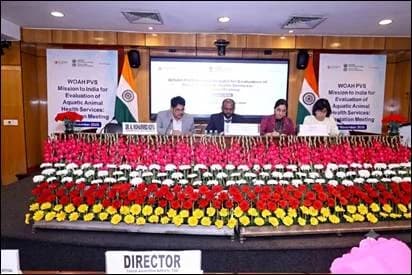
A team from the World Organisation for Animal Health (WOAH) on 26 November 2026 began an independent evaluation of how India protects the health of fish and other farmed aquatic animals, starting with an orientation meeting at the National Agricultural Science Complex in New Delhi. The Department of Fisheries, part of the Union Ministry of Fisheries, Animal Husbandry and Dairying, said in a press release that the exercise is a WOAH Performance of Veterinary Services (PVS) Evaluation of India's Aquatic Animal Health Services.
What is the WOAH PVS evaluation?
It is an outside review that checks a country's animal health system against international standards and points out where it needs strengthening. WOAH describes its PVS Pathway as its main capacity-building programme for national veterinary and aquatic animal health services, and calls it voluntary and driven by the country concerned. More than 140 countries have taken part, according to WOAH. For aquatic animal health, WOAH uses a separate tool that covers 47 "critical competencies".
The ministry said the India evaluation will look at four core areas: human, physical and financial resources; technical authority and capability; engagement with stakeholders; and regulatory capability and market access.
Who attended the opening meeting?
The meeting was chaired by Gunjan Krishnan, Joint Secretary (Inland Fisheries) in the Department of Fisheries, who is also WOAH's national focal point for aquatic animals in India. Others on the dais included Dr J. K. Jena, Deputy Director General (Fisheries Science) at the Indian Council of Agricultural Research (ICAR); K. C. Devasenapathi, Secretary of the Coastal Aquaculture Authority; Ana Luisa da Silva Afonso, who leads the WOAH mission; and K. Mohammed Koya, Fisheries Development Commissioner.
Representatives of ICAR fisheries institutes, state fisheries departments, the Marine Products Export Development Authority (MPEDA), the Export Inspection Council, the Food Safety and Standards Authority of India (FSSAI), the Bureau of Indian Standards (BIS) and the Department of Animal Husbandry and Dairying also took part, the ministry said.
According to the release, Krishnan outlined the institutional, legislative and regulatory framework India uses to manage aquatic animal health, while Afonso said the evaluation would help India identify priorities and draw up strategic plans in line with WOAH standards.
What will the mission inspect?
The WOAH experts will visit aquaculture farms, fisheries establishments, research institutes, aquatic animal disease diagnostic laboratories and quality control facilities in several states between 27 November and 9 December 2026, the ministry said. The orientation session covered research, disease surveillance, training, trade facilitation, export quality assurance, food safety, regulatory compliance, and standards for aquaculture inputs and feed.
Why does it matter?
For the government, the review is about disease control and seafood trade. The ministry said it expects the evaluation to help pinpoint where to build capacity and invest, improve disease prevention and surveillance, strengthen joint work under the One Health approach, which links human, animal and environmental health, and raise confidence among India's trading partners in international seafood trade.
What is confirmed and what is not yet known?
Confirmed: the mission began on 26 November with the Delhi meeting, and field visits are scheduled from 27 November to 9 December. Not yet known: the ministry has not named the states or sites the team will visit, and it has not said when the findings will be ready. Under WOAH's rules, a PVS report is endorsed by the country, and whether it is made public depends on that country's preference.
What happens next?
After the field visits end on 9 December, the evaluation is expected to feed into India's priorities for strengthening aquatic animal health services. On WOAH's pathway, an evaluation can be followed by a planning stage, including a gap analysis that sets costed targets, and by targeted support in areas such as laboratories and legislation, if the country chooses to take those steps.
Photo source · Press Information Bureau, GODL-India