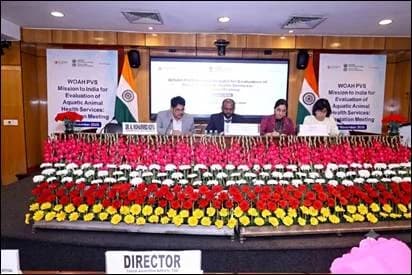
The Food Safety and Standards Authority of India (FSSAI) on 26 November 2026 showed children how to check everyday food for adulteration using portable testing kits, at a demonstration held at Bharat Mandapam in New Delhi. The event was hosted by the India Trade Promotion Organisation (ITPO), according to a report by news agency ANI.
FSSAI officials used the session to present two of the regulator's outreach tools: the "Food Safety on Wheels" mobile testing initiative and the "Food Safety Magic Box", a compact kit designed for simple tests outside a laboratory.
What is the Food Safety Magic Box?
The Food Safety Magic Box is a portable kit that lets users run basic sensory and chemical checks on common food items to spot possible adulteration. Speaking at the demonstration, FSSAI Technical Officer and Scientist S Ajay Vino said the kit can be used to test 107 different food samples across seven categories and can be carried anywhere. He said the regulator takes the box to schools to build basic awareness and to teach children how to check their food.
The kit is not new. In a press release dated 14 October 2023, FSSAI said it had handed 36 Magic Boxes to the winning students of the National Science Seminar on Millets, organised with the National Science Centre in New Delhi. That release explained the thinking behind the kit: laboratory methods are accurate and reliable but can be expensive and slow, so the regulator wanted quick screening tests that an ordinary person could carry out at home when in doubt about a food item.
How does Food Safety on Wheels work?
Food Safety on Wheels is a mobile testing initiative that FSSAI uses to take awareness drives and quick food checks to areas without nearby laboratories. Mrityunjay Anand, a Technical Officer in FSSAI's Quality Assurance Division, said at the event that the programme was started about five to six years ago and that its main purpose is awareness and outreach, especially in remote villages that lack proper testing facilities.
He added that the vans allow members of the public to get food samples tested quickly, and that they also support field surveillance by helping the regulator identify adulteration hotspots.
Why does it matter?
Adulteration remains a recurring concern for Indian consumers. District food safety officials have recently reported cases such as raids in Morena, Madhya Pradesh, that flagged excess lead in ghee. Tools that let families and students run simple first-level checks are meant to complement, not replace, formal laboratory testing.
The demonstration came on the same day the Supreme Court of India directed FSSAI to introduce separate "High Fat", "High Sugar" and "High Salt" warning labels on packaged foods, a ruling that puts the regulator's consumer-information role in sharper focus.
What is confirmed and what is not
The ANI report confirms the date, venue, organisers, the two initiatives and the officials' statements. It does not say how many children took part, which specific food tests were shown, or whether similar demonstrations will be repeated at the venue. FSSAI had not issued its own release on the event at the time of writing.
What happens next?
FSSAI officials indicated that the Magic Box will continue to be taken to schools as part of the regulator's awareness work, while Food Safety on Wheels vans remain in use for outreach and field surveillance. Shoppers who suspect adulteration can still approach their local food safety officer for formal sampling and laboratory analysis.
Photo source · Jakub Hałun, CC BY-SA 4.0