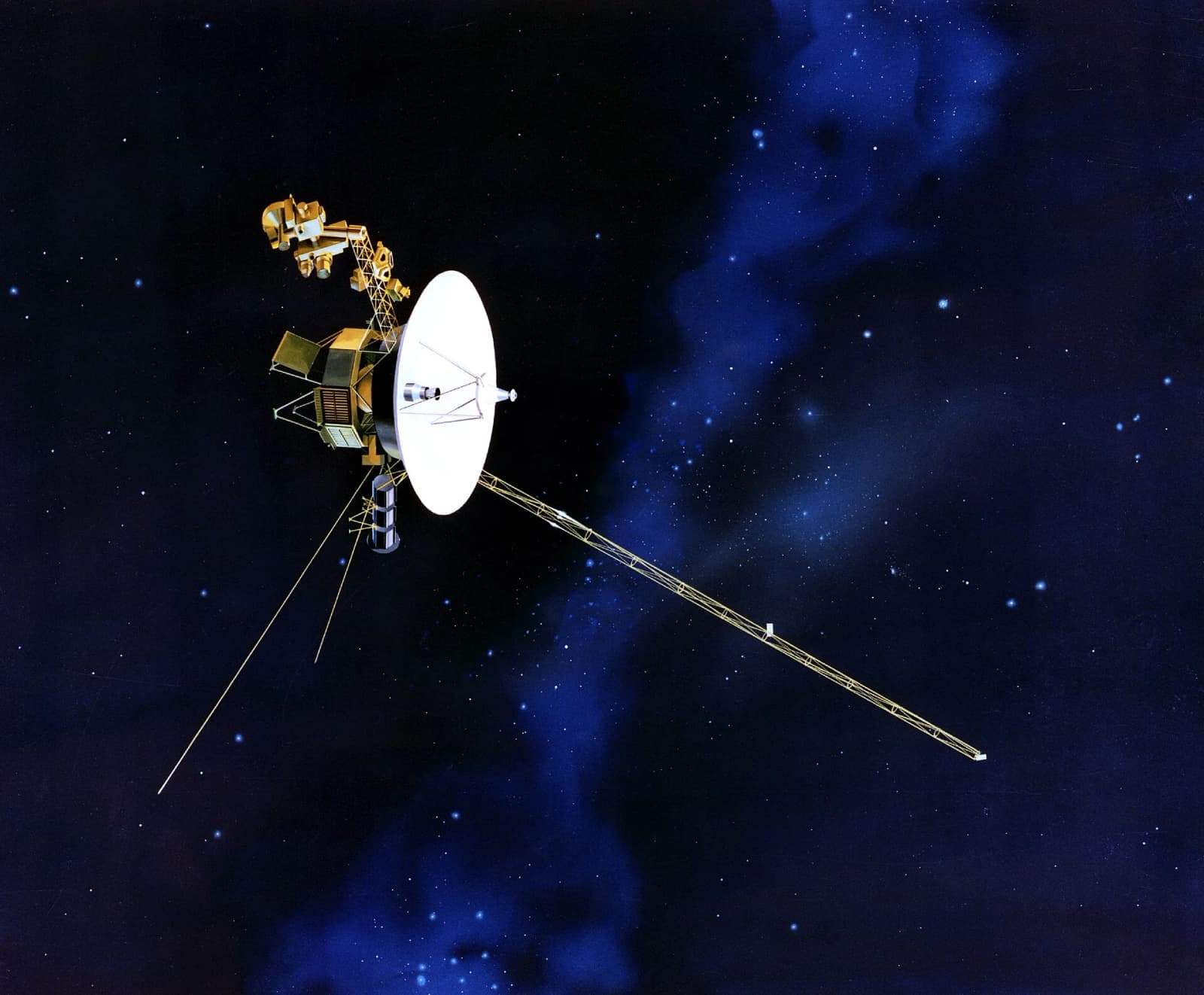
NASA's Voyager 1, launched in 1977 and already the most distant object ever built by humans, is set to pass a new marker on Wednesday, 18 November 2026: it will be one full light-day away from Earth. From that point, a radio signal travelling at the speed of light will need 24 hours to cover the gap between the spacecraft and its controllers.
The space science site EarthSky, citing NASA's timing, puts the crossing at about 10:16 UTC on 18 November, which is roughly 3:46 pm in India. One light-day is about 25.9 billion km (16.1 billion miles), or a little over 173 times the average distance between Earth and the Sun.
What changes, and what does not
Nothing physical happens to the spacecraft at the one light-day line. The milestone is about communication. According to material from NASA's Jet Propulsion Laboratory (JPL) published by ScienceDaily on 3 November, a command and its confirmation will together take about 48 hours once Voyager 1 is this far out. The probe is moving through interstellar space at roughly 61,000 km per hour, JPL said, and no other human-made object has travelled as far.
Voyager 1 lifted off on 5 September 1977, flew past Jupiter and Saturn, and in 2012 crossed the heliopause, the boundary where the Sun's influence gives way to interstellar space, EarthSky noted. It has taken the craft just over 49 years to reach one light-day.
An ageing probe kept alive by power-saving
Both Voyagers run on radioisotope generators whose output falls as their plutonium decays. JPL said each spacecraft loses about 4 watts of generating capacity a year, forcing engineers to switch off equipment that is not essential. Voyager 1 left Earth with 10 science instruments; EarthSky reported that in April 2026 NASA turned off its Low-Energy Charged Particle instrument, which measured electrons, ions and cosmic rays, though it could be switched on again later.
In early September, the JPL account said, engineers carried out an operation nicknamed the "Big Bang", swapping three devices that help regulate temperature for lower-power alternatives in a single step. The change followed an identical procedure on Voyager 2 about six weeks earlier and is expected to extend the life of Voyager 1's remaining instruments. Without it, another instrument might have had to be shut down as early as mid-2027.
A scare in October
The run-up to the milestone was not smooth. JPL said NASA's Deep Space Network failed to pick up Voyager 1's signal on two scheduled attempts on 18 and 19 October, before contact returned on 20 October. Engineers found that one set of thrusters had stopped working and that the spacecraft's fault-protection system had switched it to backup thrusters. The cause had not been established at the time of the release.
Voyager mission manager Kareem Badaruddin of JPL said in that release that with a spacecraft this old the team has "to expect the unexpected".
A Morse-code send-off from Earth
NASA is marking the occasion with a public event called "Shine Bright". People are invited to flash the letters V-G-R, for Voyager, in Morse code towards the sky after sunset on Tuesday, 17 November, using a torch, phone or any other light, EarthSky reported. NASA has also put out an automated flasher for those who do not want to tap out the code by hand.
What comes next
Voyager 1 keeps moving outward, and its remaining instruments continue to send data from a region where no other mission is taking measurements, JPL said. Its twin, Voyager 2, which is about 3.2 billion km closer to Earth, is projected by NASA to reach one light-day only in November 2035, according to EarthSky.