Europe's Hera spacecraft has reached the double asteroid system that NASA deliberately struck in 2022, and has sent back its first close-up picture of the pair, the European Space Agency (ESA) said in a release published on 16 November 2026.
Hera travelled for two years to reach Didymos and its small moon Dimorphos, which ESA said are currently 196.8 million km from Earth. The image was taken with the probe's black-and-white Asteroid Framing Camera.
What the first image shows
The larger body, Didymos, about 780 metres across, is clearly visible. ESA said the picture shows a ridge running along its equator, a scattering of boulders and craters, and features that look like grooves or ridges. Dimorphos, roughly 151 metres wide, is mostly hidden in shadow in this view.
The side of Didymos that Hera photographed is not the one seen by the camera on NASA's DART spacecraft in the moments before its impact, the agency noted.
"The first thing we said was wow!" said Patrick Michel, Hera's principal investigator and a research director at CNRS and the Observatoire de la Côte d'Azur, in the ESA release. Mission manager Ian Carnelli called the image "a hugely exciting moment for the whole Hera family".
Why Hera was sent
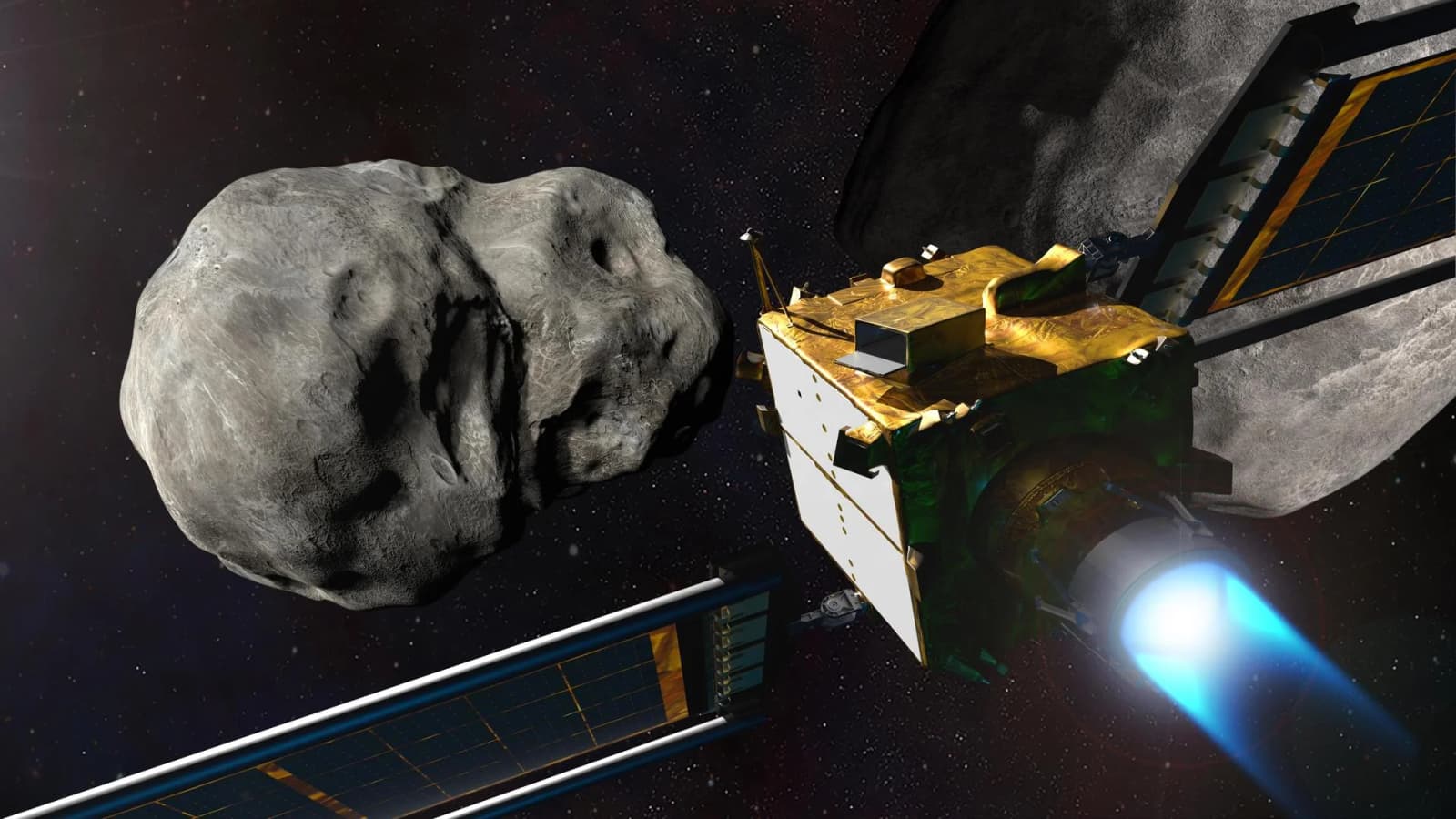
On 26 September 2022, NASA's 580-kg DART spacecraft hit Dimorphos at about 6.1 km per second. According to ESA, the collision shortened the time Dimorphos takes to circle Didymos by about 33 minutes, more than scientists had expected. It was the first time human activity measurably changed the orbit of a body in the Solar System.
Hera's job is what ESA describes as a "crash site investigation": measuring what the impact did and the physics behind the orbit change, so that striking an asteroid to nudge it off course can become a repeatable planetary-defence technique.
The two asteroids are only about 1 km apart, and scientists think some of the debris thrown up by DART may have landed on Didymos. ESA's Hera mission scientist Michael Kueppers said some of the surface features could come from material carried over from Dimorphos, and that the team plans to map such changes systematically.
What happens next
ESA said its next major release is scheduled for 25 November 2026, when detailed images of both Didymos and Dimorphos are due to be published. The findings in the current release are the agency's first observations and have not been presented in a journal paper.
PS · NASA/Johns Hopkins APL/Steve Gribben