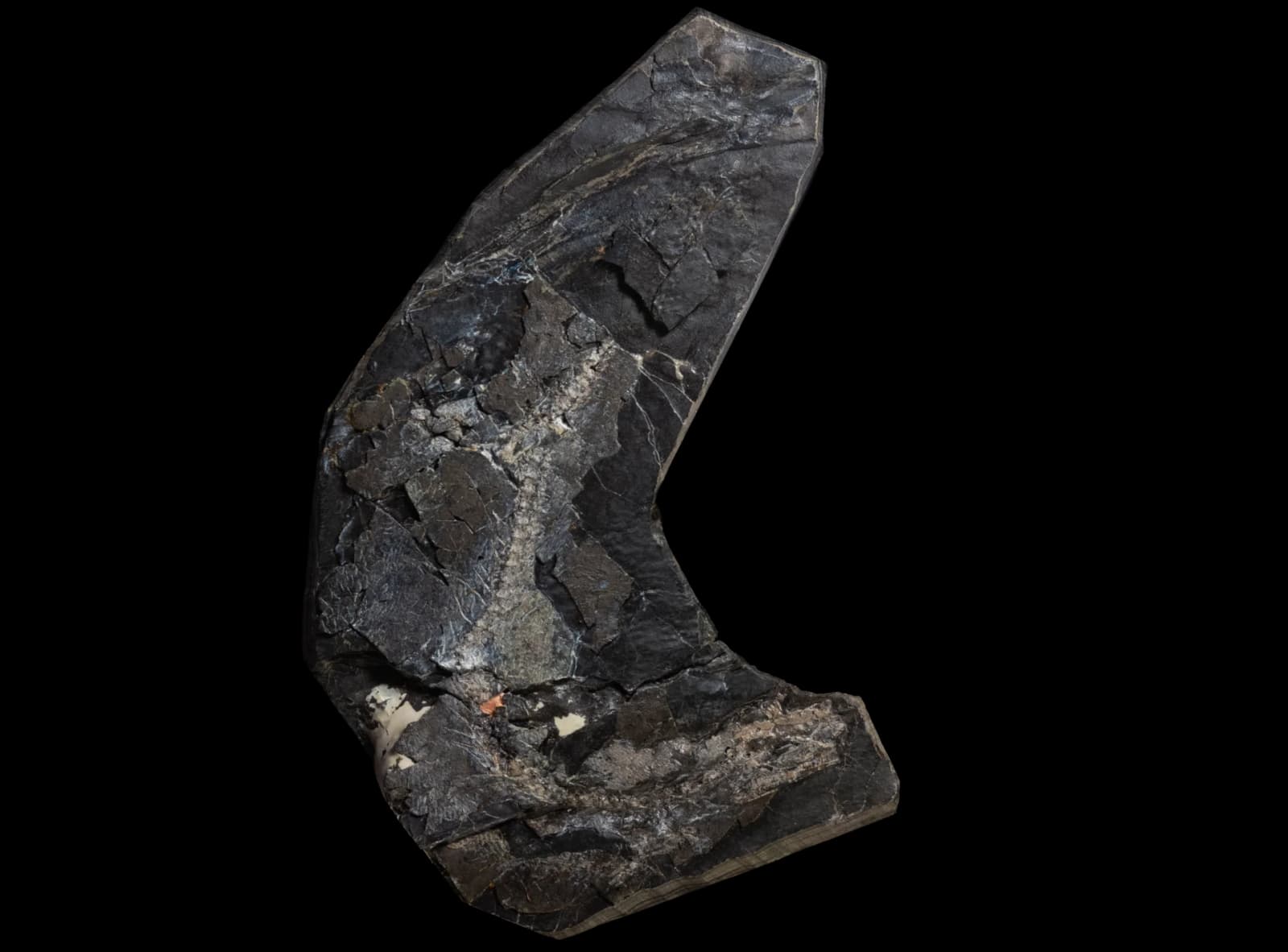
High-energy synchrotron X-ray imaging has overturned nearly three decades of evolutionary consensus surrounding Westlothiana lizziae, a 345-million-year-old Scottish fossil nicknamed 'Lizzie' that was long celebrated as one of the earliest land-adapted reptiles.
Published in Nature (DOI: 10.1038/s41586-026-11090-6), the study was co-led by Ben Igielman of the University of Oxford and Xavier Jenkins and Roger Benson of the American Museum of Natural History, alongside researchers from the European Synchrotron Radiation Facility (ESRF), Cambridge, and the Natural History Museum in London.
Inside the Crushed Slabs of 'Lizzie'
Discovered in 1984 and formally described in 1990 from two flattened rock slabs, Westlothiana exhibited four limbs and five-digit hands and feet with claw-like tips, leading scientists to place it near the dawn of amniotes—the vertebrate clade comprising reptiles, birds, and mammals.
Scanning inside the rock at the ESRF in Grenoble, France, allowed scientists to reconstruct buried skull bones and soft-tissue-linked structures without damaging the specimen.
- Revealed a primitive skull morphology incompatible with early amniote ancestry.
- Uncovered ossified internal gills indicating water breathing and an aquatic or amphibious lifestyle.
- Exposed a fish-like mouth lined with thousands of tiny teeth, placing Lizzie on the deeper stem-tetrapod lineage before the reptile-amphibian split.
Rethinking Devonian Footprints and Land Origins
Co-author Roger Benson said the findings prove reptile-like limbs, weight-bearing forelimbs, and clawed toes evolved piecemeal in water-dependent tetrapod relatives rather than exclusively after animals colonised dry land.
The reclassification also casts doubt on recent claims that Devonian fossil trackways dating back over 359 million years prove an ancient origin for true amniotes, since amphibious stem tetrapods like Westlothiana already possessed clawed five-toed feet capable of leaving similar prints.