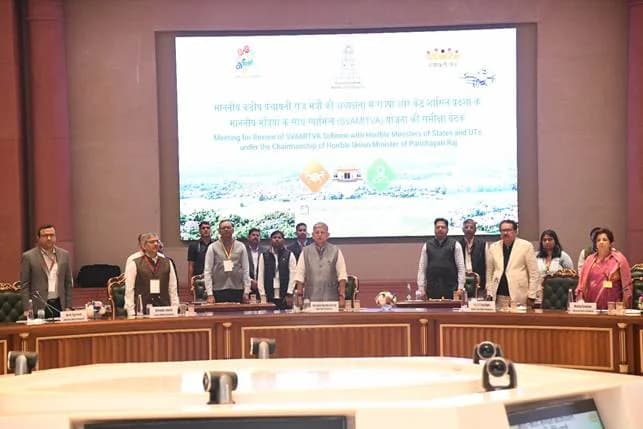
Union Minister of Panchayati Raj Rajiv Ranjan Singh, also known as Lalan Singh, on 20 November 2026 asked states to draw up time-bound action plans so that the SVAMITVA rural property-card scheme reaches full coverage by 31 March 2027. He made the call at a review meeting in New Delhi attended by ministers from nine states, according to a release from the Ministry of Panchayati Raj.
The ministry said drone surveys have now been completed in 3.28 lakh of the 3.33 lakh villages targeted, and 3.47 crore property cards have been generated for 2.20 lakh villages.
What is SVAMITVA and who does it help?
SVAMITVA is a central scheme that gives households in the inhabited (abadi) areas of villages a legal record of the land and houses they occupy. Launched by Prime Minister Narendra Modi on 24 April 2020, it uses drones and geographic information system (GIS) mapping to fix property boundaries, after which states issue property cards to owners.
At the meeting, Singh said banks now accept these cards as collateral, letting rural families take loans against their homes, start businesses and depend less on costly informal lenders. He also said clear titles were reducing land disputes and helping women gain economic security.
How far has the scheme progressed?
The scheme is close to finishing its mapping work but further behind on getting documents into people's hands. The ministry's figures show:
- Drone surveys: 3.28 lakh villages, or 98% of the target
- Village maps handed to states: 3.17 lakh villages (95%)
- Ground verification by states: 2.69 lakh villages (81%)
- Maps put up for objections and claims: 2.46 lakh villages (74%)
- Property cards generated: 3.47 crore cards covering 2.20 lakh villages (66%)
The gap between the 98% survey figure and the 66% card figure is the work that now falls to state revenue departments, which must verify maps on the ground, hear objections and then print and distribute cards.
Are the property cards being used for loans?
Yes, though on a modest scale so far. The ministry said 16,614 loans worth ₹1,769.56 crore have been taken against SVAMITVA property cards in Madhya Pradesh, Rajasthan, Maharashtra, Gujarat, Mizoram, Jammu and Kashmir, and Ladakh.
Minister of State for Panchayati Raj S P Singh Baghel said the cards had given rural households a record of rights, opened access to institutional credit and helped cut down land quarrels. He asked states to finish the remaining drone surveys and card distribution in mission mode.
What else are states being asked to do?
Beyond property cards, Singh urged states to use the high-resolution spatial data produced under the scheme to estimate solar potential, plan drainage networks and carry out spatial planning in gram panchayats. He said this would strengthen Gram Panchayat Development Plans and help villages plan works according to need.
State representatives told the meeting that the GIS maps were already being used to improve property tax assessment and to plan drainage, street lighting and solar installations, the ministry said. They assured the Centre that pending surveys and verification would be speeded up.
The question of village councils' own income is a live one: a recent Reserve Bank of India study found that gram panchayats rely on government transfers for about 90% of their receipts, and better property records can feed into local tax assessment.
What happens next?
The meeting, also attended by Panchayati Raj Secretary Vineet Joshi and officials from the Survey of India, ended with the Centre and states agreeing to work in closer coordination. The ministry has not published a state-wise breakdown in its release, so it is not yet clear which states are furthest behind the March 2027 deadline. With a third of target villages still without generated cards, the next four months will test whether states can match the pace of the drone surveys.