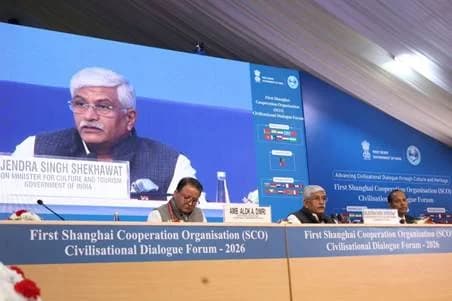
Union Minister of Culture and Tourism Gajendra Singh Shekhawat said on 21 November 2026 that shared cultural heritage is a strong bridge between the member countries of the Shanghai Cooperation Organisation (SCO), as the first SCO Civilisational Dialogue Forum entered its second day at Purana Qila in New Delhi. Ministers from Azerbaijan, Nepal, Pakistan and Tajikistan were among those who spoke at the sessions, according to a Ministry of Culture release issued through the Press Information Bureau (PIB).
What did Shekhawat tell SCO delegates?
Shekhawat said historical connections have played a major part in bringing countries closer and showed how much cultural cooperation can do to build understanding, trust and friendship. Chairing the first two joint sessions on 'Civilizational and Cultural Expressions', he described the civilisations of the region as living traditions rather than relics of the past, and called for shared heritage to be used for joint work through dialogue, institutional partnerships and cultural exchanges.
He linked the day's discussions to the Vedic prayer "Om Sangachchhadhwam Samvadadhwam Sam Vo Manamsi Janatam", which, the ministry said, Prime Minister Narendra Modi had cited a day earlier. Shekhawat said he expected the forum to become a lasting platform for ties among SCO members. Culture Secretary Vivek Agrawal gave the welcome address.
What did Pakistan's minister say about Purana Qila?
Pakistan's Federal Minister for Climate Change and Environmental Coordination, Dr Musaddiq Masood Malik, said the fort where delegates were meeting was itself a story, according to the release. He noted that its foundation was laid by Humayun of the Timurid dynasty, who came from Central Asia, and that the work was carried forward by Sher Shah Suri, who came from Afghanistan, so a single wall carried the art of two rulers and two traditions.
Malik welcomed the description of the event as 'Tehzeeb Ki Guftagu', or dialogue of civilisations, and said distinct identities matter while dialogue among them is equally essential. He also referred to a conversation with Shekhawat on the previous day.
Who else took part?
Azerbaijan's Culture Minister Adil Karimli, Nepal's Minister for Culture, Tourism and Civil Aviation Khadga Raj Poudel and Tajikistan's Culture Minister Matlubakhon Amonzoda Sattoriyon also shared their views. The ministry said representatives from Belarus, Iran, Kazakhstan, Cambodia, Kyrgyzstan, Laos, Russia, Saudi Arabia and Uzbekistan, among other countries, took part.
Summing up the first session, Alok Dimri, Additional Secretary in the Ministry of External Affairs and India's National Coordinator for the SCO, said a clear message had emerged that the grouping needs to move beyond a security-centred approach. He listed cultural networks, climate, youth, digitalisation and joint projects as common themes, and said culture should be taken beyond state institutions and closer to people.
Art, architecture and trade routes
Afternoon sessions on shared aesthetics in art and architecture were chaired by Yadubir Singh Rawat, Director General of the Archaeological Survey of India (ASI). Azerbaijan's Deputy Minister of Culture Sadat Yusifova was the special speaker. A later session, titled 'Trade: Merchants, Monks and Monarchs', looked at how trade routes, travellers, Buddhist monks and rulers linked regions and shaped their cultures. Academics from Delhi University, Jawaharlal Nehru University and the Indian Council of World Affairs also presented.
Delegates then visited the exhibition 'The Light and the Lotus: Relics of the Awakened One' at the Rai Pithora Cultural Complex. The day ended with a cultural performance and a dinner hosted by the Culture Secretary.
What happens next?
The forum, for which the Indira Gandhi National Centre for the Arts (IGNCA) is the knowledge partner, runs until 22 November. Prime Minister Modi opened it on 20 November. The ministry says its aim is to strengthen cultural ties among SCO members and create new openings for cultural dialogue.
Photo source · PIB