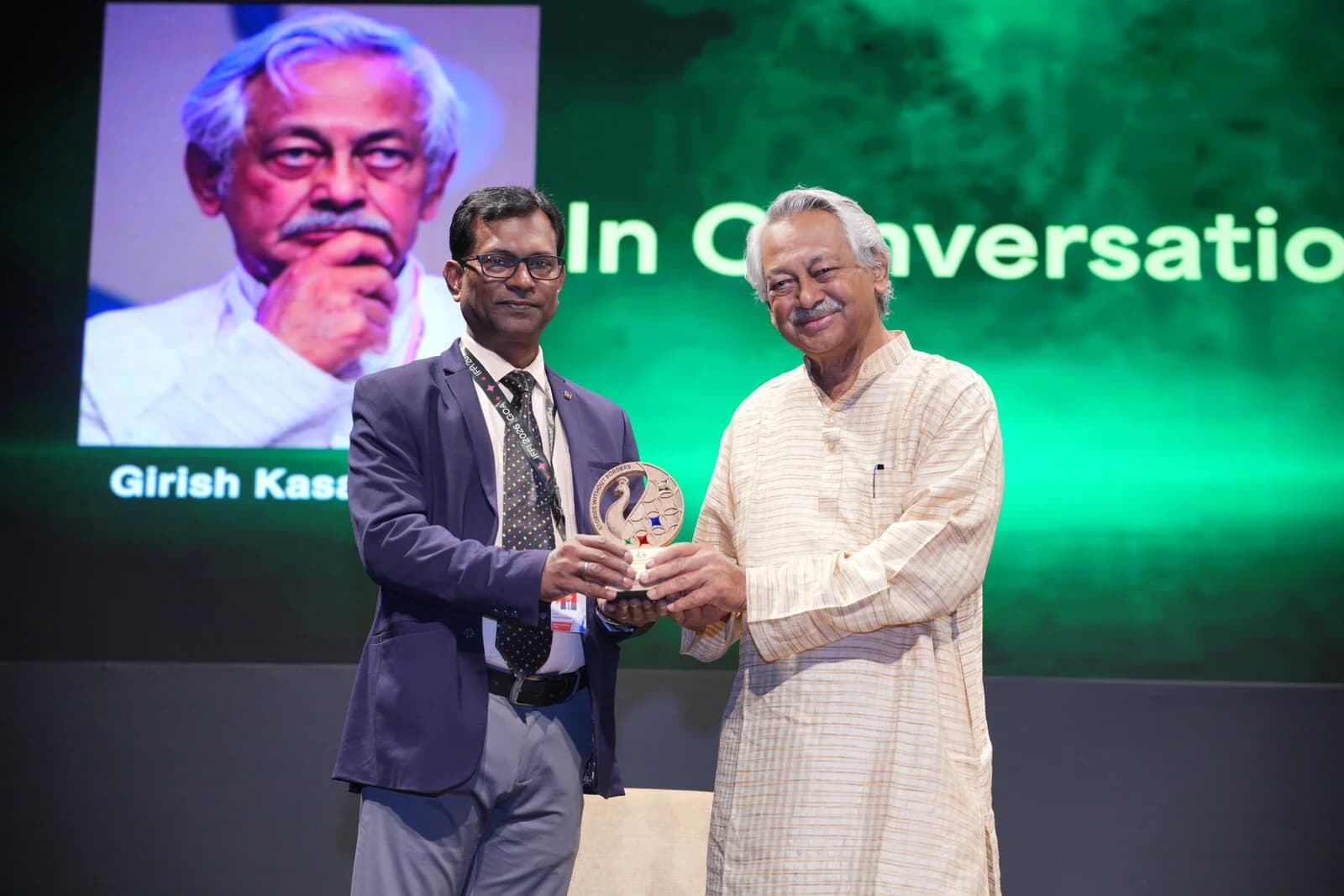
Kannada filmmaker Girish Kasaravalli told an audience at the 57th International Film Festival of India (IFFI) in Goa on 21 November 2026 that "there is nothing called 'only entertainment'", arguing that every film either endorses or challenges the dominant ideas of its society. He was speaking at an 'In Conversation' session titled 'The Moral Universe of Parallel Cinema: 50 Years of Girish Kasaravalli' at Kala Academy in Goa, according to a release issued by the Press Information Bureau (PIB).
The session, moderated by film journalist and critic Naman Ramachandran, looked back at five decades of work by the 14-time National Film Award winner, from his 1977 debut Ghatashraddha to Tabarana Kathe, Thaayi Saheba and Dweepa.
What did Kasaravalli say about cinema and politics?
Kasaravalli said even entertainment is a political form, and that filmmakers cannot stay neutral on the social order they depict. "There is nothing called 'only entertainment'. Even entertainment is a political form," he said, according to PIB.
He named 'othering' — the way a society pushes vulnerable groups to the margins through caste, social hierarchy or religious dominance — as the concern that runs through his films. Asked by the moderator whether Ghatashraddha, made almost 50 years ago, still speaks to India today, he replied that all his films are about othering, Variety reported.
Why does he refuse to give easy verdicts in his films?
Kasaravalli said a film should leave the audience thinking rather than hand down a ruling. Citing the late Kannada writer U.R. Ananthamurthy's habit of ending every answer with a 'but', he said: "To say through a film that 'this is right, this is wrong' itself is wrong. I don't make easy judgments, because that forces the audience to think."
On style, he said form must grow out of the material. "Style is not imposed on a film; it comes from within the content itself," he said, adding that "the vision of the story" mattered more than its plot.
Women, scripts and 'imperfect cinema'
The conversation also turned to the women in his films. Recalling Nagi, the protagonist of Dweepa, he quoted her line "Let me make the present pleasant" and said women often show a remarkable ability to adapt to changing and uncertain circumstances.
On his working method, Kasaravalli said he prefers detailed scripts to storyboards so that collaborators can realise what he imagines. "Cinema is germinated in my mind, but it is executed by others," he said.
He closed by invoking the Cuban filmmaker Julio García Espinosa's idea of 'imperfect cinema' and urged Indian filmmakers to stay rooted in their own culture rather than chase standards set elsewhere. "Why should I be 'perfect' by someone else's standards? I should be loyal to my own milieu," he said.
Why this session matters
Kasaravalli is one of the central figures of the New Kannada Cinema and the parallel cinema movement that grew in the 1970s. The tribute to his 50 years in film forms part of IFFI 2026's focus on Indian film heritage, which on the same day included a centenary tribute to seven cinema figures born in 1926.
What next at IFFI?
The 57th IFFI, which opened in Goa on 20 November, runs until 28 November 2026, with screenings, masterclasses and 'In Conversation' sessions continuing at venues across Goa.