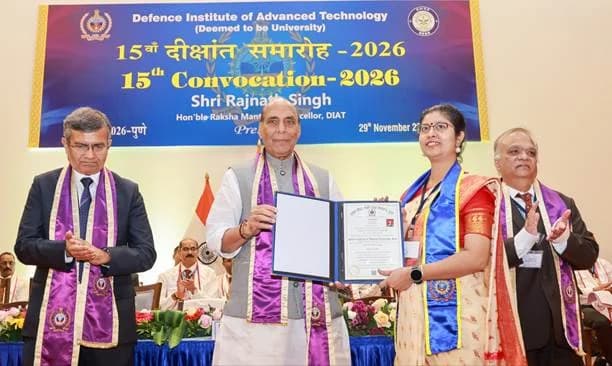
Defence Minister Rajnath Singh on 29 November 2026 urged the Defence Institute of Advanced Technology (DIAT) in Pune, Maharashtra, to grow into a modern-day 'Takshashila' for defence technology, as the institute awarded 518 degrees at its 15th convocation, the largest number in its history.
According to a Ministry of Defence release issued through the Press Information Bureau, Singh, who presided over the ceremony, also laid the foundation stone of a new academic block on the campus. DIAT is a deemed university that functions under the Department of Defence Research and Development (DDR&D).
Who received degrees at the 15th convocation?
The 518 graduates included 27 PhD scholars, one MS (by Research) scholar, 401 MTech graduates and 89 MSc graduates. The ministry said 30 of the MSc graduates specialised in tank technology, three in food technology and eight in information technology, with the remaining 48 spread across other MSc programmes.
Singh noted what he described as significant participation of women at the institute and said their growing presence in advanced science, engineering and defence technology would strengthen the country's defence research base.
What did Rajnath Singh ask DIAT to do?
He asked the institute to become a world-class centre of excellence that leads, rather than merely takes part in, the technological changes reshaping warfare. He listed artificial intelligence, machine learning, quantum computing, autonomous systems, advanced materials, cyber security, space-based capabilities and directed-energy technologies as fields that have altered how wars are fought.
"DIAT must move beyond being a participant in these technological disruptions and emerge as a leader in developing technologies for the future battlefield," Singh said, according to the release. He argued that the real challenge lies not only in building new technologies but in understanding, adopting and harnessing them quickly in line with national interests.
The minister called military strength and scientific capability two interdependent pillars of national power. "A nation that leads in technology also leads in security," he said, adding that defence research often finds uses in civilian sectors such as healthcare, agriculture, communication and transport.
Why does this matter?
The convocation came a day after Singh reviewed the passing out parade of the National Defence Academy's 151st course at Khadakwasla, where he spoke of the armed forces' shift from manpower to machine power. At DIAT, he pressed the same theme from the research side, urging the institute to attract talented researchers and scientists from India and abroad to work on futuristic technologies.
He called for deeper engagement with the armed forces, more interdisciplinary research, academic partnerships with leading global universities and stronger links with industry. He also placed responsibility for the institute's growth on its alumni, asking graduating scholars to contribute in their respective fields, and tied DIAT's role to the government's 'Viksit Bharat@2047' goal.
What will the new academic block include?
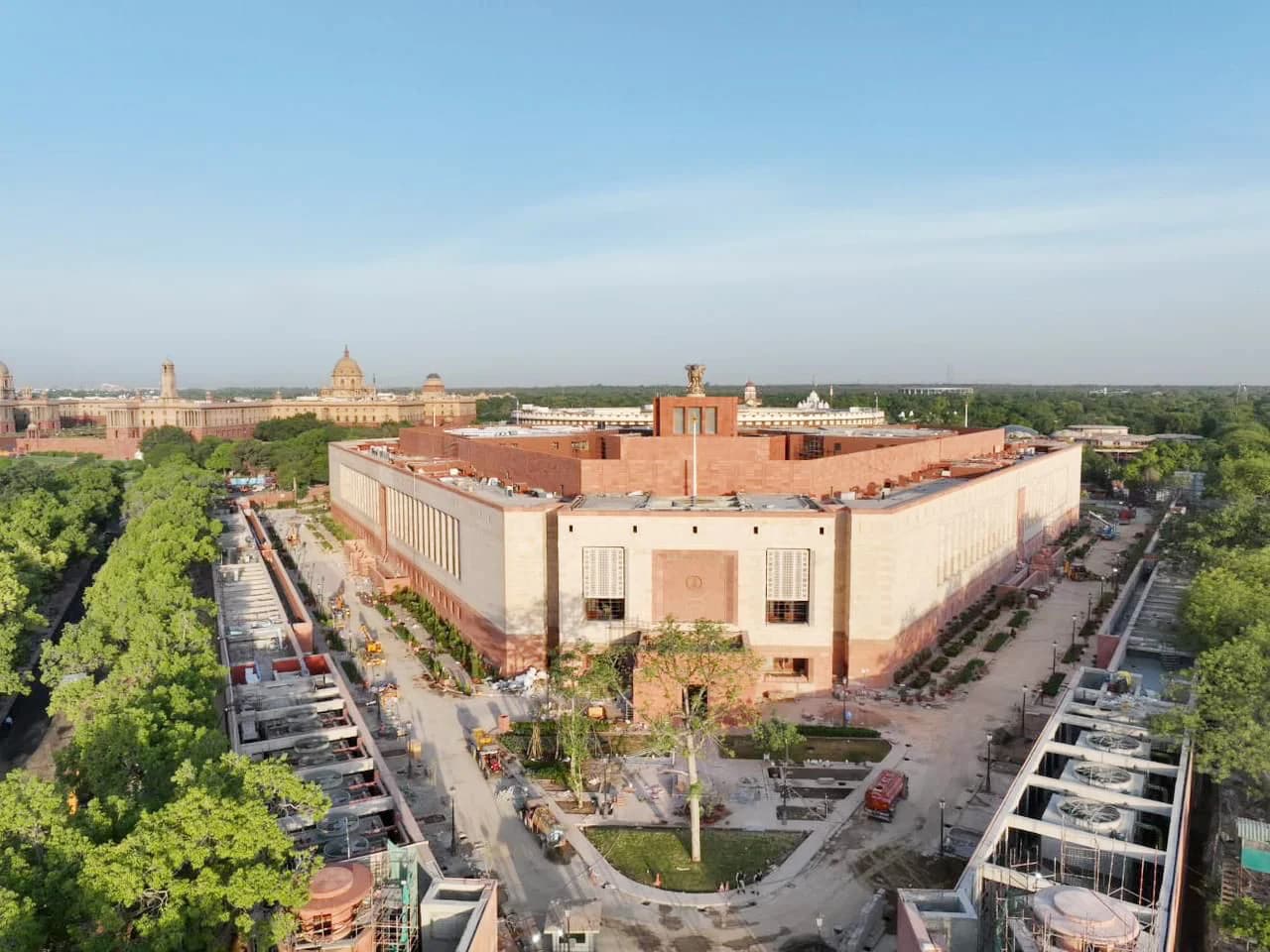
The ministry said the new complex will house modern and virtual classrooms, laboratories, research facilities, incubation centres and a seminar hall that can seat 200 students. It is meant to support the institute's expanding academic, research and technical needs. The release did not give a cost or a completion date.
Defence Secretary Rajesh Kumar Singh, who is also Secretary of DDR&D and Chairman of the Defence Research and Development Organisation (DRDO), and DIAT Vice-Chancellor Dr BHVS Narayana Murthy attended the ceremony along with senior civil and military officials and representatives of academia and industry.