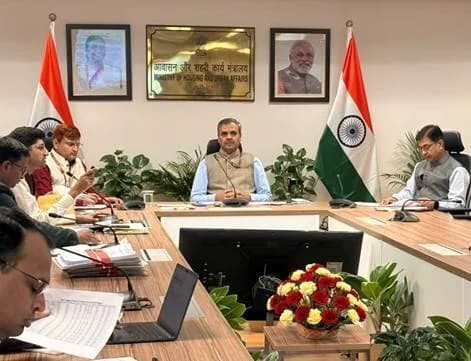
The Centre has sanctioned 1.75 lakh more urban houses under Pradhan Mantri Awas Yojana – Urban 2.0 (PMAY-U 2.0) and given in-principle approval for roughly 1.5 lakh more, the Ministry of Housing and Urban Affairs said in New Delhi on 20 November 2026. The decisions were taken at the 11th meeting of the scheme's Central Sanctioning and Monitoring Committee (CSMC) on 19 November, chaired by Satendra Singh, Secretary of the Department of Urban Development.
According to the ministry's release, the new sanctions take the total number of houses approved under PMAY-U 2.0 past 24.15 lakh.
Which states got the new houses?
Uttar Pradesh accounts for the bulk of the fresh sanctions, with 1,01,493 houses, well over half of the total. The rest were spread across ten other states and Union Territories:
- Maharashtra: 19,778
- Tamil Nadu: 14,350
- Madhya Pradesh: 10,913
- West Bengal: 10,159
- Gujarat: 5,793
- Assam: 4,841
- Rajasthan: 4,572
- Odisha: 2,681
- Puducherry: 937
- Goa: 6
These houses fall under two of the scheme's verticals: Beneficiary Led Construction (BLC), where eligible families build a house on their own land with central help, and Affordable Housing in Partnership (AHP).
What does in-principle approval mean?
It is a conditional green light rather than a final sanction. The committee cleared 1,27,349 houses for Andhra Pradesh and 22,484 for Maharashtra in principle, but only subject to the two states submitting the required compliance and following the scheme guidelines. Until that happens, these houses are not counted as sanctioned.
What did the Centre ask states to do?
The Secretary told states and UTs to speed up spending, make full use of the funds already sanctioned and release money to beneficiaries and implementing agencies on time. He also asked them to tighten monitoring, geo-tag houses and finish verifying all pending applications within the set deadlines.
States were further advised to draft comprehensive affordable housing policies and carry out the reforms required under the scheme, which the ministry said would create a better environment for low-cost housing in cities.
Why it matters
PMAY-U 2.0 was launched in September 2024 with the aim of helping one crore more urban families from the Economically Weaker Section (EWS), Low Income Group (LIG) and Middle Income Group (MIG) build or buy pucca homes. With a little over 24 lakh houses sanctioned so far, roughly a quarter of that target has been covered on paper.
The ministry said the scheme puts women's empowerment at its centre and gives priority to vulnerable groups. It also includes a rental housing component meant for urban migrants, working women and the urban poor.
Taking the original PMAY-U and the 2.0 phase together, 1.29 crore houses have been sanctioned and 1.01 crore have been completed, according to the ministry.
The push for paperwork and verification mirrors a similar message from the Centre on rural property records this week, when Lalan Singh asked states to complete SVAMITVA property cards by March 2027.
What happens next
The ministry has not given a timeline for converting the in-principle approvals for Andhra Pradesh and Maharashtra into final sanctions. That will depend on when the two states meet the compliance conditions. Families seeking to know whether they are covered will need to check with their state's PMAY-U mission or urban local body.
Photo source · Press Information Bureau, Government of India