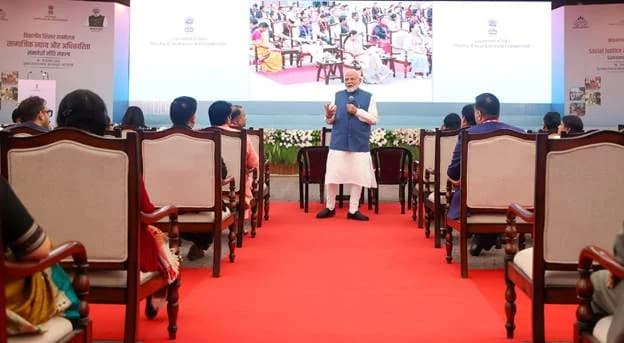
Prime Minister Narendra Modi on 19 November 2026 called for the Nasha Mukt Bharat Abhiyaan (Drug-Free India Campaign) to become a nationwide people's movement. He was addressing the plenary of 'Samaveshi Niti Sankalp 2026', a two-day summit of the Union Ministry of Social Justice and Empowerment with state governments at Sushma Swaraj Bhawan in New Delhi. Among the action points the Centre and states identified was a target of at least one de-addiction centre in every district by March 2029.
The details are in a release issued by the ministry through the Press Information Bureau on 20 November. According to the release, the summit, which began on 18 November, brought together ministers from 27 states and union territories and secretaries from 35, along with Union Social Justice and Empowerment Minister Dr Virendra Kumar and Minister of State B. L. Verma.
What did the Prime Minister ask for?
Mr Modi asked for a 'whole of government' approach, with ministries, state governments, district administrations and spiritual organisations working together against drug abuse. He suggested that schools hold essay competitions and awareness drives, and that parents learn to recognise early signs of substance abuse. He also urged farmers not to cultivate illicit crops.
On rehabilitation, the release quoted him as saying that the journeys of people who have overcome addiction "show that recovery is possible and that a life free from drugs is a life of dignity". He also encouraged wider use of the term 'Divyang' for persons with disabilities and called for more platforms to recognise their talents. According to the release, he said nearly 50 crore people lifted out of poverty had experienced social empowerment.
What are the time-bound action points?
The summit's drug-prevention session was chaired by Himachal Pradesh Social Justice Minister Dr (Col.) Dhani Ram Shandil and co-chaired by Rajasthan's Avinash Gehlot. It listed these key action points:
- Observing the 10th of every month as 'Nasha Mukti Sankalp Diwas', starting December 2026.
- Making drug prevention a standing agenda item in every gram sabha and municipal ward.
- Setting up at least one de-addiction centre in every district by March 2029.
Mr Verma said the outcomes would feed into the national action plan, according to the release. States presented their own models, including Chandigarh's VADA Clubs, Punjab's SOORMA Ambassadors, Meghalaya's DREAM Solace Home and Haryana's STARS rating for rehabilitation centres. The ministry's training push in this area includes a de-addiction counselling course run by the National Institute of Social Defence.
Scholarships, early intervention and accessibility
A session chaired by Uttar Pradesh minister Asim Arun discussed simpler scholarship applications, secure digital links between the Centre and states, timely disbursement and better grievance redress. Suggestions to revise income eligibility limits and scholarship amounts were also discussed. Odisha, Gujarat and Uttar Pradesh presented their common scholarship platforms, and Karnataka and Tamil Nadu their auto-approval systems.
A session on early intervention, chaired by Bihar minister Dr Shweta Gupta, focused on identifying developmental delays in children early, tele-rehabilitation and digital tracking. West Bengal presented its SANSPARSH model of community screening for autism using a 20-point questionnaire. On accessibility, Assam proposed a dedicated national mission and penalties for non-compliance, and Goa minister Subhash Faldessai argued for building accessibility into designs at the planning stage instead of retrofitting.
What next?
The ministry said the Centre and states committed to time-bound implementation of the agreed action points. The first monthly Nasha Mukti Sankalp Diwas would fall on 10 December 2026. The release did not give a budget or a list of districts for the new de-addiction centres.
Photo source · Press Information Bureau, Government of India