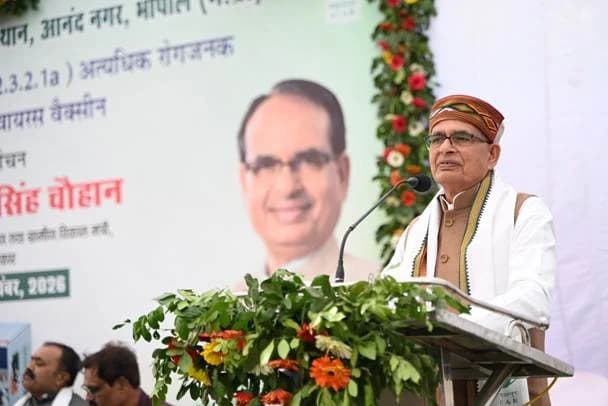
Union Agriculture and Farmers' Welfare Minister Shivraj Singh Chouhan on 20 November 2026 dedicated to the nation India's first indigenous vaccine for chickens against Avian Influenza (H5N1), commonly called bird flu, at a programme in Bhopal, Madhya Pradesh. The vaccine was developed by the Indian Council of Agricultural Research's National Institute of High Security Animal Diseases (ICAR-NIHSAD) in Bhopal.
According to a release issued by the Ministry of Agriculture and Farmers Welfare through the Press Information Bureau, the vaccine will be priced at ₹1-2 per dose. The ministry described it as the world's first vaccine against this particular variant of bird flu. Mr Chouhan also announced a new laboratory in Bhopal at an estimated cost of ₹300 crore.
What does the new vaccine mean for poultry farmers?
The government says the low price is meant to put preventive vaccination within reach of small poultry farmers. The ministry said the vaccine is expected to strengthen disease prevention in the poultry sector and reduce economic losses from outbreaks.
Recounting the history of the disease in India, the minister said the country's first bird flu outbreak was reported in 2006 at Navapur in Maharashtra, where about 10 lakh chickens died and lakhs more had to be culled. Around 9 lakh chickens died in 2021 and about 2 lakh this year, he said, adding that India has recorded more than 500 bird flu outbreaks since 2006. The release noted that the disease can also spread to mammals and humans, which makes prevention important.
The launch comes days after authorities in Kerala's Alappuzha district culled more than 18,600 birds following a bird flu outbreak.
Who developed it?
The vaccine was developed by a team of ICAR-NIHSAD scientists: Dr S. Nagarajan, Dr Manoj Kumar, Dr C. Tosh, Dr H. V. Murugkar, Dr Aniket Sanyal, Dr Senthil Kumar D., Dr Naveen Kumar and Dr Yogisharadhya R. According to the minister, the team worked for months, including weekends, under strict biosafety rules that required sanitisation before and after lab work and barred them from keeping pets at home during the research.
Mr Chouhan said an initial proposal was to launch the vaccine in Delhi, but he chose Bhopal so the event could take place among the scientists who developed it. The institute has earlier developed indigenous vaccines for Gumboro disease, Classical Swine Fever and African Swine Fever, and the Brucella abortus S-19 Delta vaccine, the ministry said.
Losses from animal diseases
Calling livestock "moving ATMs" for farmers, the minister said animal husbandry contributes 14% of India's GDP and poultry another 1%. He cited estimated average annual losses of ₹22,000 crore from Foot and Mouth Disease, ₹20,000 crore from Lumpy Skin Disease, ₹9,212 crore from Brucellosis and ₹4,683 crore from Peste des Petits Ruminants, which affects sheep and goats. Together these come to roughly ₹56,000 crore, he said.
He said 147.16 crore free vaccine doses against Foot and Mouth Disease have been given under the National Animal Disease Control Programme. He also recalled that the 2022 Lumpy Skin Disease outbreak infected 32.8 lakh animals and killed 1.86 lakh. That outbreak was followed by the 'Lumpi-ProVacInd' vaccine, developed by scientists at Hisar and Izatnagar.
Political remarks
At the event, Mr Chouhan criticised unnamed opposition leaders who, he said, question India's constitutional institutions, armed forces and scientists while speaking abroad. He said they should take note of the country's scientific achievements, and he cited India's two indigenous COVID-19 vaccines as an earlier example.
What next?
The release did not give a timeline for commercial supply of the vaccine or for building the ₹300-crore laboratory. ICAR Director General Dr M. L. Jat, NIHSAD Director Dr Aniket Sanyal, Madhya Pradesh minister Vishwas Sarang, Bhopal MP Alok Sharma and Bhopal Mayor Malti Rai attended the programme.
Photo source · Press Information Bureau, Government of India