This is a MapMyTimes opinion piece. It responds to the key findings of the SAMPADA 2023-2025 survey released by the Indian Council of Medical Research (ICMR) on Monday, 23 November 2026, which MapMyTimes reported here. Our view: the lower anaemia numbers are welcome, but their real value lies in telling India where to aim, and that should shape how the Anaemia Mukt Bharat programme spends its effort.
What did the survey find?
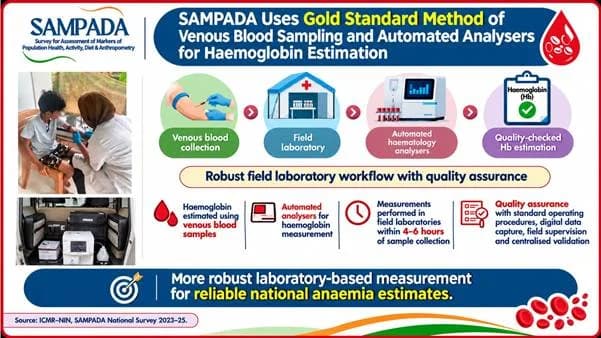
According to the Health Ministry's release on 23 November, SAMPADA covered more than 2 lakh people from over 81,000 households in 183 districts across 35 States and Union Territories, and analysed more than 1.7 lakh blood samples for haemoglobin. It used venous blood samples and automated analysers, which the ministry describes as the gold standard. The headline is that anaemia prevalence is lower than in previous national surveys. Most cases are mild, and severe anaemia was found in under 2% of people in most age groups.
Those are good numbers to have. But the same release shows the burden is far from evenly spread. Anaemia prevalence was 56% among women of reproductive age, 46% among adolescent girls aged 10 to 19 and 42% among children aged 12 to 59 months, against 22-23% for adolescent boys and men aged 20 to 59.
Why does this matter beyond the headline?
It matters because the survey challenges a one-size-fits-all approach. The ICMR findings say iron deficiency accounts for about half of anaemia cases among women, adolescent girls and children. The rest is linked to other causes the release lists, including infections, inherited blood disorders known as haemoglobinopathies and inflammation from chronic disease. The release also says vitamin B12 and folate deficiency were about as common in people without anaemia as in those with it, which suggests a limited role for those deficiencies in India's anaemia.
Iron deficiency, the survey found, is concentrated in under-five children, adolescent girls and women of reproductive age, and in people with moderate and severe anaemia. That points to a clear priority: find the people with moderate and severe anaemia through testing, treat them and follow them until they recover, as the release says Anaemia Mukt Bharat 2.0 already envisages. Dr Bharati Kulkarni, Director of ICMR's National Institute of Nutrition, said the findings support "more targeted, population-specific and life-course approaches".
What is the strongest case against changing course?
There is a fair argument for caution. Broad iron supplementation is simple and cheap to deliver through schools and health workers, while testing and follow-up need equipment, trained staff and records that many primary health centres may struggle to maintain. Some will also worry that a lower national figure could be read as a reason to cut budgets, when more than half of women of reproductive age are still anaemic. And because SAMPADA used a different, more rigorous sampling method, some of the fall from earlier surveys may reflect how haemoglobin was measured rather than how much it has changed; the release does not set out how far the figures can be directly compared.
These concerns are real. But they argue for doing targeting carefully, not for ignoring what the survey shows. A programme that treats everyone the same way risks spending heavily where iron is not the problem while under-serving the women and girls for whom it is.
What should happen next?
Three steps would help. First, ICMR should publish State and district-level results and, where privacy allows, anonymised data, so that States can plan with their own numbers and independent researchers can test the comparisons with earlier surveys. Second, the Health Ministry should set out how test-and-treat for moderate and severe anaemia will be funded and tracked at the primary-care level. Third, the non-iron causes the survey highlights should get their own plans rather than being folded into supplementation drives.
India has shown this year that a well-run public health campaign can reach scale quickly, as with the HPV vaccination drive crossing 1 crore doses. SAMPADA gives the anaemia programme a sharper map. The test now is whether policy follows it to the women, girls and young children who still carry most of the burden.