The Indian Council of Medical Research (ICMR) said on 23 November 2026 that its new national nutrition survey, SAMPADA, has found lower anaemia levels across most groups than earlier national surveys did, with most cases mild and severe anaemia under 2% in most age groups. The findings were released through the Press Information Bureau in New Delhi by the Department of Health Research under the Ministry of Health and Family Welfare.
What is the SAMPADA survey?
SAMPADA, short for the Survey for Assessment of Markers of Population Health, Activity, Diet and Anthropometry, is a nationally representative survey carried out in 2023–2025 by the ICMR-National Institute of Nutrition (ICMR-NIN) in Hyderabad. It reached more than 2 lakh people in over 81,000 households across 183 districts in 35 states and Union Territories, and analysed more than 1.7 lakh blood samples for haemoglobin.
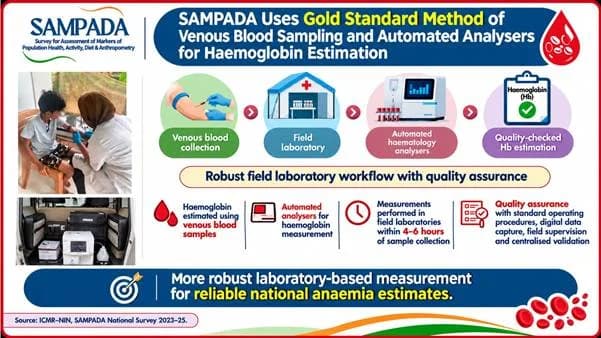
The ICMR describes it as one of the largest nutrition surveys carried out anywhere. Unlike earlier national surveys, which the institute's fact sheet says relied on point-of-care devices, SAMPADA drew venous blood and measured haemoglobin on automated analysers in field laboratories within four to six hours of collection. A sub-sample was also tested for iron, folate, vitamin B12 and markers of inflammation.
How many Indians are anaemic, according to SAMPADA?
The answer depends sharply on age and sex. According to the fact sheet, about 41.8% of children aged 12 to 59 months had anaemia, compared with 31.3% of children aged 5 to 9 years. Among adolescents aged 10 to 19, the figure was 46.3% for girls and 22.8% for boys.
- Non-pregnant, non-lactating women aged 15 to 49: 55.9%
- Pregnant women: 43.6%
- Men aged 20 to 59: 22.0%
- Women aged 60 and above: 55.7%; men aged 60 and above: 44.7%
Severe anaemia was rare in most groups: 1.5% among young children, 2.9% among women of reproductive age and 0.7% among adult men, according to the fact sheet.
Is iron deficiency the main cause?
Only partly. The ICMR said iron deficiency explains about half of anaemia among women, adolescent girls and children, and is concentrated in those groups and among people with moderate or severe anaemia. Boys, men and older people showed little iron deficiency. Vitamin B12 and folate deficiency were found at similar levels in people with and without anaemia, which the council said points to a limited role for those two nutrients. It said other causes, such as infections, inherited blood disorders and inflammation linked to chronic disease, also need attention.
Why it matters
The findings feed into Anaemia Mukt Bharat, the government's anaemia-control programme. The ICMR said people with moderate or severe anaemia should be identified through testing, treated and followed until they recover, as envisaged under the programme's second phase.
"It is encouraging that prevalence of anaemia is lower in SAMPADA compared to previous national surveys," said Dr Rajiv Bahl, Secretary of the Department of Health Research and Director General of the ICMR.
Dr Bharati Kulkarni, Director of ICMR-NIN, said the evidence supports more targeted approaches for different population groups across the life course, while also showing where more research and better surveillance are needed.
What to keep in mind
Because SAMPADA used a different, laboratory-based way of measuring haemoglobin from earlier national surveys, part of the gap with older figures may reflect method rather than change on the ground; the release does not separate the two. The fact sheet says the survey was designed to give state-level estimates as well, but state-wise anaemia figures were not part of the material released on 23 November.
Photo source · PIB / ICMR-NIN