Astronomers using NASA's James Webb Space Telescope and several other observatories have tracked a star being swallowed by a much larger companion in the Andromeda galaxy, a merger NASA describes as the first of its kind to be caught in this detail. The findings were published in the journal Nature on 18 November 2026, according to a NASA release issued by its Goddard Space Flight Center.
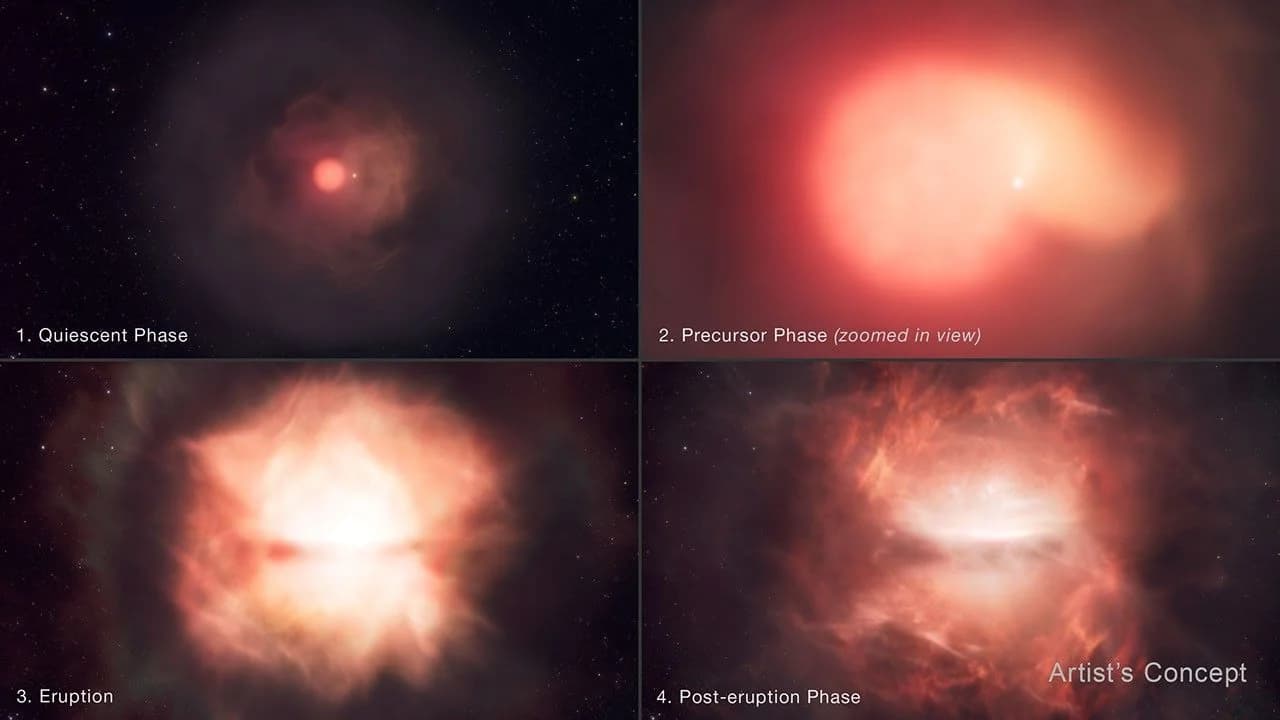
The system, catalogued as AT 2025abao and nicknamed "Bao", sits on the outskirts of Andromeda. In it, a star slightly lighter than the Sun spiralled into a bloated supergiant and was pulled into its core.
What exactly did astronomers see?
They watched two stars that had orbited each other for thousands of years merge after only about seven orbits, roughly seven years. NASA said previously known mergers involving two smaller stars took thousands of orbits.
Before the merger, the larger star, dubbed "Big Bao", had about seven times the Sun's mass, a radius 350 times the Sun's and was about 18,000 times brighter. The smaller "Little Bao" had about 0.7 solar masses. NASA said this is the first time a mass has been estimated for the companion star in such an event.
Early modelling suggested the smaller star might carry enough energy to escape, but further analysis showed it was drawn into the core of its partner. Kishalay De, assistant professor at Columbia University and a co-author, likened the companion's fate to something "almost like a bomb exploding inside a living star".
How was the event caught in time?
The team pieced together years of archival and fresh data from several missions. NASA's NEOWISE showed steady brightness before 2018 and revealed an unusual variable star in February 2023. The WINTER infrared telescope saw it begin to brighten and form dust in September 2024, and NASA's SPHEREx recorded it fading in visible light while brightening in infrared in July 2025.
The Zwicky Transient Facility detected the eruption on 17 October 2025. NASA's Neil Gehrels Swift Observatory and the Gemini North telescope followed up in November 2025, and Webb observed the system on 24 December 2025, 47 days after the eruption peaked.
"Stellar mergers are very, very difficult to observe in real time because they are hard to predict," said first author Viraj Karambelkar, a NASA Hubble Fellow at Columbia University.
Who was involved?
Co-authors include Nadia Blagorodnova, associate professor at the University of Barcelona in Spain, and Karel Temmink, a PhD student at Radboud University in Nijmegen, the Netherlands, who led the simulations. NASA said the work was supported in part by a grant from its Astrophysics Data Analysis Program.
Why it matters
Stellar mergers are rarely seen as they happen, so a well-documented case gives researchers a reference point for how such events unfold, from early warning signs to the eruption and its aftermath. Karambelkar said he expects "a large influx of similar discoveries just ahead".
What happens next
According to NASA, future observations will show how the mass of the merged star settles, a question the current data cannot yet answer.
Photo source · Illustration: NASA, ESA, CSA, STScI, Leah Hustak (STScI)