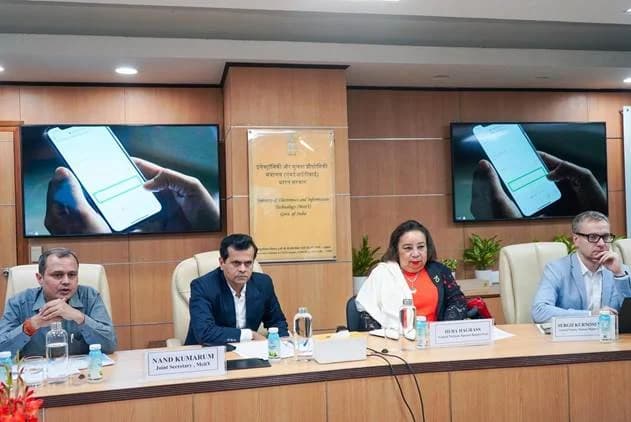
The Ministry of Electronics and Information Technology (MeitY) held an interactive session in New Delhi with Heba Hagrass, the United Nations Special Rapporteur on the Rights of Persons with Disabilities, on digital accessibility and the inclusion of persons with disabilities, the ministry said in a release issued through the Press Information Bureau on 20 November 2026. The meeting, held at the ministry's CeG Hall, was part of Hagrass's official visit to India from 16 to 25 November 2026.
Officials of the Ministry of External Affairs, the National Informatics Centre (NIC), Standardisation Testing and Quality Certification (STQC), the Centre for Development of Advanced Computing (C-DAC) and the National e-Governance Division (NeGD) also took part. The session was led by Nand Kumarum, Joint Secretary at MeitY and President and CEO of NeGD.
What did MeitY present to the UN expert?
MeitY set out the legal framework and the standards, testing tools and services it says make government digital platforms usable by persons with disabilities. According to the release, the presentation noted that India ratified the UN Convention on the Rights of Persons with Disabilities in 2007, that the Rights of Persons with Disabilities Act, 2016 requires accessible information and communication technology, and that MeitY notified the National Policy on Universal Electronic Accessibility in 2013. The ministry described its own role as largely facilitative, through standards, guidelines and tools.
The initiatives highlighted included:
- Standards: GIGW 3.0, the Guidelines for Indian Government Websites and Apps, aligned with WCAG 2.1 Level AA, and Indian Standard IS 17802 on accessibility of ICT products and services, made enforceable through a 2023 amendment to the disability rules.
- Certification and testing: STQC accessibility certification, which the ministry said 73 ministries and departments have received, and testing tools SugamyaWeb and SATYA.
- Design support: UX4G, which the release said has given audit and design support to more than 400 government websites and apps, with its accessibility widget in use on over 1,800 websites.
- Services: Bhashini for multilingual access, UMANG for citizen services in 23 languages, the Namaste Bharat AI citizen guide with voice support, and Divyang Sarthi, a platform with VR-based learning content for persons with intellectual disabilities.
Why does it matter?
As more welfare schemes, certificates and payments move online, a website or app that does not work with a screen reader or keyboard navigation can effectively shut out a blind or physically disabled citizen. The figures in the release are the ministry's own; they show how many departments hold certification, but not how many government sites and apps remain uncertified or how accessibility is checked after launch.
The UN Special Rapporteur's visit is an independent fact-finding mission, and Hagrass's own observations had not been published at the time of writing. The release does not record any comments she made during the session.
What happens next?
MeitY said it would keep updating its accessibility guidelines in line with international standards, support certification and compliance, train officials and developers, and continue developing digital assistive tools. Hagrass's visit continues until 25 November. Accessibility has also been in focus at the International Film Festival of India this week, where the organisers have brought in Svayam to audit festival venues.
Photo source · Press Information Bureau, Government of India