Physicists at the Raman Research Institute (RRI) in Bengaluru, Karnataka, have shown that the magnetic order of a small quantum system can be redesigned simply by changing how its sites are connected, the Union Ministry of Science and Technology said in a release on 20 November 2026. The theoretical result, published in the journal Physical Review B, points to a possible way of building entangled states that could one day hold quantum information.
The study was carried out by Revathy B. S., a postdoctoral fellow at RRI and the paper's lead author, and Shovan Dutta, an assistant professor in the institute's Theoretical Physics group. RRI is an autonomous institute of the Department of Science and Technology (DST).
What did the Bengaluru researchers find?
They found that adding a single extra link inside a quantum lattice reliably flips the alignment of the two electrons it joins, while the rest of the lattice keeps its original ordering. In other words, geometry alone was enough to engineer the overall magnetic pattern.
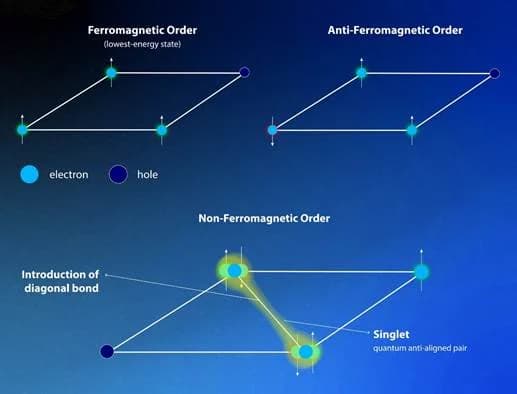
The team modelled a square lattice in which every site holds one electron except for one empty site, called a hole. Each electron has a property called spin that can point up or down. As the hole hops from site to site, its motion influences how the spins line up, an effect physicists call kinetic magnetism. According to the ministry, this effect comes from the quantum motion of particles rather than from direct interaction between spins, and has no counterpart in classical physics.
Earlier work had shown that such a square lattice with one hole settles into a ferromagnetic state, with all spins pointing the same way. Revathy and Dutta reported that inserting a diagonal bond makes the two electrons on that bond point in opposite directions, forming an entangled pair known as a singlet. The other sites stay ferromagnetic and the hole continues to move through the network.
"What's amazing is that I can almost deterministically predict that wherever I [introduce a diagonal bond], I will get [singlets]," Revathy said, as quoted in the ministry release.
Why does connectivity matter in a quantum system?
It matters because in a classical magnet the same kind of change in shape would barely affect the magnetic order, which makes the quantum behaviour surprising. "This is far from obvious, because if you had a classical system, similar changes in geometry do not really affect the magnetic order," Dutta said in the release.
The ministry compared the idea with everyday networks such as airline hub-and-spoke routes or the role of superspreaders during COVID-19, where the pattern of connections shapes how a whole system behaves. The RRI work asks the same question for many interacting quantum particles.
Why was this hard to study?
The difficulty is the sheer number of possible arrangements. According to the release, a lattice of just 20 sites has about two million configurations, a level of computational complexity that kept physicists from tackling the problem for decades. The pair used a mix of advanced numerical and analytical methods to identify the microscopic patterns and explain where they come from. The paper is available through its Physical Review B listing.
Why it matters
Ordinary hard drives store data as magnetic patterns, but only as classical bits. The ministry noted that the singlets formed in these networks are entangled quantum states and could potentially be used to store quantum information, which is why the finding may be relevant to future quantum devices.
What is confirmed and what is not
- Confirmed: the study is theoretical and has been published in Physical Review B, with RRI's Revathy B. S. and Shovan Dutta as authors.
- Not yet shown: the effect has not been demonstrated in a laboratory experiment, and no device using it has been announced.
What happens next
The release said the work is timely because experimental techniques are reaching the point where researchers may be able to observe such behaviour directly. Any practical use in quantum storage would depend on such experiments confirming the theory.
Photo source · Press Information Bureau / Raman Research Institute (handout figure)