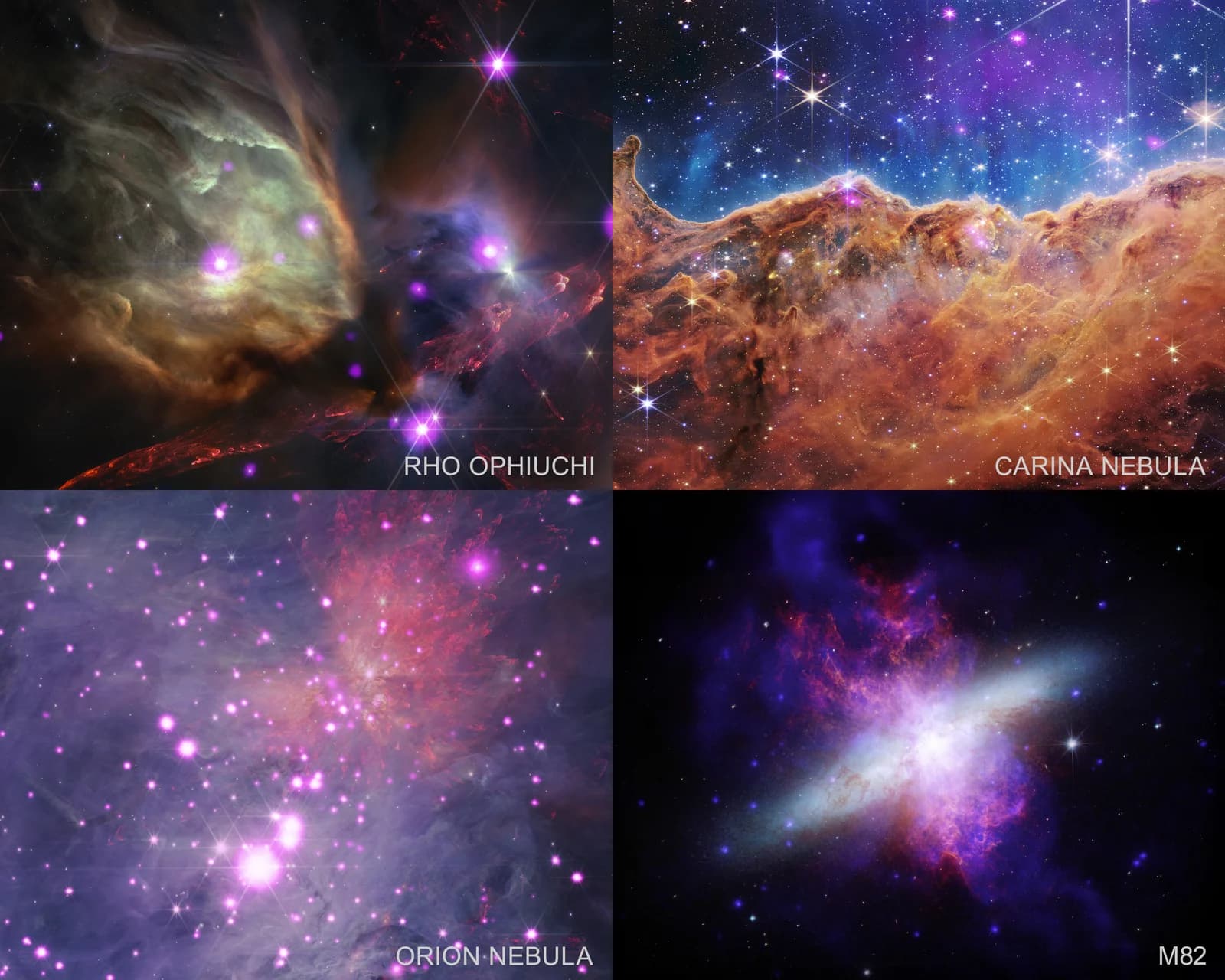
NASA's Chandra X-ray Observatory has released four new "sonifications", pieces of audio made by translating telescope data into sound, all built around places where stars are being born. The set, published by NASA on 17 November 2026, covers the galaxy M82 and three star-forming clouds: the Orion Nebula, the Carina Nebula and Rho Ophiuchi.
The tracks combine X-ray observations from Chandra with data from other NASA telescopes, the space agency said. These include the Hubble Space Telescope, which observes in optical light, the James Webb Space Telescope and the now-retired Spitzer Space Telescope, both of which observe in infrared.
How data becomes sound
In a sonification, features of an image such as brightness and position are assigned to pitch, volume or a particular instrument, so that a listener can follow the same information that a viewer would see. NASA described how each of the four pieces was put together.
- M82: NASA describes this as a starburst galaxy where stars form at rates tens or hundreds of times higher than in the Milky Way, possibly set off by a past collision with another galaxy. The piece opens with a radar-like sweep that grows louder where sources are brighter. Chandra's X-rays are given the highest frequencies, infrared data from Webb and Spitzer becomes a low drone with plucked sounds, and Hubble's optical data is turned into musical pitches and textures.
- Orion Nebula: One of the closest active star-forming regions to Earth, it can be seen below Orion's belt with a small telescope, NASA said. Chandra sees more than a thousand young, energetic stars here, and they are heard as twinkling sounds. Webb's view of the dust and gas is played as lower musical tones, distorted strings and a digital harp.
- Carina Nebula: This is the region known from Webb's infrared image as the "Cosmic Cliffs". Individual baby stars detected by Chandra become short string sounds, while the diffuse X-ray glow is given longer string notes. The piece includes a cello part credited to Johnny Mok.
- Rho Ophiuchi: In this cloud of gas and stars of different sizes and ages, X-rays from flaring infant stars are heard as high-pitched, glassy tones and stars as metallic plucks. A quiet gap in the middle corresponds to dark dust clouds that give off little light.
Who made them
The sonification programme is led by the Chandra X-ray Center (CXC), NASA said. The collaboration was driven by CXC visualisation scientist Kimberly Arcand. The pieces were created by astrophysicist Matt Russo and musician Andrew Santaguida of the SYSTEM Sounds project, with Christine Malec as consultant.
NASA's Marshall Space Flight Center in Huntsville, Alabama, manages the Chandra programme. The Smithsonian Astrophysical Observatory's Chandra X-ray Center controls science operations from Cambridge, Massachusetts, and flight operations from Burlington, Massachusetts, according to the agency.
Where to listen
The four tracks have been published along with the composite images they are based on. NASA said more sonifications from the programme are available on the Chandra website's sound page, chandra.si.edu/sound.
PS · NASA/CXC/SAO/K. Arcand, SYSTEM Sounds (M. Russo, A. Santaguida)