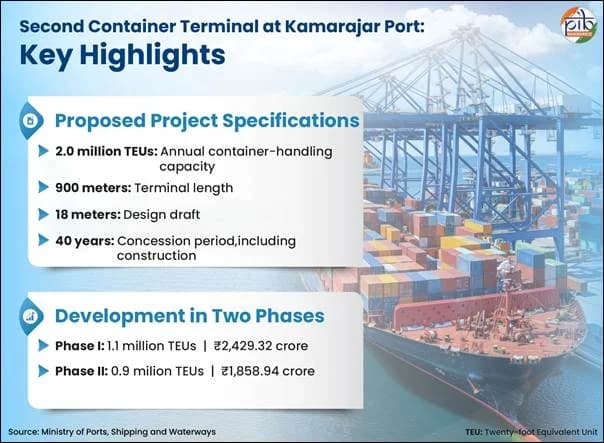
The Union government's research wing has set out the full plan for a second container terminal at Kamarajar Port Limited, about 24 km north of Chennai in Tamil Nadu. A PIB backgrounder published on 28 November 2026 says the terminal, approved by the government on 25 November 2026, will add 2 million twenty-foot equivalent units (TEUs) a year in container-handling capacity at an estimated PPP project cost of Rs 4,288.26 crore including GST.
What has been approved at Kamarajar Port?
The government has cleared a new 111-acre container terminal that will be built and run by a private partner under a public-private partnership. The backgrounder lists a terminal length of 900 metres, a berth width of 30 metres, a design draft of 18 metres and a water depth of 20 metres along the berth. The facility is designed to take container ships up to 400 metres long, carrying as many as 24,346 TEUs.
The project follows the Design, Build, Finance, Operate and Transfer (DBFOT) model. Apart from the PPP cost, Kamarajar Port Limited will separately spend an estimated Rs 450 crore on dredging, according to the document.
How will the project be phased?
The terminal will come up in two phases over a 40-year concession that includes a 48-month construction period. A PIB infographic puts Phase I at 1.1 million TEUs costing Rs 2,429.32 crore and Phase II at 0.9 million TEUs costing Rs 1,858.94 crore.
- Phase I is due within two years of the concession agreement being signed, with commercial operations from the 25th month.
- Phase II is due by the end of the fourth year, with the full terminal running from the 49th month.
The government expects about 750 direct and indirect jobs during construction and around 800 once the terminal is operating.
Why does the port need more container capacity?
The existing terminal is already running close to full. Kamarajar's first container terminal began commercial operations in March 2018 with a capacity of 0.8 million TEUs and handled about 0.7 million TEUs in 2025-26, or roughly 88 per cent of capacity, the backgrounder says. Container traffic at the port has grown about 9.9 per cent a year over five years.
Nationally, container traffic at Indian ports rose at a compound annual rate of 6.9 per cent between 2019-20 and 2025-26 to reach 25.7 million TEUs, and is projected to touch about 40 million TEUs by 2030. Ports carry nearly 95 per cent of India's trade by volume and about 70 per cent by value, according to the document.
Who stands to benefit?
The terminal is meant to serve manufacturers across Tamil Nadu, Karnataka and Andhra Pradesh. The backgrounder names the Chennai–Sriperumbudur–Oragadam belt, Hosur, Bengaluru, Sri City and Tirupati as key industrial clusters in its catchment. Exporters looking to use new trade agreements could gain from shorter waits at the quay; the Commerce Ministry has been urging smaller businesses to tap zero-duty access under FTAs.
How deep is the port, and how is it performing?
Kamarajar Port, formerly Ennore Port Limited, is one of India's 12 major ports and handles coal, petroleum products, LNG, LPG, containers, cars and general cargo. By July 2026 it completed Capital Dredging Phase VI, reaching an operational draft of 18 metres that allows fully laden Capesize ships of up to 1,70,000 deadweight tonnes. PIB says it is the second major port to reach that depth, after Visakhapatnam. In 2025-26 the port reported revenue of about Rs 1,280 crore and a profit before tax of Rs 924 crore.
What happens next?
The next step is to select a private concessionaire and sign the concession agreement, which starts the clock on Phase I. The backgrounder does not give a date for the bidding process. The government links the project to its Maritime India Vision 2030, which emphasises port capacity and private participation. Shipbuilding activity is also rising on the west coast, where Goa Shipyard recently launched a hybrid dredger.