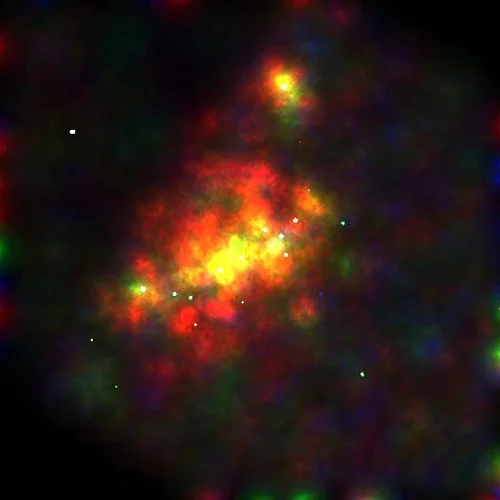
Researchers have analysed 24 years of observations of a bright X-ray source in the galaxy pair NGC 4490 and NGC 4485, finding evidence that a black hole may be powering it, India’s Ministry of Science and Technology said on 2 November.
The team combined observations of NGC 4490 ULX-8 made between 2000 and 2024 using the Chandra, XMM-Newton and Swift space telescopes. Researchers from the Indian Institute of Astrophysics, Raman Research Institute and other institutions took part.
Ultraluminous X-ray sources are unusually bright objects outside the centres of galaxies. The ministry said they are thought to contain neutron stars or black holes drawing in matter; as that matter falls inward, it heats up and emits X-rays.
ULX-8 remained exceptionally luminous while its brightness varied over the observing period. The reported findings suggest a stellar-mass black hole with a persistently active flow of matter, but the object’s nature remains a research conclusion rather than a direct photograph of a black hole.
The study was published in Monthly Notices of the Royal Astronomical Society, the ministry said.
Source: Ministry of Science and Technology, Press Information Bureau, 2 November 2026 — https://www.pib.gov.in/PressReleseDetailm.aspx?PRID=2331589
Image: NASA image of the NGC 4485/4490 galaxy pair via Wikimedia Commons, public domain; it is not a direct image of the black hole.
 India