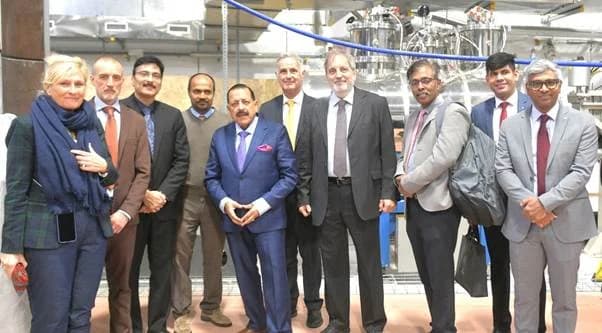
India will put more than 7 million euros over five years, starting in 2026-27, into rebuilding its dedicated research beamlines at Elettra Sincrotrone Trieste in Italy, joining the facility's Elettra 2.0 upgrade as a co-partner. Union Minister of State (Independent Charge) for Science and Technology Dr Jitendra Singh announced the commitment during a visit to the Trieste facility on 13 November 2026, the Ministry of Science and Technology said on Friday.
What India is paying for
Under Elettra 2.0, the two existing India-centric beamlines, XRD2 and Xpress, will be decommissioned and replaced by two new beamlines with upgraded capabilities, according to the ministry. The first is a microfocus beamline for macromolecular crystallography, to be named micro-XRD (μXRD). The second is a high-pressure diffraction beamline called Xpress Superbend (Xpress-SB).
The ministry said the money will support both research infrastructure and the development of human resources. The upgraded facilities are expected to widen research possibilities in chemistry, physics, advanced materials and structural biology, among other fields, for Indian and international researchers alike.
A partnership going back to 1998
Indian scientists have run experiments at Elettra since 1998, the ministry said, and India is now the facility's second-largest user after Italy. Indian research groups have sent more than 1,100 experimental proposals to Elettra, placing India second after Italy and just ahead of France, which has submitted 1,098 proposals, according to the release.
The current beamlines were themselves an Indo-Italian project. The Department of Science and Technology (DST) contributed about Rs 22 crore towards building XRD2 and Xpress, which were jointly inaugurated on 20 October 2016. Since then, roughly 50 to 60 Indian scientists have travelled to Trieste every year to use them, the ministry said.
Support for researcher visits
DST has also funded Indian researchers' access through the Indo-Italian Executive Programme of Cooperation (EPOC). Under EPOC 2022-2024, it sanctioned Rs 2 crore over three years to cover visits by 50 researchers a year, split into 25 visits each semester. The EPOC 2025-2027 programme carries a proposed allocation of Rs 1.5 crore over three years for the same purpose, the ministry said.
India had already agreed to take part in redeveloping its beamlines and had signed a Letter of Intent before Dr Singh's visit. The announcement in Trieste formalised the size of the investment.
Why it matters
India is already Elettra's second-largest user, and its researchers have relied on the two India-centric beamlines for close to a decade. Co-funding their replacement keeps a dedicated channel open for Indian crystallographers, materials scientists and structural biologists, and the ministry said the new stations will also serve researchers from other countries.
The ministry described the step as the start of a new phase in the India-Italy scientific partnership, building on the experience gained from designing and using the first set of beamlines.
What comes next
The investment is spread across five years from 2026-27, during which the old beamlines are due to be replaced with the new μXRD and Xpress-SB stations. The ministry did not give a date for when the new beamlines would begin operating.
PS · PIB