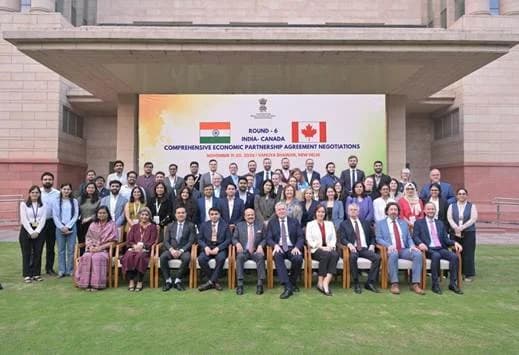
India and Canada have wrapped up the sixth round of negotiations on their proposed Comprehensive Economic Partnership Agreement (CEPA) in New Delhi, the Ministry of Commerce and Industry said on 21 November 2026. The round ran from 11 to 20 November, and both sides said they had moved closer to a deal they want to close within the timelines set by their leaders.
What did the sixth round cover?
The round covered trade in goods, trade in services, rules of origin, trade remedies, intellectual property and investment promotion, according to a Press Information Bureau (PIB) release. Dr Brij Mohan Mishra, India's Chief Negotiator, led the Indian delegation. Mary-Catherine Speirs, Canada's Chief Negotiator, led the Canadian team.
The ministry described the talks across the negotiating tracks as constructive and substantive, with both sides making progress. It did not say which chapters, if any, had been closed during the round.
Ministers set the tone at the start
The round opened on 11 November with a meeting between Piyush Goyal, Union Minister of Commerce and Industry, and Maninder Sidhu, Canada's Minister of International Trade. According to the ministry, both called for a balanced agreement that gives meaningful market access and builds on how the two economies complement each other.
In a Global Affairs Canada statement issued on 13 November, Ottawa said Sidhu joined the negotiators during a three-day visit to India. It quoted him as saying the agreement would help double bilateral trade to $70 billion by 2030. During the same trip he met Civil Aviation Minister Kinjarapu Ram Mohan Naidu about code-share services and air links, and attended the Confederation of Indian Industry (CII) Partnership Summit in Visakhapatnam.
Towards the end of the round, Commerce Secretary Rajesh Agrawal met Glenn Purves, Canada's Vice Minister of International Trade, to review progress and take stock of the talks, the PIB release said. Both sides pledged to conclude an agreement that benefits farmers, industry and Micro, Small and Medium Enterprises (MSMEs) in both countries.
How close is a deal?
Neither government has announced a conclusion yet. ThePrint reported on 13 November, citing government sources, that India and Canada had already closed three chapters related to services and were aiming to finish the remaining ones by the end of the year. The same report said another round was planned for December and that Prime Minister Narendra Modi was likely to visit Ottawa and Toronto in early December.
According to ThePrint, issues still being worked on include wording on goods flows, especially potash shipments from Canada to India, and ways to draw more investment from large Canadian pension funds. A separate investment protection agreement is being negotiated outside the CEPA, the report said.
Why it matters
The talks mark a revival of economic engagement after ties between the two countries soured in 2023. ThePrint reported that the terms of reference for the CEPA were agreed in early 2026 during Canadian Prime Minister Mark Carney's visit to New Delhi, and that five rounds were held in the seven months after that.
Canadian government figures show that Canada's merchandise imports from India were worth $9.7 billion in 2025, up 20.7% from 2024. Canada's top exports to India include vegetables, mineral fuels, wood pulp and fertiliser, while India mainly sells precious stones and metals, machinery, pharmaceuticals and electronics to Canada.
The deal would add to India's push into new markets. MapMyTimes recently reported on India's fast-rising exports to Africa and Asia in the first half of 2026-27.
What happens next
Both sides have said they want to finish the negotiations quickly. Whether a deal is announced during a possible Modi visit to Canada in December depends on how the remaining chapters are settled. Neither government has confirmed the dates of that visit.