The world's mangrove forests, long counted among the most rapidly disappearing ecosystems, have been recovering ground since 2010, according to a new satellite-based study highlighted by NASA's Earth Observatory on 13 November. The analysis, published in the journal Science, found that the coastal forests are not only spreading into new areas but in many places growing denser.
Four decades of Landsat images
The research team, led by Zhen Zhang of Tulane University, examined Landsat satellite imagery spanning 1984 to 2023 to measure how the extent and canopy density of mangroves changed over time. Their paper is titled "Unexpected expansion and regrowth in Earth's mangrove forests over the past four decades".
The results show two distinct phases. Between 1984 and 2010, mangroves lost close to 3,000 square kilometres worldwide. After 2010 the trend reversed, with a net gain of nearly 2,000 square kilometres. Asia, Australia and South America led the recovery, NASA said, and many forests now have thicker canopies than they did in 2010, particularly in South America.
According to the researchers, roughly two-thirds of the expansion came from mangroves naturally colonising new stretches of coast, while about one-third resulted from restoration and regrowth. "About two-thirds of the expansion was due to mangroves colonizing new areas," Zhang said, as quoted by NASA.
Myanmar's turnaround
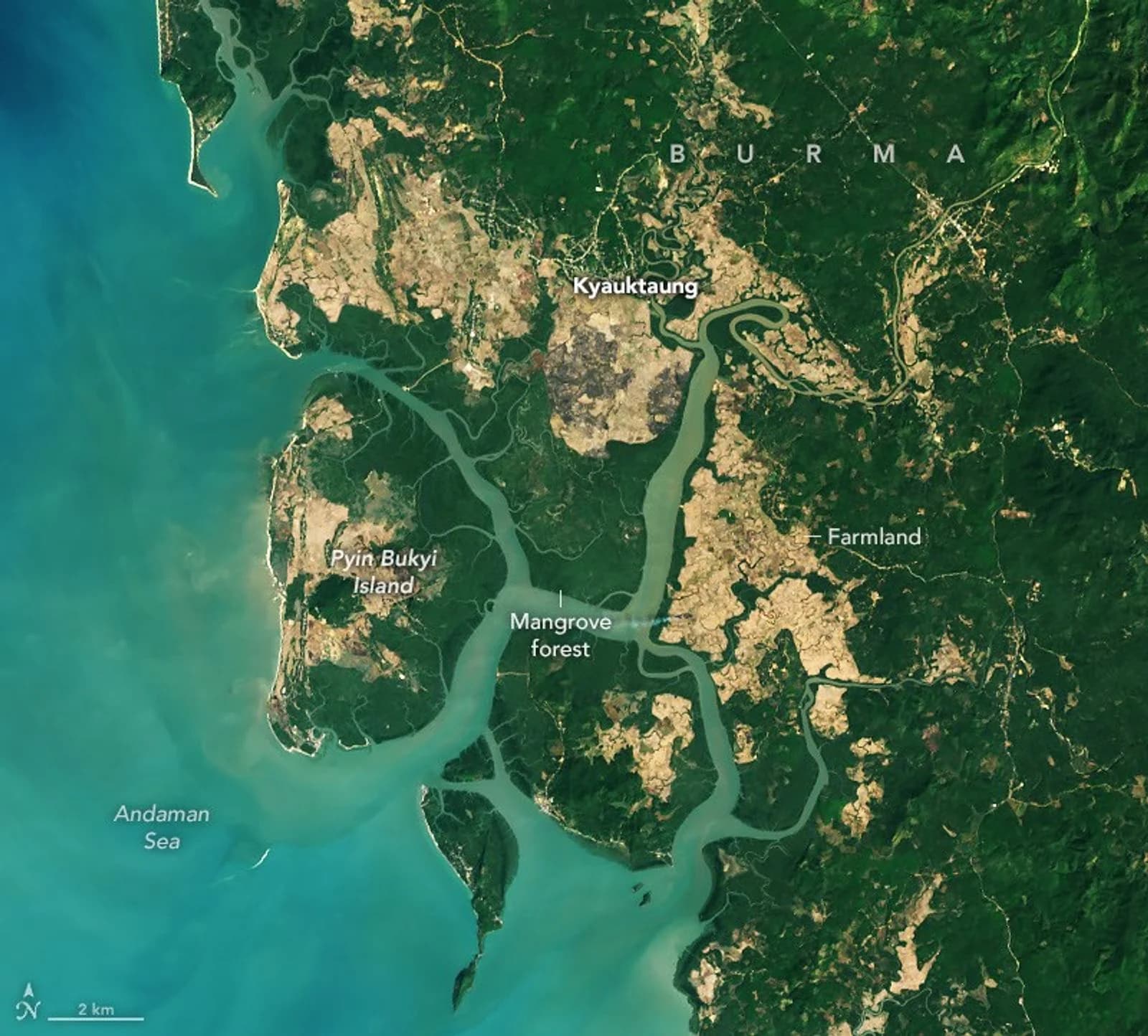
NASA illustrated the findings with Landsat images of Myanmar's Myeik District, where mangroves have taken over land that was once used for rice paddies. Myanmar lost 28.6 per cent of its mangrove area between the 1980s and 2010 but has since regained about 10 per cent, the article said. The authors linked part of that turnaround to the aftermath of the 2004 Indian Ocean tsunami.
Why mangroves matter
Mangroves grow in the salty, tidal zones of tropical and subtropical coasts. Although the trees average only about 13 metres in height, they can store up to four times as much carbon as taller tropical forests inland, according to NASA. They also act as natural buffers against storm surges and coastal erosion and serve as nurseries for fish.
For countries such as India, whose coastline includes extensive mangrove systems such as the Sundarbans in the Bay of Bengal delta, these forests are a key part of coastal protection and carbon storage strategies. The study's global findings do not, however, single out India's mangroves.
Not all good news
The recovery is uneven. Losses are continuing in the Niger Delta and other parts of West and Central Africa, while mangroves in North America and southern Africa have degraded after tropical cyclones, the researchers found. Zhang cautioned against reading too much into the improvement. "The global successes we've seen with mangroves during the past decade should not be seen as grounds for complacency," he said.
The findings arrive as climate negotiators meet at COP31 in Antalya, where nature-based solutions such as coastal ecosystem protection are part of wider discussions on adaptation and emissions.
PS · NASA Earth Observatory/Michala Garrison, using Landsat data from the U.S. Geological Survey