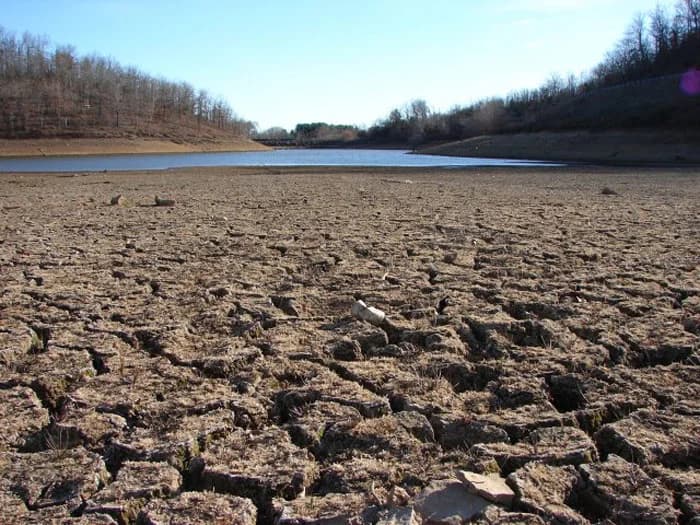
Record global heat in 2023 and 2024 drove an unprecedented synchronized decline in surface freshwater across the planet, cutting global river flows by about 5.7% below normal and reducing water stored in lakes and reservoirs by 9.5%, according to an international study led by Chinese Academy of Sciences researcher Yongqiang Zhang.
Record Drop Across 150 Basins and 1.2 Million Lakes
Combining streamflow measurements from 150 major river basins with satellite observations of more than 1.2 million lakes and reservoirs from 1991 to 2025, the researchers identified three distinct hydrological periods: pronounced fluctuations between 1991 and 2006, relative stability from 2007 to 2022, and an abrupt global drop during 2023–2024 compared with the 1991–2020 baseline.
Although river flows began recovering in 2025, the study noted that the 2023–2024 contraction marked the steepest synchronized surface-water decline in the historical satellite and gauge record. Co-author Dr. Sulagna Mishra said the results underscore a key climate paradox: even when global precipitation rises in a warmer atmosphere, much of the extra rainfall falls over oceans while land basins suffer steep moisture deficits.
South America Hit Hardest Despite Regional Flooding
South America experienced the sharpest drop among major regions, with river discharge declining by 17.8% and lake and reservoir storage falling by 16.5% during 2023–2024, even though parts of the continent endured severe floods over the same period.
The researchers linked South America's freshwater depletion to an unusual pairing of a Pacific El Niño event with simultaneous anomalous warming in the Tropical North Atlantic, which diverted atmospheric moisture away from northern South America. University of East Anglia hydrologist Dr. Yi He explained that rivers can flood briefly during extreme downpours while still carrying sharply reduced water volumes across most of the year.
Climate Whiplash and Global Water Security Risks
Independent climate scientists warned that freshwater reserves can shrink rapidly even in regions long considered wet. Prof. Christian Dunn of the British Ecological Society noted that flood events do not equate to water security, while Prof. Richard Allan of the University of Reading said swings between wet and dry extremes—described as climate whiplash—will intensify until greenhouse gas emissions are curbed.