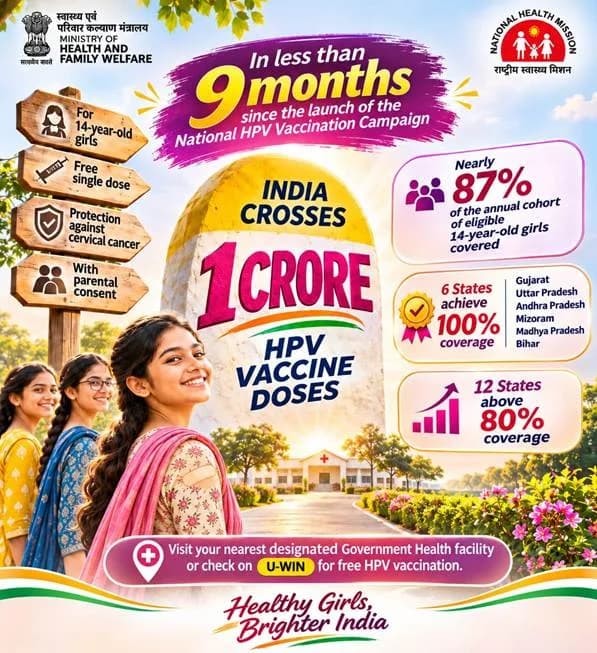
India's national HPV vaccination campaign for 14-year-old girls crossed 1 crore doses in less than nine months, the Union Ministry of Health and Family Welfare said in a release issued on 21 November 2026. MapMyTimes reported the milestone the same day. This explainer sets out what the campaign is, why the number matters, what it means for families and what remains open.
What is the HPV vaccine and why is it given?
The HPV vaccine protects against infection with the Human Papillomavirus, which the government's launch backgrounder describes as the cause of almost all cervical cancer cases. According to that PIB backgrounder of 28 February 2026, high-risk HPV types 16 and 18 account for more than 80% of cervical cancer cases in India.
The national programme uses Gardasil-4, a quadrivalent vaccine that covers HPV types 16 and 18 as well as types 6 and 11, the backgrounder says. It states that the vaccine is approved by India's drug regulator and is procured in partnership with GAVI, the Vaccine Alliance, and that a single dose gives 93–100% effectiveness against the HPV types that cause cervical cancer.
How big a problem is cervical cancer in India?
Cervical cancer is the second most common cancer among Indian women, with over 1,20,000 new cases and nearly 80,000 deaths a year according to GLOBOCAN 2022 data cited by the government. The same backgrounder says India accounts for 25% of global cervical cancer deaths, and that worldwide the disease caused around 660,000 new cases and around 350,000 deaths in 2022.
Why is it in the news?
It is in the news because the Health Ministry says more than 1 crore doses have now been given since Prime Minister Narendra Modi launched the campaign at Ajmer, Rajasthan, on 28 February 2026. The ministry puts cumulative coverage at nearly 87% of an annual target cohort of about 1.2 crore girls, a figure based on Registrar General of India 2021 population estimates.
The release lists six states at 100% coverage of their identified target populations: Gujarat, Uttar Pradesh, Andhra Pradesh, Mizoram, Madhya Pradesh and Bihar. Assam (95.63%), Telangana (95.28%), Karnataka (93.16%) and Uttarakhand (90.17%) follow. Kerala (77.02%), Tamil Nadu (76.12%), Odisha (74.90%) and Dadra and Nagar Haveli and Daman and Diu (72.99%) are above 70%.
In absolute numbers, Uttar Pradesh has vaccinated more than 29.33 lakh girls, Bihar over 13.70 lakh and Gujarat over 7.75 lakh, according to the ministry.
Who is eligible, and how is it given?
Girls aged 14 are eligible for one free dose at designated government health facilities, given voluntarily and with parental consent. The February backgrounder said girls who turned 15 within 90 days of the launch could also be covered during the intensive three-month campaign, after which the vaccine would remain available on routine immunisation days.
According to the backgrounder, vaccination is offered only at government facilities with a functioning cold-chain point, a medical officer for managing adverse events and internet connectivity. Sessions generally run from 9 am to 2 pm, each site is linked to the nearest 24x7 government health facility, and girls are kept under observation for 30 minutes after the shot. The government also listed groups to be excluded, including girls with moderate or severe illness until recovery, those with a known allergy to yeast or a prior allergic reaction to a vaccine, pregnant girls and those already vaccinated with any HPV vaccine.
How does it affect you?
For families with a 14-year-old daughter, the main effect is that the vaccine is available free at government facilities and slots can be booked on the U-WIN platform, which also issues downloadable digital certificates, the ministry says. Parents with medical questions about their own child should speak to a doctor at the vaccination site or their own physician.
For programme managers, U-WIN is used to track progress district by district and find eligible girls not yet vaccinated, according to the November release.
What is established and what is not?
Established: the dose count, the state-wise coverage percentages and the single-dose schedule are stated in the government's own release. The ministry also cites global experience of more than 800 million HPV vaccine doses administered worldwide.
Less certain: coverage percentages are calculated against estimated target populations derived from 2021 projections, so they depend on how accurate those estimates are. The government's figures on the target cohort have also shifted, from about 1.15 crore at launch to about 1.2 crore in the November release. And because the vaccine is given years before exposure to the virus, any effect on cervical cancer rates will only become measurable over the long term; the ministry describes the campaign as contributing to long-term prevention.
What happens next?
The government says the next step is to reach eligible girls still unvaccinated and to strengthen coverage across all states and Union Territories. With roughly 13% of the annual cohort still to be covered by the ministry's own estimate, the gap is largest in states and UTs whose coverage remains between 70% and 80%. The ministry said state initiatives in Bihar, Tamil Nadu and Sikkim have been integrated with the national campaign.
Photo source · PIB, GODL-India