The European Space Agency's Science Programme Committee, made up of representatives of ESA's 23 Member States, on 19 November 2026 selected Plasma Observatory, a fleet of seven coordinated spacecraft, as the agency's next medium-class science mission, according to an ESA announcement. The mission fills the slot known as M7 and is provisionally expected to launch in the late 2030s.
What will Plasma Observatory study?
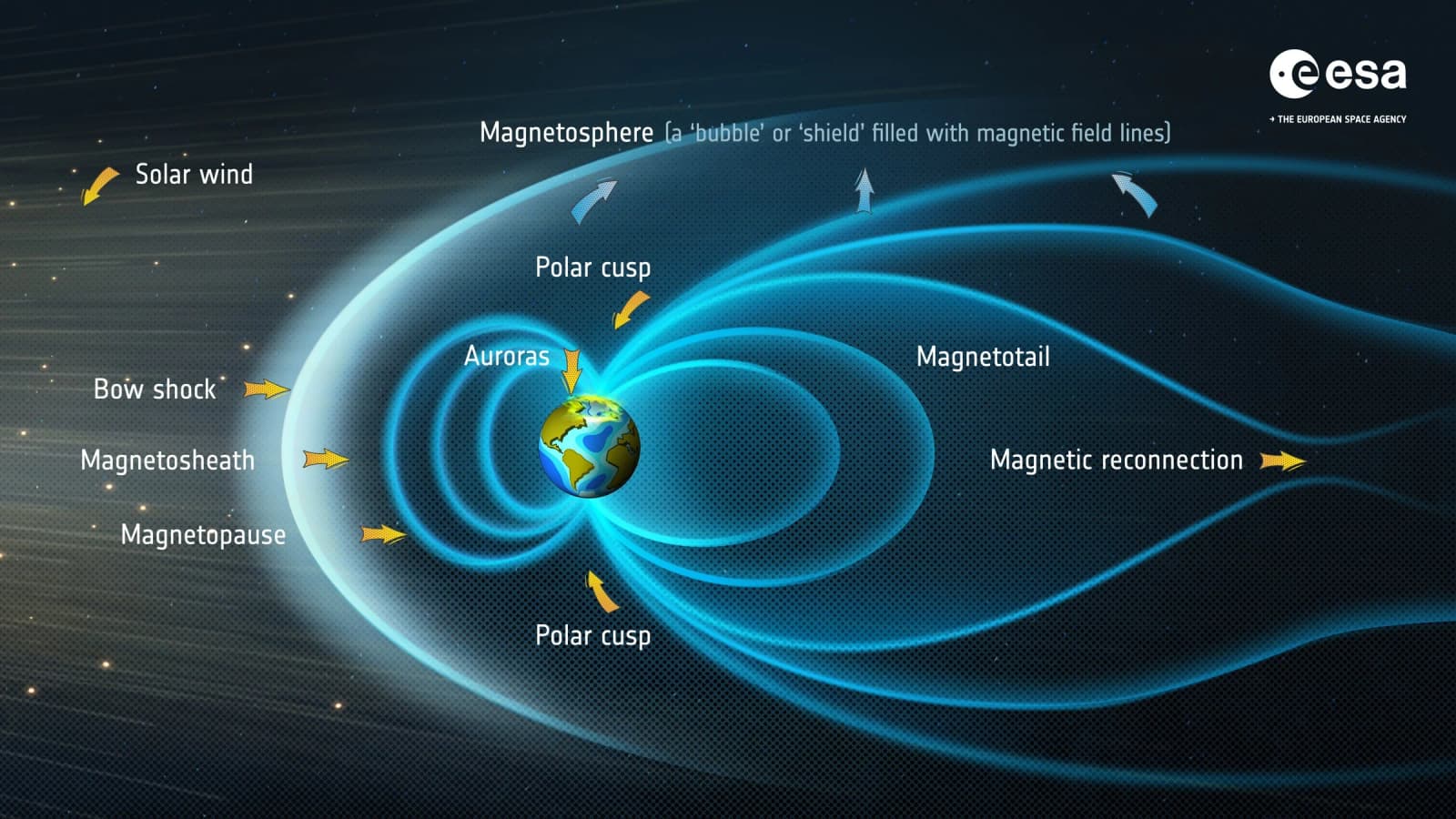
Plasma Observatory will study how energy from the Sun moves through the magnetic shield that surrounds Earth, known as the magnetosphere. By flying seven spacecraft together in near-Earth space and at the boundaries of the magnetosphere, ESA says the mission will be able to follow these processes across different scales of distance and time at once, something a single spacecraft cannot do.
ESA says the mission builds on its Cluster mission, a quartet of spacecraft that studied Earth's magnetic environment.
Why does it matter?
Plasma, the electrically charged state of matter, is found throughout the Solar System and the wider Universe. The solar wind that streams from the Sun is plasma, and its interaction with Earth's magnetosphere shapes the space environment around our planet.
Prof. Carole Mundell, ESA's Director of Science, said the mission would help scientists understand how Earth interacts with this sea of plasma, and that it would carry "European leadership in heliophysics into the next decade and beyond". Matt Taylor, ESA's Study Scientist for Plasma Observatory, said plasma's prevalence across the Universe made it essential to understand.
How was it chosen?
The selection followed a process that began in December 2021, when ESA called for M7 mission proposals and received 27 responses, according to the agency. Five concepts remained by November 2022 and went through early-stage (Phase 0) studies during 2023, after which three missions moved into Phase A, an industrial competitive study lasting about two and a half years. ESA proposed Plasma Observatory to the committee in June 2026 before the formal selection this week.
Which other missions moved forward?
The committee also narrowed the field for future missions. Four concepts, CALICO+, FOSSIL, PRIAMOS and SPARK, advance as candidates for the next medium-class (M8) slot, and three, GRINTA, MUSTI and SIRIUS, advance for the next fast-class (F3) slot. ESA says all seven will undergo initial studies in 2027, with the fast-class choice expected in about a year and the medium-class choice in 2030.
What is confirmed and what is not
- Confirmed: Plasma Observatory has been selected as ESA's M7 mission, with seven spacecraft and a launch provisionally foreseen in the late 2030s.
- Not yet stated: ESA's announcement does not give the mission's cost, its exact orbits or its international partners.
What happens next?
The mission now heads towards formal "adoption", the step that commits ESA to building it and preparing for launch. Construction would follow.
The selection comes during a busy month for ESA science: the agency's BepiColombo spacecraft was scheduled to enter Mercury orbit on 21 November, and ESA plans to unveil Hera's first close-up images of Dimorphos on 25 November.
Photo source · ESA, CC BY-SA 3.0 IGO