The European Space Agency (ESA) will show the first detailed images of asteroid Dimorphos taken by its Hera spacecraft since NASA deliberately crashed a probe into it four years ago. ESA said in a media notice published on 19 November 2026 that the images will be unveiled at a live event on Wednesday, 25 November 2026, from 19:45 to 20:30 Central European Time, which is 00:15 to 01:00 IST on 26 November in India.
The event will be held in the dinosaur hall of the Museum für Naturkunde, the natural history museum in Berlin, Germany, and streamed on ESA WebTV and ESA's YouTube channel, the agency said.
Why is Hera looking at Dimorphos?
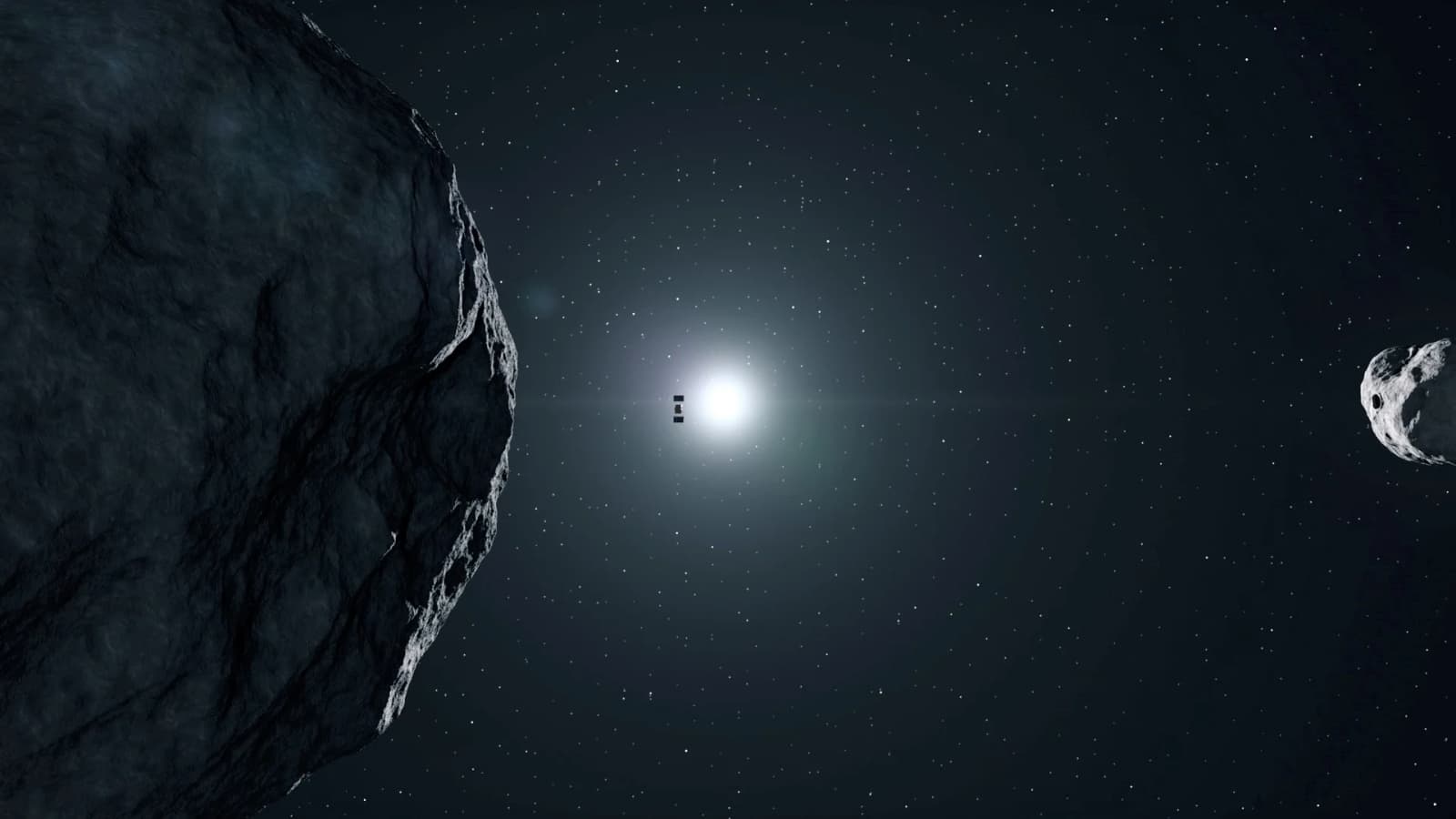
Hera is examining the result of the first test of a way to push a threatening asteroid off course. On 26 September 2022, NASA's DART spacecraft struck Dimorphos, a 151-metre moonlet that circles a larger asteroid, the 780-metre Didymos. According to ESA, the collision at 6.1 km per second threw out millions of tons of debris in a plume stretching 10,000 km, and observations from Earth showed the moonlet's orbit around Didymos had been shortened by about 33 minutes.
ESA said Hera reached the pair after a two-year journey. Its task is to gather close-up data that could turn this "kinetic impact" method into a repeatable technique for planetary defence.
What has Hera seen so far?
In an update on 17 November, ESA released early views of Didymos taken by Hera's Asteroid Framing Camera from 28.5 km away, at a resolution of about 2.7 metres per pixel. The agency said the images show boulder-strewn patches, smoother areas and possible landslides moving towards the asteroid's equatorial ridge. Didymos spins roughly once every 2.2 hours.
In those visible-light pictures, Dimorphos was mostly in shadow, with only a small sunlit speck showing. ESA said the Thermal Infrared Imager (TIRI), supplied and operated by the Japan Aerospace Exploration Agency (JAXA), captured the whole moonlet. Mapping surface temperatures can indicate whether material is solid rock, porous, broken up or loose dust. Another instrument, HyperScout H, records 25 colour bands from visible red into the near-infrared to help identify what the surface is made of.
"Next week's unveiling is only the start of Hera's exploration," said Michael Kueppers, Hera mission scientist, according to ESA. Patrick Michel, Hera's principal investigator at CNRS and the Observatoire de la Côte d'Azur in France, said: "This is a very exciting time for us."
Why it matters
DART showed that hitting an asteroid can change its path. Hera's close-up measurements are meant to show how that happened, so that the method could be used again if an asteroid were ever found to threaten Earth. ESA described the next phase as a "crash site investigation" of Dimorphos.
The Hera images come in a busy week for European planetary missions; ESA and JAXA's BepiColombo is due to enter orbit around Mercury on 21 November.
What happens next?
After the 25 November release, ESA said Hera will move closer to the two asteroids over the coming months. Early next year it is due to release two shoebox-sized CubeSats for an even closer look, and ESA said the survey will eventually progress to a landing. ESA has not yet said what the new images show; that will be revealed at the event.
Photo source · ESA – Science Office, CC BY-SA 3.0 IGO