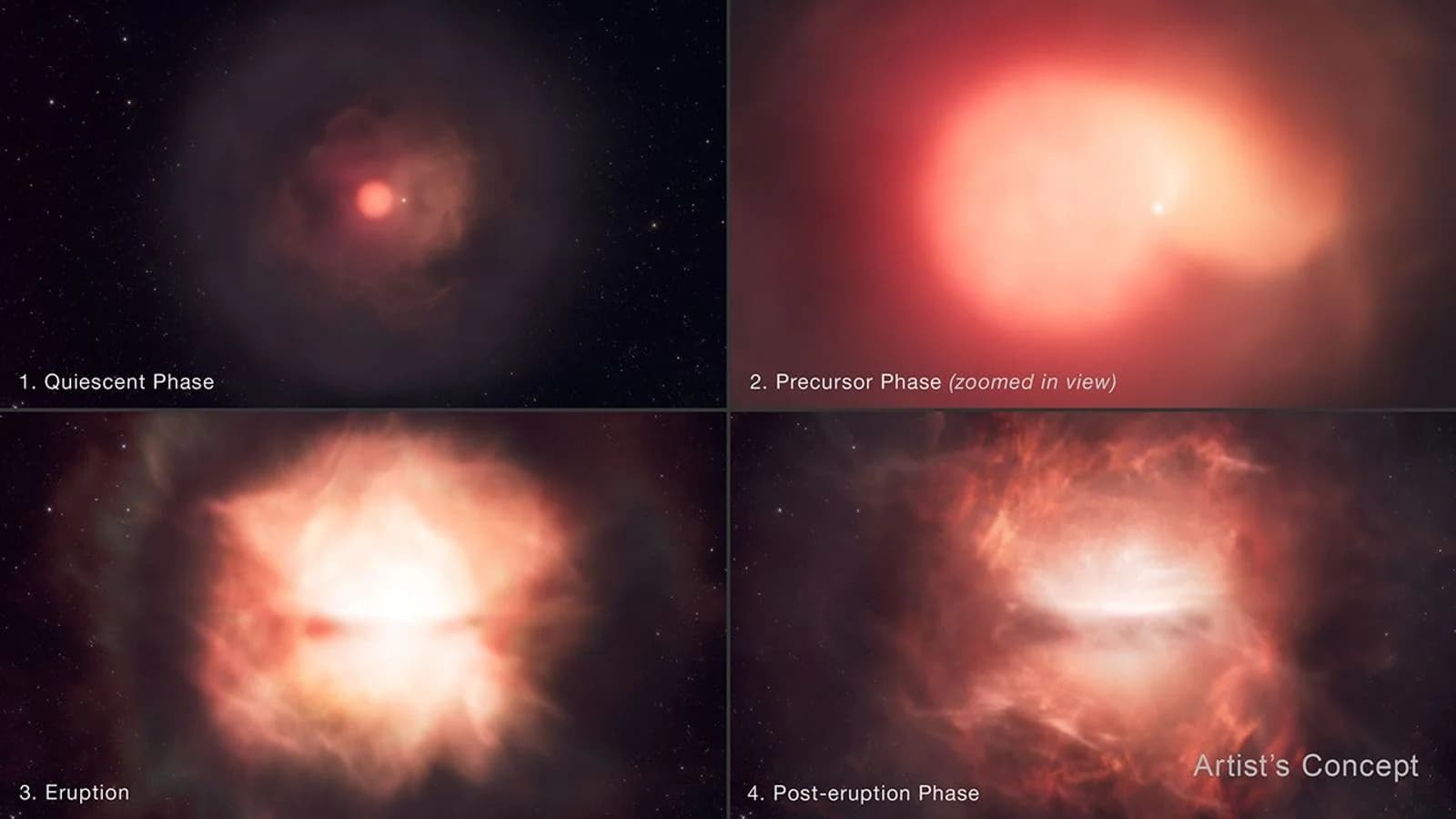
Astronomers have caught, almost as it happened, a small star diving into a far larger companion and merging with it on the edge of the Andromeda galaxy. NASA said on 18 November 2026 that the event, formally catalogued as AT 2025abao and nicknamed "Bao", is the first of its kind, and that its James Webb Space Telescope followed up the eruption only 47 days after its peak. The findings appear in a new paper in the journal Nature, published the same day.
What happened to Bao
According to NASA's Webb mission team, the two stars had orbited each other as a pair for thousands of years. The larger one was a bloated supergiant of roughly seven solar masses, about 350 times the Sun's radius and around 18,000 times as bright as the Sun. Its partner, which the researchers call "Little Bao", had about 0.7 times the Sun's mass.
Once the two stars came into contact, NASA said, the merger unfolded after only about seven orbits, or roughly seven years. Other known mergers of binary stars, which involved two smaller stars, took thousands of orbits. Computer simulations showed that the companion did not escape but was dragged into the core of the bigger star; the agency compared the result to a bomb going off inside a living star.
A decade of clues from many telescopes
The research team pieced the story together from archival and new data gathered by several observatories. NASA's account lists these milestones:
- Until 2018, the star's brightness was steady.
- In February 2023, data from the now-retired NEOWISE mission flagged it as an unusual variable star.
- In September 2024, the WINTER infrared telescope saw it brightening and producing dust.
- In July 2025, NASA's SPHEREx, during a routine survey, recorded it fading quickly in visible light while brightening in the infrared.
- On 17 October 2025, the Zwicky Transient Facility detected the eruption itself.
- In November 2025, the Neil Gehrels Swift Observatory and the Gemini North telescope in Hawaii made fast follow-up observations.
- On 24 December 2025, Webb observed the system under a Director's Discretionary Time programme.
Webb's mid-infrared data were used to study the dust thrown out around the merged star.
What the scientists said
"Stellar mergers are very, very difficult to observe in real time because they are hard to predict," lead author Viraj Karambelkar, a NASA Hubble Fellow at Columbia University in New York, said in NASA's release. He described Webb's look at Bao, 47 days after the eruption peaked, as "the earliest ever follow-up of an event like this."
Co-author Nadia Blagorodnova of the University of Barcelona recalled how sudden the outburst was: "One day, its brightness started rising and within a week, it peaked!" Karel Temmink, a PhD student at Radboud University in the Netherlands who led the simulations, described the primary as "an absolute beast of a star, completely outshining its companion in the data."
Kishalay De, an assistant professor at Columbia and a co-author, explained the early warning signs the team relied on, saying that when a companion begins to interact with the outer surface of the main star, "it produces a subtle effect".
Why it matters
Because such mergers are hard to predict, they are usually spotted only after the fact. In Bao's case, years of survey data before the eruption allowed the team to reconstruct the run-up. The work was partly supported by a NASA Astrophysics Data Analysis Program grant, the agency said.
What's next
Karambelkar expects many more such finds: "There's going to be a large influx of similar discoveries just ahead," he said. NASA pointed in particular to its upcoming Nancy Grace Roman Space Telescope, whose Galactic Bulge Time-Domain Survey is expected to turn up similar events.
The release did not say how far Bao is from Earth or what the merged star is expected to become.
PS · Illustration: NASA, ESA, CSA, STScI, Leah Hustak (STScI); Science: Viraj Karambelkar (Columbia)