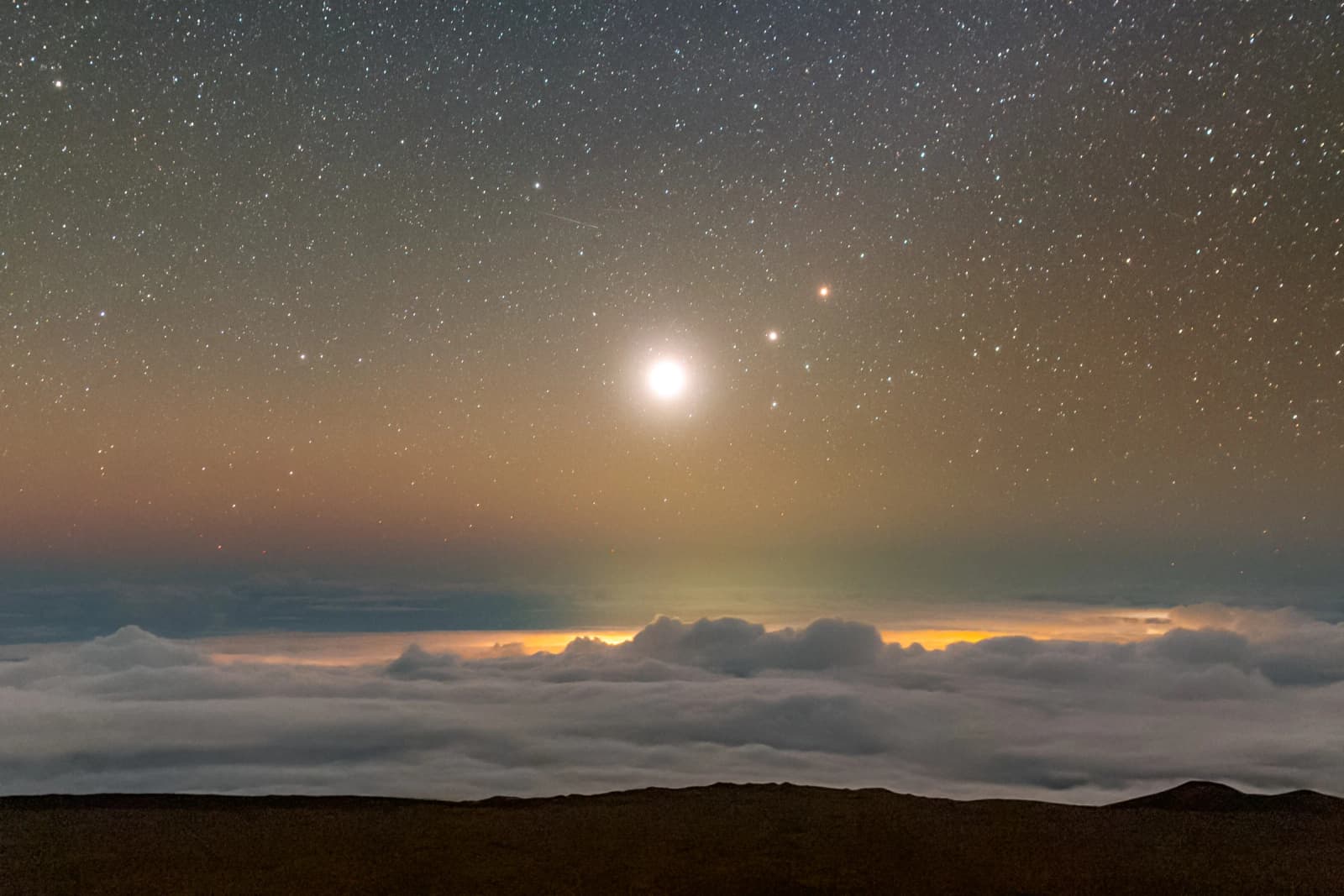
Venus reaches its greatest brilliancy of the current morning appearance on 27 November 2026, making the planet the most dazzling object in the pre-dawn sky this week as it hangs close to Spica, the brightest star in the constellation Virgo. Space.com, citing the In-The-Sky astronomy website, put the moment of peak brightness at 18:37 GMT on 27 November, which is 00:07 IST on 28 November, so for observers in India the best chances are the dawns of 28 November and the days that follow.
When and where should you look?
Look low towards the east-southeast roughly one to two hours before sunrise, according to BBC Sky at Night Magazine. Venus rises ahead of the Sun and climbs into the south-eastern sky as dawn approaches. No telescope is needed: the planet is easily visible to the naked eye and will outshine every star around it.
Space.com reported that Spica sits less than five degrees from Venus before dawn on 27 November, a gap roughly the width of three middle fingers held at arm's length. Mercury lies near the horizon below Venus, so a clear, flat eastern horizon helps.
Why is Venus so bright right now?
Venus is at its brightest now because of the balance between how much of its sunlit face we see and how close it is to Earth. As an inner planet, Venus never strays far from the Sun in our sky, alternating between evening and morning appearances, and its changing phase and distance govern its brightness, Space.com explained. BBC Sky at Night Magazine put the planet's magnitude at around −4.7 to −4.9 at its peak and described this as Venus at its brightest in the morning sky for the year.
Over the coming weeks, Venus will appear more fully lit through a telescope, but its apparent size will shrink as it moves farther from Earth, according to Space.com.
What else is in the morning sky?
Venus is part of a wider gathering of planets before sunrise. BBC Sky at Night Magazine said Venus, Mercury, Jupiter and Mars have formed a four-planet line-up in the pre-dawn sky since mid-November, a display expected to last through late November and December.
Spica itself is a close double star whose two components orbit each other about every four days. The pair are about 11 million miles (under 18 million km) apart, too close to be split with amateur equipment, and the star appears blue-white through a small telescope, Space.com noted.
Is it safe to use binoculars?
Binoculars and telescopes should only be used while the Sun is still well below the horizon, both guides stress. Pointing optical equipment near the rising Sun can cause serious eye damage. A small telescope can show the planet's phase, BBC Sky at Night Magazine said.
What happens next?
Venus will remain a morning object through December. On 4 December, a crescent Moon will sit to the right of Venus in the south-east before dawn with Spica between the two, and on 5 December the three will form a triangle, according to BBC Sky at Night Magazine. Exact positions vary slightly with location, so observers in India should use the east-southeast horizon as their guide.
Photo source · NOIRLab/NSF/AURA/P. Horálek (Institute of Physics in Opava), CC BY 4.0