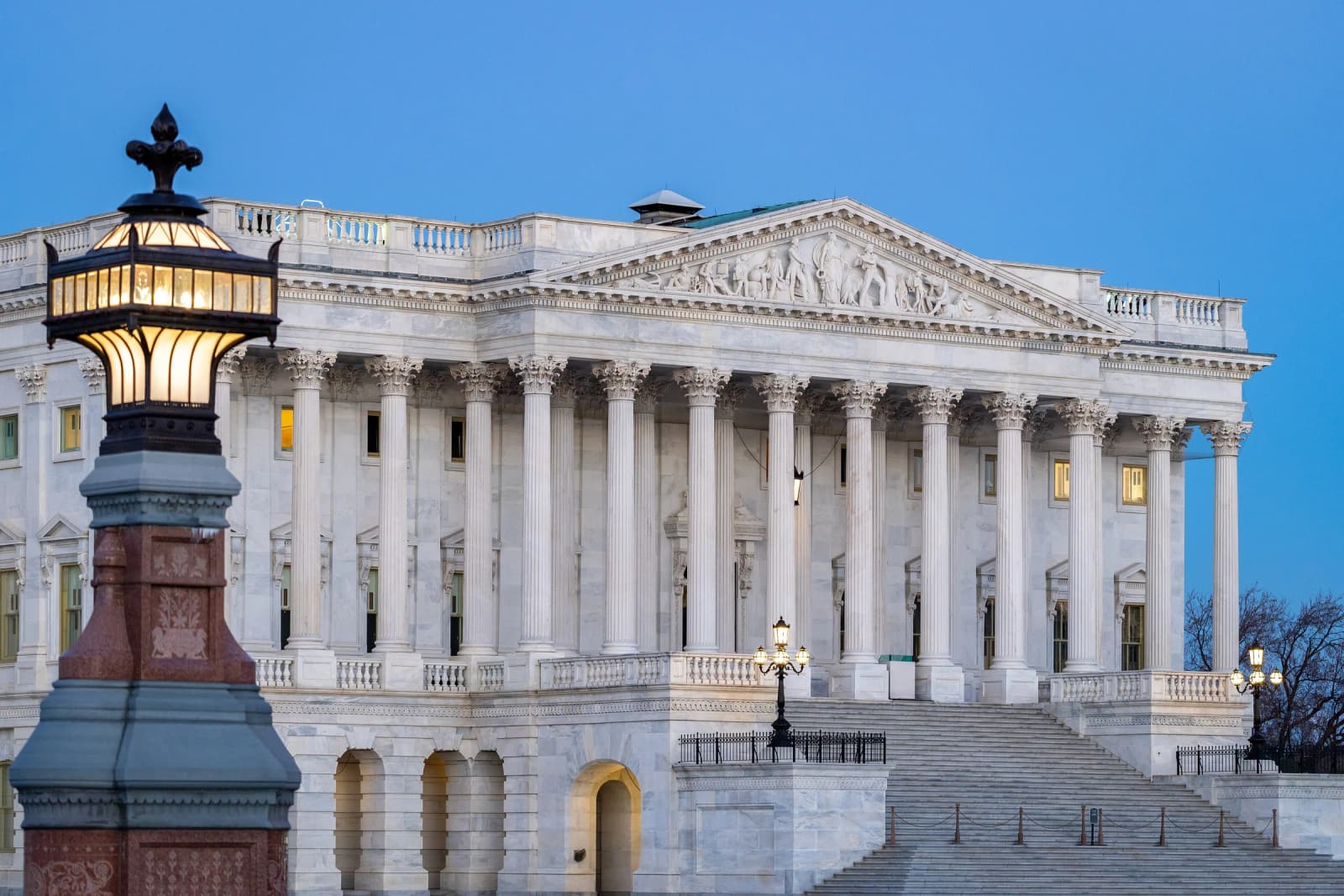
The United States Senate in Washington, D.C. on 19 November 2026 passed a sweeping bipartisan bill to speed up federal approvals for power plants, transmission lines and other energy projects, voting 62-33 to send the Bipartisan American Affordability and Jobs Act (BAAJA) to the House of Representatives. The bill would also make large data centre operators pay for the grid upgrades needed to supply them.
The vote, held at 9:30 pm local time on Thursday (8 am on Friday in India), drew support from 47 Republicans, 14 Democrats and one independent, according to the official Senate roll call. Thirty Democrats, one independent and two Republicans voted against it, and five senators did not vote.
What does the permitting bill do?
The bill shortens the time federal agencies can take to review energy projects and limits how approvals can be challenged in court, Al Jazeera reported. It amends several environmental laws, including the National Environmental Policy Act, and restricts the power of federal agencies to revoke permits already granted.
According to CNBC, the bill also overhauls rules for electricity transmission and blocks President Donald Trump from cancelling wind and solar projects that already have permits. One of its most closely watched provisions requires hyperscalers, the companies that run very large data centres, to pay for the grid upgrades needed to serve them, as electricity demand from artificial intelligence rises.
The text was passed as a substitute amendment to an unrelated House bill, H.R. 2347, which the Senate had adopted on 18 November, the Senate's vote records show.
Who wrote it and what did they say?
The bill was negotiated by two Republicans, Shelley Moore Capito of West Virginia and Mike Lee of Utah, and two Democrats, Martin Heinrich of New Mexico and Sheldon Whitehouse of Rhode Island. Senate Minority Leader Chuck Schumer was among the Democrats who voted yes.
Capito, who chairs the Senate Environment and Public Works Committee, said in a statement after the vote that "passage of permitting reform in the Senate finally became reality" and urged House leaders to pass it quickly. Lee also called for quick House action in a press release. Heinrich told CNBC: "Working people can't afford to wait another few years for us to get this done."
Both the American Clean Power Association and the American Petroleum Institute backed the bill, CNBC reported.
Why are environmental groups opposed?
Groups including the Sierra Club and the National Wildlife Federation say the bill weakens water and wildlife protections and makes approvals harder to challenge, Al Jazeera reported. Jen Duggan of the Environmental Integrity Project called it a "gift to some of the biggest polluters in America". The Natural Resources Defense Council urged the House not to pass what it called "a blank check" for oil and gas companies and data centre developers.
Senator Maria Cantwell of Washington said the bill would undermine tribal sovereignty, while amendments from Oregon's two senators, including one to bar data centres from public land, were not adopted. CNBC reported that the bill was changed before the vote to address some tribal objections.
The Rhodium Group, a research firm, estimated that the bill could add between 17 and 249 gigawatts of clean energy capacity by 2040, CNBC reported, while also lifting US natural gas exports.
What happens next?
The bill now needs approval from the House of Representatives before it can reach President Trump, who has said he supports the deal. Republican leaders are expected to push it through, but Democrats are divided: Representative Scott Peters of California told CNBC "we should pass it before the end of this Congress", while Representative Jared Huffman of California said "we can produce a better deal".
Timing matters. Republicans hold slim majorities until the new Congress convenes on 3 January, when Democrats take control of both chambers, according to Al Jazeera. Some Democrats have argued the party should wait until then for a stronger bill.
The vote came as climate talks stalled abroad; read our report on the fossil fuel dispute at COP31 in Antalya.