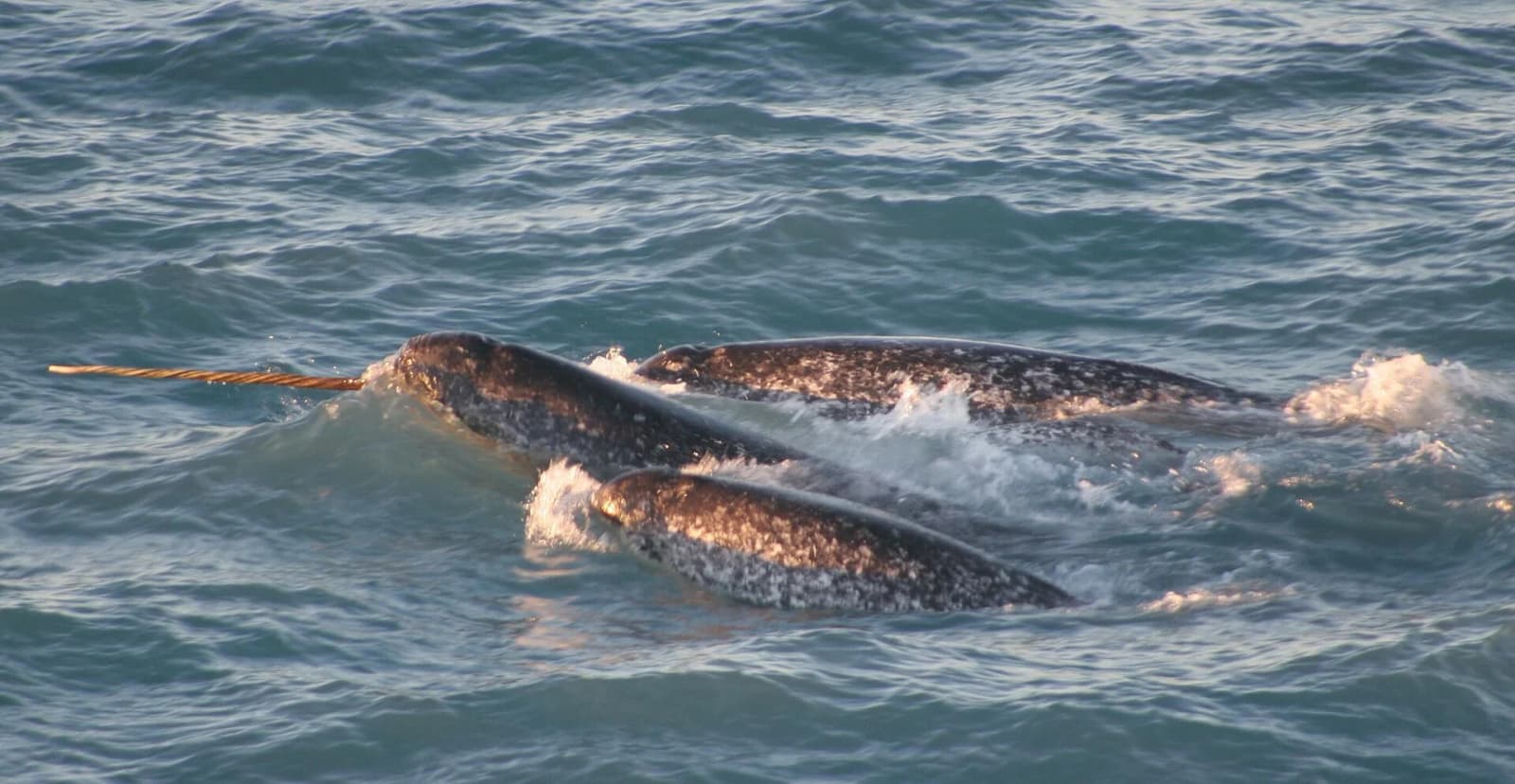
An international team of scientists led by researchers at Aarhus University and Chalmers University of Technology, working with biologists from the Greenland Institute of Natural Resources, has uncovered why the Arctic narwhal's corkscrew-shaped tusk achieves remarkable strength and flexibility: at the nanoscale, the tooth contains two intertwined helical layers that twist in opposite directions.
Three European Synchrotrons Map Nanoscale Architecture
Published in Nature Communications, the study combined X-ray tensor tomography across three particle-accelerator light sources: the Swiss Light Source (SLS) at the Paul Scherrer Institute in Switzerland, the MAX IV Laboratory in Lund, Sweden, and the European Synchrotron Radiation Facility (ESRF) in Grenoble, France. Unlike human teeth, the narwhal tusk—an elongated upper left canine that can exceed two metres in length—has no enamel; instead, it consists of an inner core of dentin wrapped in a thinner outer coat of cementum.
By mapping how X-rays scattered off nanometer-sized mineralized collagen fibrils across millions of 3D measurements, lead author Adrian Rodriguez-Palomo and senior co-authors Marianne Liebi and Henrik Birkedal discovered a structural counterbalance. In the outer cementum layer, collagen fibrils twist in a left-handed spiral, whereas inside the dentin core, they form a right-handed spiral.
Built Against Torsion and Recording Decades of Arctic Change
Acting like intertwined strands of rope or steel rebar inside concrete, these opposing nanoscale spirals meet at the dentin-cementum boundary and give the tooth high resistance to bending and twisting forces generated during rapid swimming. The study also found that this counter-twisting arrangement repeats consistently across annual growth rings, pointing to a genetically programmed blueprint preserved over lifespans of up to 80 years.
Researchers note that the findings could inspire new composite engineering materials for medicine and construction, while the annual growth layers inside narwhal tusks offer a multi-decade archive of environmental shifts in the rapidly warming North Atlantic.