Researchers at the Centre for Nano and Soft Matter Sciences (CeNS) in Bengaluru, Karnataka, working with the Indian Institute of Technology (IIT) Delhi, have found a way to stop the colours in perovskite-based white LEDs from bleeding into each other, the Department of Science and Technology (DST) said on 27 November 2026. CeNS is an autonomous institute under DST, and the work was announced in a Ministry of Science and Technology release.
The team says the approach could lead to white lighting that is cheaper, can be tuned, and can be made on flexible surfaces, though the material still contains lead and needs further work before it is ready for the market.
What problem were the researchers trying to solve?
They were trying to keep two colour-emitting materials from mixing once they are packed close together. Commercial white LEDs in homes and phones are very energy-efficient, but according to the release they depend on costly rare-earth elements and high-temperature manufacturing, and their shade of white is fixed once made.
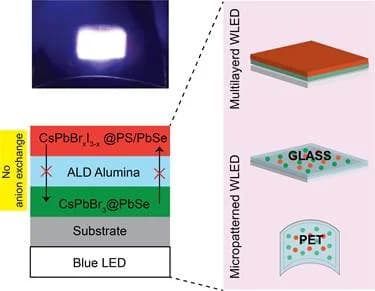
A promising alternative is a family of all-inorganic halide perovskite nanocrystals, with the formula CsPbX₃, where X can be chlorine, bromine or iodine. These crystals are inexpensive and give off very bright, pure colours. The catch is a process called anion exchange: when green-emitting CsPbBr₃ and red-emitting CsPbI₃ crystals touch, their halide ions move across and swap. Within minutes the green and red can merge into an unwanted orange, ruining the white light.
How does the new method work?
The researchers used two layers of protection. First, they treated the crystal surfaces with lead selenide to fill halide vacancies, which the release describes as the main route for ions to migrate. This was done without dimming the crystals or changing their colour.
Second, they used atomic layer deposition to coat the material with a transparent film of aluminium oxide only about 5 to 6 nanometres thick. That film acts as a physical wall, stopping ions from drifting between neighbouring colour layers.
Using spray coating and micropatterning, a technique the team calls simple and scalable, they built multi-layer white LEDs on both rigid glass and flexible PET plastic.
How well did the devices perform?
The optimised devices ran continuously for up to 24 hours, the release said, with white emission that stayed close to ideal white light even through heating and cooling. The researchers also showed that the light could be shifted towards a dimmer or warmer tone simply by changing the electrical current.
The study's authors are Gauri Sharma, Swati Khurana, Sameer Sapra and Pralay K. Santra. Their findings appear in the journal Small, published under DOI 10.1002/smll.202512820.
What still needs to happen?
DST describes the result as an important step rather than a finished product. Before such LEDs can reach shops, the release said, researchers must deal with the toxicity of the lead in the crystals and find ways to make the technology environmentally friendly. No timeline for commercialisation or industry partnership was announced.
Photo source · Press Information Bureau, Government of India